
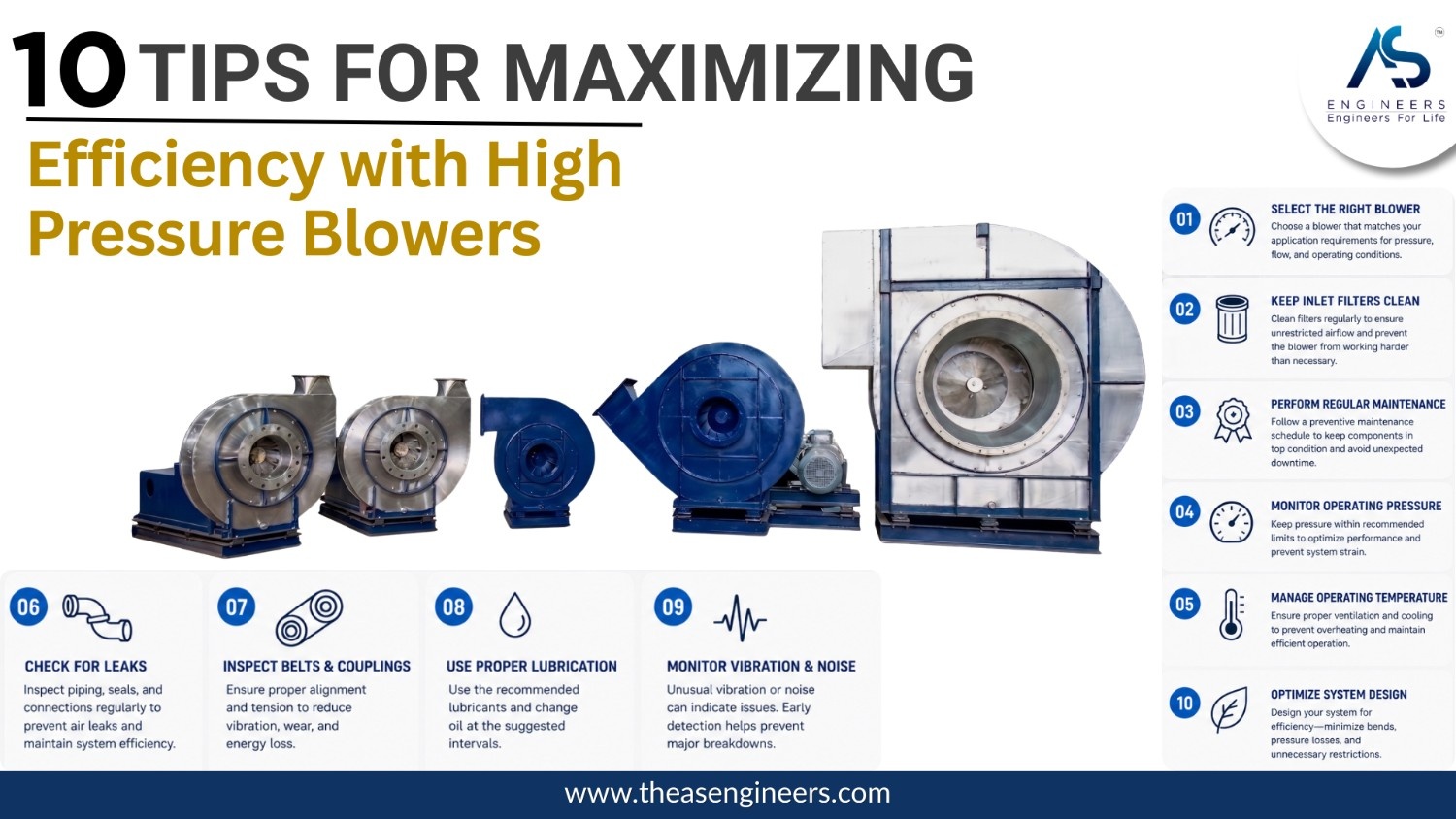
High pressure blower efficiency means delivering the required airflow and pressure with the lowest practical energy use, stable operation, and acceptable maintenance load. The mistake is judging efficiency only by motor HP. Real efficiency depends on the blower, impeller, motor, drive, ducting, filters, dampers, temperature, dust load, and actual process resistance.
A blower that looks efficient on paper can waste power if the duty point is wrong. In plant discussions, we often see buyers ask for “more CFM” when the real issue is static pressure loss through bends, filters, dampers, or undersized ducting.
Before selecting or improving a blower, confirm:
- Required airflow in CFM or m³/hr
- Required static pressure or total pressure
- Gas or air temperature
- Dust load, moisture, fumes, or corrosive content
- Altitude and site location
- Continuous or batch operation
- Motor mounting and drive arrangement
AS Engineers manufactures centrifugal blower solutions across airflow requirements from 300 CFM to 200,000+ CFM, pressure up to 1700 mmWG, fan speeds from 300 RPM to 4500 RPM, and motor power from 0.5 HP to 500 HP. The right point inside that range depends on the process, not only the catalogue size.
For the engineering background, connect this page with understanding the science of high pressure blower design.
Select the right blower type for the process, not just the price
The fastest way to lose efficiency is choosing the wrong blower type for the application. A backward curved blower, backward inclined blower, high pressure radial blade blower, exhauster radial blower, high temperature plug blower, and exhauster air handling blower do not behave the same under dust, heat, airflow, and pressure resistance.
For clean air or moderate-duty applications, backward curved designs may offer better operating efficiency. For dustier or heavier industrial applications, radial blade designs may be more suitable because they handle process load better. For furnace or hot gas applications, temperature resistance and material selection become more important than peak efficiency alone.
| Operating condition | Better efficiency question | Common buyer mistake | Practical action |
|---|---|---|---|
| Clean air, high volume | Is the impeller selected near its efficient zone? | Oversizing the blower for “safety” | Review fan curve and duty point |
| Dust-laden air | Can the impeller handle buildup and abrasion? | Choosing a clean-air blower for dusty service | Consider radial/exhauster design |
| Hot gas or furnace duty | Can bearings, MOC, and drive handle temperature? | Ignoring inlet temperature effect | Specify temperature clearly |
| Variable process load | Can speed control reduce wasted energy? | Using damper control only | Evaluate VFD or control logic |
| Long ducting | Is pressure loss calculated correctly? | Buying bigger motor instead of fixing layout | Audit duct route and losses |
For product-level comparison, review AS Engineers’ centrifugal blower range and application-specific options such as backward curved blowers and high pressure radial blade blowers.
Reduce system resistance before increasing blower capacity
A blower does not work alone. It works against the complete system. If ducting, bends, filters, dampers, silencers, scrubbers, bag filters, or discharge points create avoidable resistance, the blower consumes more power to do the same work.
This is why a bigger motor is not always the correct solution. If the process has unnecessary pressure loss, a larger motor only hides the real problem and increases operating cost.
Check these areas first:
- Sharp duct bends close to the inlet or outlet
- Sudden expansion or contraction in duct size
- Dirty filters or clogged strainers
- Partly closed dampers used as permanent control devices
- Undersized ducting
- Leaks on the suction or discharge side
- Poor inlet box geometry
- Misaligned flexible connections
The U.S. Department of Energy notes that fan systems can achieve major energy and cost savings through energy management practices and efficient equipment selection. For an industrial buyer, the practical takeaway is simple: do not optimize the blower before checking whether the system is forcing it to waste energy.
For airflow-related reading, use maximizing air flow with high pressure blowers.
Use VFD control where the process load actually varies
A variable frequency drive can improve high pressure blower efficiency when the plant does not need full airflow all the time. In batch processes, ETP/STP aeration, drying systems, air pollution control, combustion support, and ventilation systems, demand often changes by shift, process stage, filter condition, or production load.
A VFD is not a magic efficiency device. It works best when speed reduction matches real process demand. If the blower is always running near full duty, the saving may be limited. If operators are using dampers to throttle airflow for long hours, VFD review is usually worthwhile.
Good VFD use requires:
- Stable pressure or airflow feedback
- Correct motor compatibility
- Safe minimum speed limits
- Proper bearing and cooling review
- Protection against resonance zones
- Trained operator settings
- Process interlock logic
AMCA explains that Fan Energy Index considers wire-to-air performance, including the fan, motor, and controller, and evaluates performance at specific operating conditions rather than only peak efficiency. This is useful because industrial buyers should compare efficiency at the actual operating point, not only at an ideal catalogue point.
Keep the impeller, inlet, filters, and casing clean
A blower that was efficient at commissioning can become inefficient after months of dust, fines, moisture, oil mist, or chemical buildup. Even a small layer of buildup on the impeller can disturb balance, reduce airflow, increase vibration, and load the motor.
Cleaning is not only a housekeeping activity. It is a performance activity.
Build a routine around:
- Inlet screen inspection
- Filter cleaning or replacement
- Impeller surface inspection
- Casing buildup removal
- Drain point checking in wet applications
- Duct inspection near bends and elbows
- Bearing housing temperature observation
- Unusual sound and vibration recording
The maintenance interval should change with the application. A clean HVAC-type duty can run longer between inspections. A bag filter, scrubber, furnace, cement, shot blasting, or chemical fume application needs tighter inspection because the process air is more demanding.
For related maintenance content, link this section to expert tips for maintaining high pressure blowers and the importance of regular cleaning for high pressure blowers.
Monitor vibration, alignment, and balancing before efficiency drops
Efficiency loss often appears first as vibration, bearing temperature, belt slip, noise, or motor overload. By the time airflow becomes visibly weak, the machine may already be operating outside healthy limits.
In high pressure blowers, vibration is not a minor issue. It can come from impeller buildup, bearing wear, coupling misalignment, foundation looseness, belt tension errors, rotor imbalance, or operation away from the intended duty point.
The practical checks are:
- Take baseline vibration readings after installation or service
- Compare readings at regular intervals
- Check coupling alignment after foundation settlement
- Inspect belt tension and pulley condition
- Confirm impeller balance after cleaning or repair
- Check bearing temperature trends
- Investigate repeated fastener loosening
- Record motor current under comparable process conditions
AS Engineers provides blower services such as performance analysis, engineering surveys, retrofitment, repair, material identification, on-site alignment, on-site balancing, customized engineering, AMC, expedited shipping, and site-based design. For support needs, refer to centrifugal blower services.
Do not ignore temperature, density, humidity, and altitude
Blower performance changes when air or gas conditions change. A blower handling hot air, humid air, dusty gas, or process fumes will not behave exactly like a blower moving clean ambient air.
This matters in applications such as hot air generators, furnaces, boilers, spray dryers, fluid bed dryers, galvanizing plants, textile exhaust, chemical fumes, and air pollution control systems. Higher temperature changes gas density. Humidity can influence corrosion and deposits. Dust load affects impeller selection and balancing frequency. Altitude affects air density and performance calculations.
Before finalizing an efficiency improvement plan, confirm:
- Normal and maximum inlet temperature
- Gas composition
- Dust concentration and particle behavior
- Moisture or condensation risk
- Corrosion risk
- Site altitude
- Process load variation
- Start-stop frequency
This is also why a blower copied from another plant can fail in a new plant. Same CFM does not mean same operating condition. For selection basics, link to 8 key factors to consider when choosing a high pressure blower.
Use testing data, not assumptions, to measure efficiency
You cannot improve what you do not measure. For high pressure blower efficiency, the minimum useful data includes airflow, pressure, motor current, voltage, speed, vibration, bearing temperature, damper position, filter differential pressure, and process output.
A practical performance review should compare current operation against:
- Original design duty point
- Fan curve or selection sheet
- Motor nameplate rating
- Actual process demand
- Filter and duct pressure loss
- Vibration history
- Maintenance history
- Production complaints or process instability
If the motor current is high but airflow is low, the issue may be system resistance, impeller fouling, rotation error, duct blockage, or wrong operating point. If airflow is high but process performance is poor, the problem may be distribution, leakage, dwell time, or process-side design.
The U.S. Department of Energy’s fan system sourcebook is designed as a reference for industrial users to identify fan system performance improvement opportunities. For site teams, the main lesson is to test the full fan system, not only the blower casing.
Related reading: the importance of testing your high pressure blower for quality and performance.
Match maintenance strategy with operating risk
The right maintenance plan depends on how critical the blower is to production. A blower serving a small ventilation point does not need the same maintenance intensity as an ID fan, FD fan, scrubber fan, furnace blower, bag filter fan, or process drying blower.
Use this simple maintenance priority model:
| Blower role | Efficiency risk | Maintenance priority | Suggested focus |
|---|---|---|---|
| Continuous process blower | High | High | Vibration, current, bearing temperature, cleaning |
| Dust collection or bag filter fan | High | High | Filter DP, impeller buildup, leakage |
| Furnace or hot air duty | High | High | Temperature, bearing protection, MOC |
| Intermittent utility blower | Medium | Medium | Start-up current, belts, lubrication |
| General ventilation support | Medium to Low | Medium | Cleaning, alignment, filter condition |
The buyer mistake is treating all blowers as the same asset class. Efficiency planning should follow production risk. A breakdown in a critical air system can stop a line, disturb combustion, reduce drying performance, or affect pollution control stability.
For troubleshooting support, connect this topic with troubleshooting common issues with high pressure blowers.
Ask better RFQ questions before buying or upgrading a blower
The best time to improve high pressure blower efficiency is before the blower is ordered. A weak RFQ usually leads to a weak selection. “Send price for 10 HP blower” is not enough for an engineering decision.
A serious RFQ should include:
- Application and industry
- Airflow requirement
- Pressure requirement
- Temperature range
- Dust, fumes, humidity, or corrosive content
- Continuous or batch operation
- Existing duct layout, if available
- Motor, drive, and control preference
- Space constraints
- Maintenance access requirement
- Required MOC
- Site location and altitude
- Noise or vibration constraints
- Current problem, if it is a replacement or retrofit
AS Engineers can evaluate blower requirements for backward curved, backward inclined, high pressure radial blade, exhauster radial, high temperature plug, and exhauster air handling blower applications. For custom selection, retrofit, or site-based design, review make to order blower solutions.
The practical rule is this: efficiency is not one feature. It is the result of correct selection, clean airflow path, stable control, proper maintenance, and measured performance.
FAQs
1. What is the best way to improve high pressure blower efficiency?
The best way is to confirm the actual duty point first, then check duct pressure loss, filter condition, impeller cleanliness, vibration, motor current, and control method. Many plants try to improve efficiency by changing motor size, but the real loss is often in ducting, wrong selection, fouled impeller, or unnecessary throttling.
2. Does a VFD always save energy in high pressure blower systems?
No. A VFD saves energy when blower demand varies and speed can be safely reduced. If the blower runs at full duty most of the time, savings may be limited. VFD selection should include motor compatibility, minimum speed limits, process feedback, bearing cooling, and vibration review.
3. How often should a high pressure blower be cleaned?
Cleaning frequency depends on dust load, moisture, fumes, and process duty. Clean-air applications may need less frequent cleaning, while bag filter, scrubber, furnace, cement, shot blasting, chemical, and high-dust systems need tighter inspection. Track airflow, current, vibration, and filter pressure drop to set the right interval.
4. Can an oversized blower reduce efficiency?
Yes. An oversized blower can run away from its efficient operating zone, consume unnecessary power, create control problems, increase noise, and force operators to throttle airflow with dampers. Correct sizing should be based on real airflow, pressure, gas condition, and system resistance.
5. Which blower type is more efficient for industrial use?
There is no single most efficient blower for every industrial use. Backward curved and backward inclined designs may suit cleaner air and energy-focused duties, while radial or exhauster designs may be better for dust, fumes, abrasion, or heavier process conditions. The correct choice depends on application, density, temperature, dust load, humidity, MOC, and impeller design.
If your blower is consuming more power, creating vibration, failing frequently, or not delivering stable airflow, do not start with motor replacement. Start with a duty point and system resistance review. AS Engineers can support performance analysis, site-based design, repair, retrofitment, on-site alignment, on-site balancing, and custom blower selection for industrial applications.
For technical selection or retrofit support, connect with AS Engineers and share your airflow, pressure, temperature, application, dust load, and existing blower details.

Karan Dargode is Head of Operations at AS Engineers, where he supports manufacturing, assembly, commissioning, and operational execution for industrial equipment including paddle dryers, sludge dryers, centrifugal blowers, industrial fans, and pollution control systems. His role connects shop-floor manufacturing discipline with practical site commissioning, EHS compliance, and process reliability for industrial clients.