
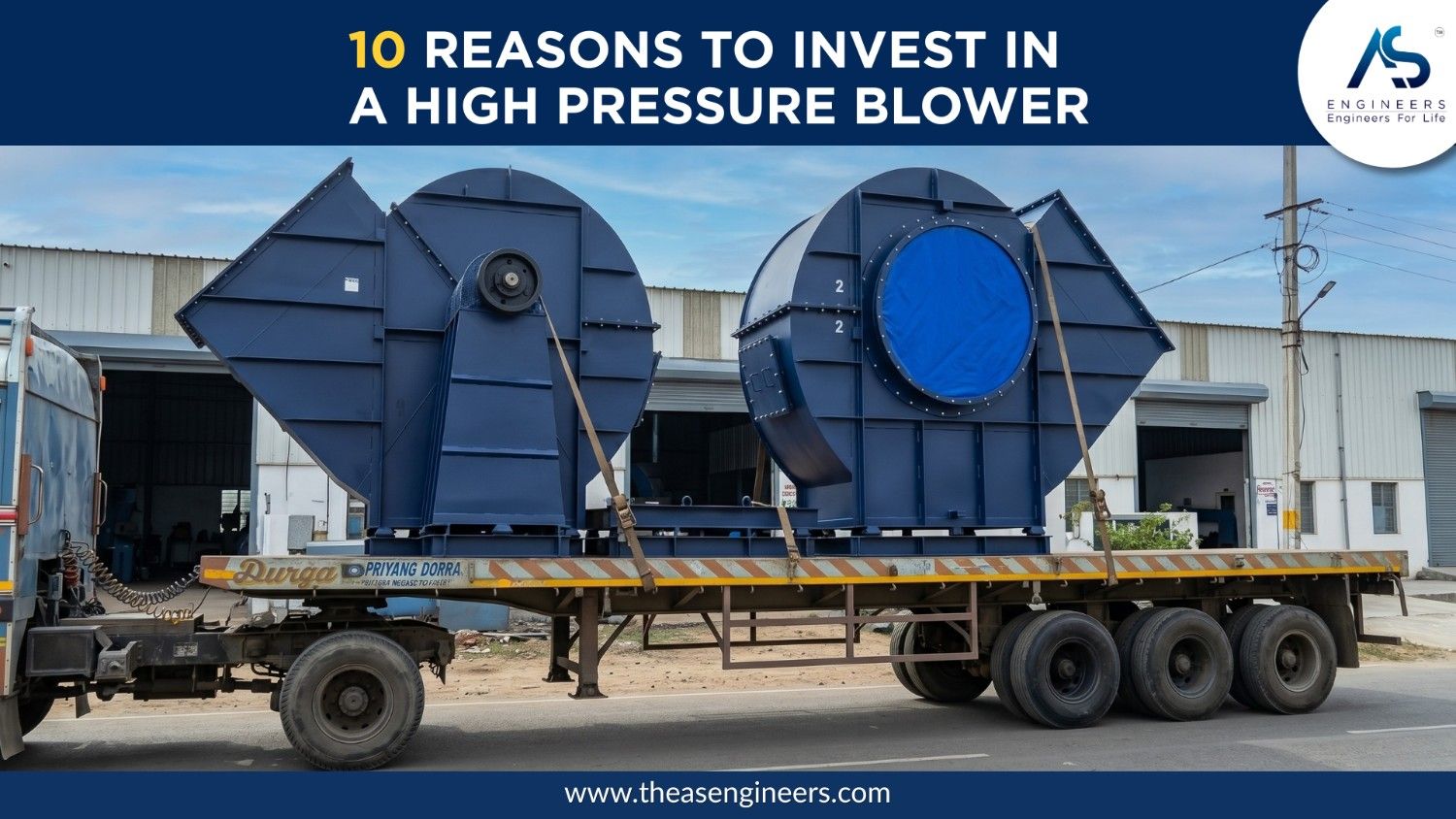
You should invest in a high pressure blower when your process needs stable airflow against duct resistance, dust load, heat, filters, scrubbers, dryers, furnaces, pneumatic conveying lines, or ventilation systems. The real value is not only higher pressure. It is better process control, lower avoidable downtime, safer air movement, and a blower design matched to actual site conditions.
In many plants, the wrong blower runs every day but silently wastes money. It may still move air, but it may operate away from its efficient zone, overload the motor, vibrate, overheat bearings, or fail to maintain airflow when filters load with dust.
A good investment decision starts with the system, not the blower alone. Before comparing motor HP or price, confirm airflow, static pressure, gas temperature, dust load, humidity, altitude, material of construction, impeller design, duct layout, and operating hours. For deeper selection logic, see this guide on choosing a high pressure blower.
Reason 1: Stable airflow improves process consistency
A high pressure blower helps maintain airflow where resistance is naturally high. This matters in processes where air must pass through ducts, filters, burners, scrubbers, cyclones, bag filters, ovens, or material beds.
In drying, combustion, fume extraction, and dust collection, unstable airflow can affect product quality, heat distribution, emissions capture, and operator comfort. A low-pressure fan may look cheaper at purchase time, but it may not hold the required duty point when the system pressure rises.
This is where centrifugal blower design becomes important. AS Engineers manufactures industrial centrifugal blowers including backward curved, backward inclined, high pressure radial blade, exhauster radial, high temperature plug, and exhauster air handling blower designs. The verified range covers airflow from 300 CFM to 200,000+ CFM, pressure up to 1700 mmWG, fan speed from 300 RPM to 4500 RPM, and motor power from 0.5 HP to 500 HP.
The buyer mistake is assuming airflow alone is enough. Airflow without pressure is incomplete data. A blower must be selected for the point where your process actually operates.
Reason 2: Better energy control over the blower lifecycle
Energy cost is often the largest long-term cost in a running blower system. The U.S. Department of Energy treats fan systems as an industrial energy area and provides assessment tools and publications for improving fan system performance.
The investment question should not be, “Which blower has the lowest price?” It should be, “Which blower gives the required airflow and pressure with the lowest lifecycle risk?”
A correctly selected high pressure blower can reduce waste caused by oversizing, poor impeller selection, wrong motor margin, inefficient ducting, and throttled operation. When a plant buys an oversized blower “for safety,” the result is often damper loss, extra power draw, noise, vibration, and premature wear.
For practical operating improvements after installation, use this companion guide on maximizing efficiency with high pressure blowers.
Reason 3: It handles industrial resistance better than ordinary fans
A high pressure blower is useful where the system has meaningful resistance. This resistance may come from long duct runs, bends, filters, baghouses, cyclones, scrubbers, heat exchangers, dampers, or process equipment.
In the field, installed performance often differs from catalog performance. AMCA explains that system effect losses can come from turbulence, swirl, obstructions, and poor inlet or outlet duct conditions near the fan. It also notes that increasing fan speed to overcome such losses increases energy consumption and stress on components.
This is why a blower investment should include layout review. If the inlet elbow is too close, the outlet duct is badly arranged, or the damper is creating unstable flow, even a good blower can perform badly.
A serious RFQ should include duct arrangement, filter pressure drop, operating temperature, gas composition, dust loading, and whether the blower will work with a scrubber, dryer, furnace, bag filter, or cyclone.
Reason 4: It supports dust, fumes, and pollution-control systems
A high pressure blower can support air pollution control equipment when the system needs induced draft, forced draft, exhaust, or process air movement. This includes scrubbers, cyclones, bag filters, dust collection systems, and fume extraction setups.
The important point is selection discipline. Dusty gas is not the same as clean air. Abrasive dust, sticky particles, corrosive fumes, moisture, and temperature all affect impeller design, material of construction, bearing life, balancing requirements, and maintenance frequency.
For plants comparing blower use in pollution-control equipment, AS Engineers’ page on a custom centrifugal blower for pollution control systems is a relevant next reference. You can also review the industry-specific article on high pressure blowers in bag filter applications.
A blower is not only an accessory in these systems. If it fails or underperforms, the whole pollution-control line may lose effectiveness.
Reason 5: It improves reliability in heat, dust, and continuous-duty operation
Industrial blowers often run in difficult conditions: high temperature, dust exposure, process fumes, long operating hours, and fluctuating load. A properly engineered high pressure blower gives better reliability because the design can be matched to the duty.
This includes impeller type, shaft design, bearing selection, balancing quality, motor mounting arrangement, drive arrangement, base frame, vibration control, and material choice.
For example, a high temperature plug blower is not selected for the same reason as a backward curved blower. A radial blade design may be more suitable where dust handling is more demanding, while a backward curved design may be preferred where efficiency and clean-air performance matter more.
For technical background, read the guide on high pressure blower design fundamentals and AS Engineers’ guide to blower and fan impeller selection.
Reason 6: It reduces avoidable downtime when service access is planned early
Maintenance cost is not controlled after the blower fails. It is controlled during selection and layout planning.
A good blower investment considers inspection access, bearing accessibility, belt or coupling maintenance, lubrication points, foundation, vibration monitoring, filter cleaning, and safe isolation. If the blower is installed in a cramped corner with poor access, even a simple bearing check becomes a shutdown headache.
AS Engineers supports blower users with performance analysis, engineering surveys, retrofitment, repair, material identification, on-site alignment, on-site balancing, customized engineering, AMC, expedited shipping, and site-based design.
The practical buyer question is simple: can your maintenance team inspect and service the blower without dismantling half the line? For post-installation care, see proper high pressure blower maintenance and troubleshooting common high pressure blower issues.
Reason 7: It gives flexibility across multiple industrial applications
One reason to invest in a high pressure blower is application flexibility. The same blower category can support different duties, but the final design must match the operating condition.
Common industrial uses include combustion air, drying air, cooling air, exhaust, fume extraction, dust collection, pneumatic conveying support, scrubber ID fans, boiler FD or ID applications, furnace air, and process ventilation.
AS Engineers’ centrifugal blowers serve industries such as steel and metals, automobile, power plants, fertilizer and chemical, refinery and petrochemical, cement, and food processing. For broader application mapping, read 13 applications for high pressure blowers in industrial settings.
The warning is this: flexibility does not mean one blower fits every duty. A blower selected for clean ventilation may not survive abrasive dust. A blower selected for ambient air may not suit high-temperature gas. A blower selected only on motor HP may miss the real process requirement.
Reason 8: It supports safer air movement when selected for the actual duty
A high pressure blower can support safer plant operation by improving fume removal, heat removal, dust capture, combustion air control, and ventilation. But safety should never be treated as a generic benefit.
The safety value depends on correct specification. For hazardous dust, corrosive fumes, high temperature, explosive atmosphere risk, or toxic gas handling, the buyer must define the operating environment clearly and involve the relevant safety and engineering review.
Important RFQ inputs include gas composition, temperature, dust type, corrosion risk, hazardous-area classification if applicable, duct routing, motor location, access limitations, and whether the blower is handling clean air or process gas.
A blower can reduce risk only when it is selected as part of the whole system. Wrong material, wrong sealing, wrong motor specification, poor duct design, or poor installation can create new risks.
Reason 9: It can be customized for site conditions instead of forcing a standard fit
Industrial plants rarely have identical site conditions. Two buyers may ask for the same airflow, but the correct blower may differ because of altitude, gas density, temperature, dust load, space, duct design, and corrosion risk.
That is where customization becomes valuable. AS Engineers considers application, density, temperature, dust load, humidity, site location, altitude, material of construction, impeller blade design, and motor mounting arrangement while selecting or engineering blower solutions.
Customization may include material selection, impeller design, motor mounting, base arrangement, drive type, high-temperature suitability, abrasion resistance, corrosion protection, inlet/outlet orientation, and service access planning.
For buyers comparing vendors, AS Engineers’ industrial centrifugal blowers page and industrial blowers manufacturer in India page are useful next steps.
Reason 10: The ROI is stronger when you calculate total cost, not purchase price
A high pressure blower gives the best return when ROI is measured across energy, downtime, maintenance, process stability, product quality, and equipment life.
A low-cost blower can become expensive if it needs frequent bearing replacement, causes vibration, fails to hold airflow, overloads the motor, creates noise complaints, or forces operators to adjust dampers every shift.
Use this buyer decision table before approving a blower investment:
| Investment factor | What to check before buying | Why it affects ROI |
|---|---|---|
| Airflow and pressure | Confirm required duty point, not only nominal airflow | Prevents undersizing or oversizing |
| Gas condition | Temperature, density, humidity, dust, fumes | Protects impeller, motor, bearings, and MOC |
| System resistance | Duct length, bends, filters, scrubber, bag filter, cyclone | Avoids field performance loss |
| Impeller design | Backward curved, backward inclined, radial, exhauster, plug type | Matches efficiency, dust, heat, and pressure needs |
| Motor and drive | HP, speed, mounting, belt or direct drive | Affects power use and maintenance |
| Installation layout | Inlet/outlet conditions, access, foundation | Reduces vibration and system effect |
| Service support | Alignment, balancing, repair, AMC, spares | Reduces downtime and ownership risk |
For a cost-focused companion article, see how high pressure blowers save time and money.
When should you not invest in a high pressure blower?
Do not invest in a high pressure blower just because it sounds stronger. If your process needs only low-pressure ventilation with minimal resistance, an axial fan or lower-pressure centrifugal fan may be more suitable.
You should also pause the purchase if the process data is incomplete. Buying without real airflow, pressure, temperature, density, dust load, duct layout, and operating-hour information increases the risk of wrong selection.
A high pressure blower is the right investment when the application genuinely needs pressure capability, reliable duty performance, and engineering support. It is the wrong investment when it is used as a shortcut for poor duct design, unclear process data, or oversized safety margins.
The better approach is to define the process first, then select the blower.
FAQs
1. Is a high pressure blower worth the investment for every factory?
No. A high pressure blower is worth the investment when the system has meaningful resistance, such as ducts, filters, scrubbers, furnaces, dryers, bag filters, or process equipment. For simple ventilation, a different fan type may be more cost-effective.
2. What is the most important factor before buying a high pressure blower?
The most important factor is the actual duty point: required airflow at required static pressure under real operating conditions. Temperature, dust load, gas density, humidity, altitude, and duct layout must be checked before final selection.
3. Does a bigger motor make a blower better?
No. A bigger motor does not automatically mean better performance. If the impeller, speed, pressure requirement, and system resistance are not matched, the blower can waste energy, create vibration, and increase maintenance cost.
4. How does a high pressure blower reduce operating cost?
It reduces operating cost when it is correctly selected for the process, runs near its efficient operating range, avoids unnecessary throttling, and reduces downtime. The main savings usually come from energy control, reliability, and process stability.
5. What details should I share for a high pressure blower quotation?
Share airflow, static pressure, gas temperature, dust load, humidity, gas composition, application, operating hours, duct layout, altitude, material preference, motor mounting requirement, and whether the blower will work with a dryer, furnace, scrubber, cyclone, or bag filter.
If you are planning to invest in a high pressure blower, do not start with motor HP or price alone. Start with the process condition, system resistance, and operating risk.
AS Engineers can review your airflow, pressure, dust, temperature, material, and site constraints to suggest a suitable blower design for your application. For a project-specific discussion, contact the AS Engineers team with your duty details and operating conditions.

Karan Dargode is Head of Operations at AS Engineers, where he supports manufacturing, assembly, commissioning, and operational execution for industrial equipment including paddle dryers, sludge dryers, centrifugal blowers, industrial fans, and pollution control systems. His role connects shop-floor manufacturing discipline with practical site commissioning, EHS compliance, and process reliability for industrial clients.