
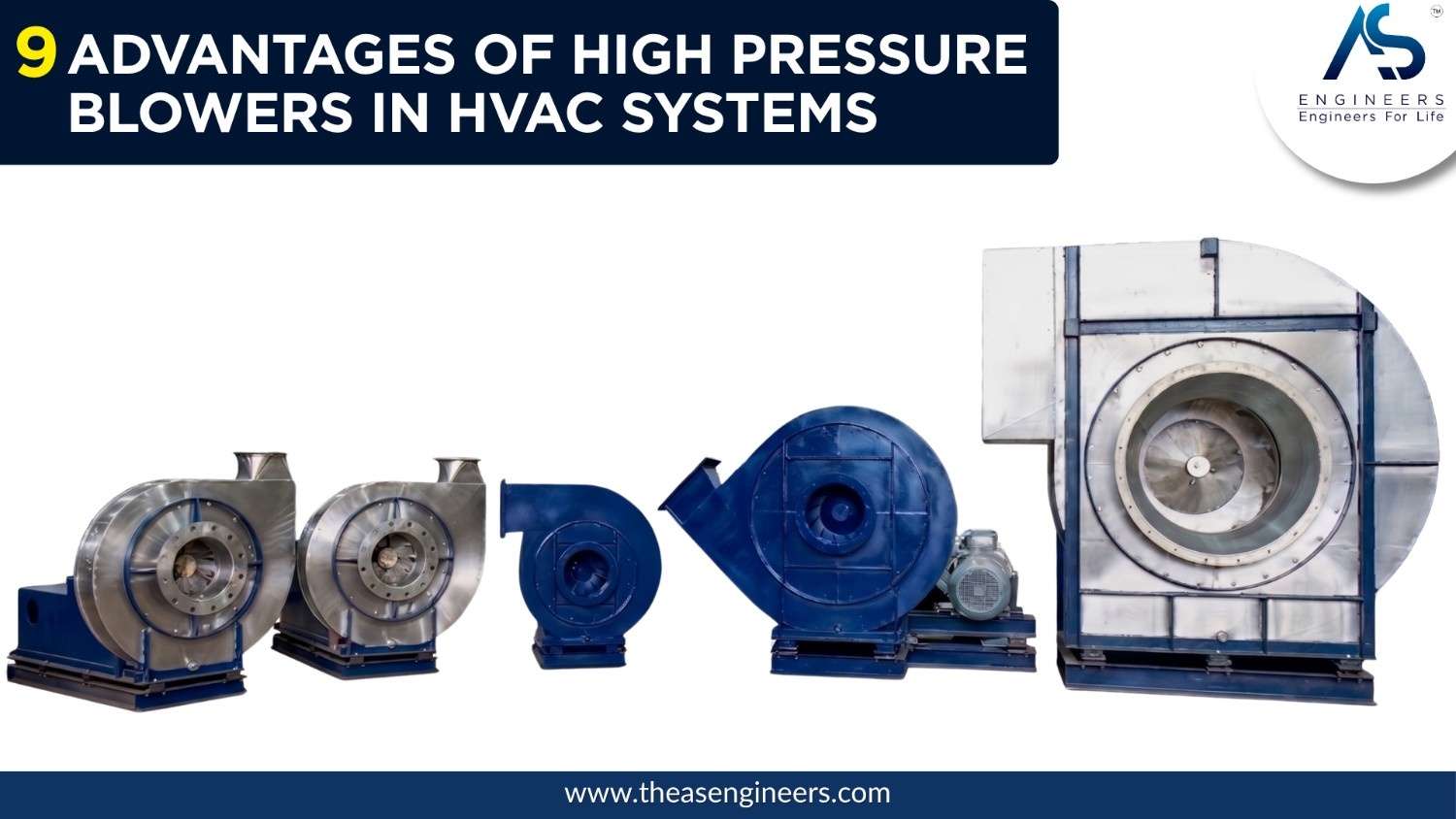
High pressure blowers in HVAC systems are useful when the system must move air through resistance: long duct runs, filters, coils, dampers, scrubbers, silencers, or industrial exhaust paths. In industrial HVAC and AHU applications, the advantage is not just “more air.” It is stable airflow against static pressure, better control of ventilation, and safer handling of demanding plant conditions.
HVAC is not only about cooling comfort. In industrial buildings, it also supports ventilation, filtration, heat removal, humidity control, equipment rooms, process areas, and worker comfort. ASHRAE identifies ventilation and acceptable indoor air quality as standard-driven design areas, with requirements covering ventilation rates, filtration, controls, air cleaning, operation, and maintenance.
For buyers, the important question is simple: will a normal fan maintain the required airflow after the real duct losses are added? If the answer is no, a correctly selected high pressure centrifugal blower becomes the more dependable option.
For related AHU-specific context, you can also review high pressure blowers in the AHU HVAC industry.
What Are the 9 Main Advantages of High Pressure Blowers in HVAC Systems?
High pressure blowers help HVAC systems maintain airflow, pressure, filtration, exhaust, and operating reliability when the system resistance is higher than a standard ventilation fan can handle.
| Advantage | Why It Matters in HVAC/AHU Systems | Buyer Check Before Selection |
|---|---|---|
| 1. Higher static pressure handling | Supports duct losses, filters, coils, dampers, and silencers | Confirm total static pressure, not only CFM |
| 2. Stable airflow delivery | Helps maintain designed ventilation and exhaust rates | Check operating point on blower curve |
| 3. Better filtration support | Helps overcome pressure drop from higher-efficiency filters | Verify filter resistance at clean and loaded condition |
| 4. Improved industrial exhaust | Helps remove fumes, heat, vapours, and dusty air from defined zones | Confirm contaminant type and exhaust path |
| 5. Compact installation potential | Useful where plant rooms or AHU spaces are tight | Check inlet/outlet clearance, not only footprint |
| 6. Energy control with correct selection | Can reduce wastage when matched with the duty point and VFD | Avoid oversizing and damper-only control |
| 7. Lower vibration risk when engineered correctly | Balanced impeller and proper mounting support smoother operation | Check foundation, alignment, and balancing |
| 8. Durability in demanding conditions | Suitable for high temperature, dust load, humidity, and industrial duty | Select MOC, impeller type, and sealing carefully |
| 9. Customization for site conditions | Allows application-specific design for industrial HVAC layouts | Share altitude, density, duct layout, and temperature data |
The mistake I see often is that buyers compare blower motor HP first. That is backwards. In HVAC and AHU systems, the correct starting point is airflow, static pressure, air temperature, density, duct layout, and resistance from filters or air-cleaning devices.
For broader selection logic, use this guide on key factors to consider when choosing a high pressure blower.
How Do High Pressure Blowers Improve Airflow and Static Pressure?
High pressure blowers improve HVAC performance by maintaining airflow when resistance increases across ducts, filters, coils, bends, dampers, and terminal devices. This is especially important in industrial HVAC systems where the duct path is rarely simple.
A blower selected only for free-air delivery may fail after installation. The actual system may include elbows near the inlet, undersized ducting, dirty filters, or restrictive louvers. These conditions increase static pressure and reduce airflow.
ASHRAE’s filtration guidance also notes that increasing filter efficiency usually increases pressure drop, which can reduce airflow, increase fan energy use, or both if the system cannot accommodate the resistance.
That is where a high pressure centrifugal blower becomes valuable. It can support airflow through higher resistance, but only when selected on the correct duty point.
For technical airflow basics, read maximizing air flow with high pressure blowers. For product-side evaluation, AS Engineers offers industrial centrifugal blowers for demanding air movement and process ventilation applications.
How Do They Support Ventilation, IAQ, and Exhaust Control?
High pressure blowers support ventilation and IAQ by helping move fresh air in, exhaust contaminated air out, and maintain designed air movement across industrial zones. They are not a substitute for correct ventilation design, but they are often a critical airflow component.
Industrial ventilation is used to control the work environment through airflow. CCOHS explains that ventilation brings in fresh outdoor air or exchanges air, and it is used to remove or dilute contaminants such as fumes, dusts, and vapours. It also lists ventilation purposes such as fresh air supply, contaminant dilution, fire or explosion hazard reduction, and temperature/humidity control.
In HVAC systems, high pressure blowers are commonly useful for:
- AHU supply air where filters and coils create pressure drop
- Exhaust systems for process halls, utility rooms, and production zones
- Makeup air systems for industrial plants
- Pressurization or depressurization zones
- Dust, fume, odour, and heat removal support
- Air handling before scrubbers, bag filters, or other air-cleaning equipment
However, do not use general HVAC airflow as a shortcut for hazardous contaminant control. Toxic fumes, heavy dust, and process emissions may need local exhaust ventilation, hoods, scrubbers, bag filters, or dedicated pollution control equipment.
For pollution-heavy facilities, see high pressure blowers in air pollution control.
Why Can Correct Blower Selection Improve Energy Control?
Correct high pressure blower selection can improve energy control because the blower is matched to the actual airflow and pressure requirement instead of forcing the system to compensate through dampers, overspeed, or oversized motors.
The important word is “correct.” A high pressure blower is not automatically energy-saving. If it is oversized, installed with poor duct transitions, or run far away from its efficient operating point, energy consumption can increase.
AMCA explains that system effect losses occur when adverse flow conditions such as turbulence or swirl appear near the fan inlet or outlet. It also notes that increasing fan speed by 10% can result in a 33% increase in energy consumption.
This is why blower selection must consider:
- Total static pressure, including accessories
- Filter clean and dirty pressure drop
- Coil pressure drop
- Duct length, elbows, transitions, and dampers
- Inlet and outlet conditions
- VFD control requirement
- Operating hours and load variation
- Motor efficiency and service factor
A properly selected backward curved blower or backward inclined blower may be suitable where efficiency, stable airflow, and moderate-to-high system resistance matter.
Which HVAC and AHU Applications Benefit Most?
High pressure blowers benefit HVAC and AHU applications where air must move through resistance, operate continuously, or handle industrial site conditions.
| HVAC / AHU Application | Why High Pressure Blower Helps | Selection Warning |
|---|---|---|
| Industrial AHU supply air | Handles filters, coils, dampers, and long ducts | Check full AHU pressure loss |
| Process hall ventilation | Supports large air exchange and heat removal | Confirm makeup air path |
| Utility room exhaust | Removes heat from compressor, boiler, or electrical rooms | Check temperature and duty cycle |
| Filtered fresh air supply | Maintains airflow across filter pressure drop | Design for loaded filter condition |
| Paint booth or fume exhaust support | Helps maintain extraction pressure | Requires proper capture design and safety review |
| High-temperature air handling | Supports hot zones and furnace-adjacent areas | Select temperature-rated blower and MOC |
| Industrial odour or vapour exhaust | Helps move contaminated air to treatment equipment | Do not rely on dilution alone for hazardous vapours |
AS Engineers’ verified centrifugal blower range covers airflow from 300 CFM to 200,000+ CFM, pressure up to 1700 mmWG, fan speeds from 300 RPM to 4500 RPM, and motor power from 0.5 HP to 500 HP. These ranges should still be matched to the actual site duty point, not used as a shortcut for selection.
For system-level process applications, review the role of high pressure blowers in industrial processes.
When Should You Not Choose a High Pressure Blower for HVAC?
Do not choose a high pressure blower when a low-pressure fan can meet the airflow requirement efficiently, when the duct losses are not calculated, or when the problem is poor system design rather than insufficient blower pressure.
A high pressure blower may be the wrong choice when:
- The application is simple comfort ventilation with low static pressure
- The ductwork has avoidable restrictions near the fan inlet or outlet
- The airflow issue is caused by clogged filters or poor maintenance
- The system needs local exhaust capture, not general dilution airflow
- The contaminant is toxic, explosive, corrosive, or sticky without proper design review
- The plant has no space for access, isolation, alignment, or maintenance
- The buyer has not confirmed temperature, humidity, dust load, density, or altitude
CCOHS warns that dilution ventilation does not completely remove contaminants, is not suitable for highly toxic products, is not effective for dusts or metal fumes, and may require large amounts of makeup air that must be heated or cooled.
This is where engineering judgement matters. Sometimes the answer is not a bigger blower. It may be better ducting, a corrected inlet transition, a local exhaust hood, filter maintenance, impeller cleaning, or a different blower type.
For failure diagnosis, use troubleshooting common issues with high pressure blowers.
How Should Buyers Select a High Pressure Blower for HVAC Systems?
Buyers should select a high pressure blower by confirming the actual process and HVAC duty conditions before comparing models, prices, or motor ratings.
Minimum RFQ details should include:
- Required airflow in CFM or m³/hr
- Total static pressure in mmWG or Pa
- Duct layout with bends, transitions, dampers, and silencers
- Filter type and pressure drop at clean and dirty condition
- Air temperature and expected variation
- Dust load, humidity, fumes, vapours, or corrosive elements
- Site altitude and ambient condition
- Required material of construction
- Impeller preference or application requirement
- Motor mounting arrangement and space limitation
- Continuous or intermittent operation
- Noise and vibration expectations
- Maintenance access and shutdown window
AS Engineers considers application, density, temperature, dust load, humidity, site location, altitude, material of construction, impeller blade design, and motor mounting arrangement while selecting centrifugal blowers.
For custom or heavy-duty HVAC applications, an industrial exhauster radial blower or application-specific blower design may be more suitable than a standard catalog fan.
What Maintenance Points Protect HVAC Blower Performance?
Maintenance protects HVAC blower performance by preventing capacity loss, vibration, bearing damage, belt issues, and airflow instability. A clean blower is not only a housekeeping issue. It is a performance issue.
CCOHS notes that dust, fumes, or particulate buildup on fan blades or housing can cause imbalance, vibration, and reduced airflow. It also recommends checking bearings, belt drives, coupling or belt alignment, impeller condition, fasteners, and safety guards.
For HVAC and AHU blower maintenance, check:
- Bearing temperature, lubrication, and vibration
- Belt tension and pulley alignment
- Impeller wear, dust buildup, or corrosion
- Flexible connector condition
- Foundation bolts and vibration isolators
- Filter pressure drop trends
- Motor current and voltage
- Damper/louver linkage
- Abnormal noise during startup or shutdown
- Airflow test points after filter change or duct modification
AS Engineers provides centrifugal blower services including performance analysis, engineering surveys, retrofitment, repair, material identification, on-site alignment, on-site balancing, customized engineering, AMC, and site-based design.
For plant teams, this guide on high pressure blower maintenance is a useful next read.
High Pressure Blower vs Standard Fan vs Axial Fan for HVAC
The right HVAC air movement equipment depends on pressure requirement, airflow volume, duct resistance, installation space, and operating condition.
| Option | Best Fit | Strength | Limitation |
|---|---|---|---|
| High pressure centrifugal blower | Industrial HVAC, AHU, exhaust, filtered air, long duct runs | Handles higher static pressure and demanding duty | Can waste energy if oversized or poorly installed |
| Standard centrifugal fan | General HVAC supply/exhaust with moderate resistance | Good balance of airflow and pressure | May struggle with high filter or duct losses |
| Axial fan | High airflow, low-pressure ventilation | Efficient for open ventilation and large air movement | Not ideal for high static pressure systems |
| Plug fan / AHU fan arrangement | Compact AHU and clean air handling | Good for integrated AHU layouts | Requires careful selection and balancing |
| Local exhaust system fan | Source capture for fumes, dust, vapour | More effective for contaminant capture | Needs hood, duct, air cleaner, and safety design |
A buyer should not decide based on the equipment name alone. The fan curve, system curve, operating point, and site condition decide the correct choice.
For design fundamentals, read understanding the science of high pressure blower design.
Final Buyer Takeaway
High pressure blowers in HVAC systems are valuable when the system needs dependable airflow against resistance. They help with static pressure, filtration, exhaust, ventilation, heat removal, and industrial AHU performance. But the benefit appears only when the blower is selected for the real duty point and installed with proper ducting, access, alignment, and maintenance.
The practical rule is this: do not ask only for “high CFM.” Ask for the right CFM at the required static pressure under actual site conditions.
FAQs
1. Are high pressure blowers suitable for all HVAC systems?
No. High pressure blowers are mainly suitable for HVAC or AHU systems with higher static pressure, long ducts, filters, coils, dampers, or industrial exhaust needs. For low-pressure comfort ventilation, a standard centrifugal fan or axial fan may be more efficient.
2. Do high pressure blowers reduce HVAC energy consumption?
They can reduce energy waste when selected correctly, especially when matched with the operating point and controlled with a VFD. But an oversized blower or poor duct design can increase energy use. Energy savings depend on airflow, pressure, system effect, operating hours, and control method.
3. Can a high pressure blower improve indoor air quality?
A high pressure blower can support IAQ by maintaining airflow through ventilation and filtration systems. It does not improve IAQ alone. Proper outdoor air design, filtration, exhaust location, air cleaning, maintenance, and contaminant control are also required.
4. Which blower type is best for industrial HVAC applications?
Backward curved, backward inclined, radial blade, and exhauster blower designs may all be suitable depending on static pressure, airflow, dust load, temperature, humidity, and duct layout. There is no universal best type. The correct blower is selected from the application data.
5. What information should I provide before requesting an HVAC blower quote?
Provide airflow, static pressure, duct layout, filter details, air temperature, dust or fume condition, humidity, site altitude, material preference, motor arrangement, operating hours, and installation space. These details help avoid under-selection, oversizing, vibration, and poor field performance.
For industrial HVAC, AHU, exhaust, and plant ventilation applications, AS Engineers can evaluate the airflow requirement, pressure loss, impeller design, material of construction, and site condition before recommending a blower. Share your airflow, static pressure, duct layout, temperature, filter details, and operating duty with the AS Engineers team through the AS Engineers contact page for an application-specific review.

Karan Dargode is Head of Operations at AS Engineers, where he supports manufacturing, assembly, commissioning, and operational execution for industrial equipment including paddle dryers, sludge dryers, centrifugal blowers, industrial fans, and pollution control systems. His role connects shop-floor manufacturing discipline with practical site commissioning, EHS compliance, and process reliability for industrial clients.