
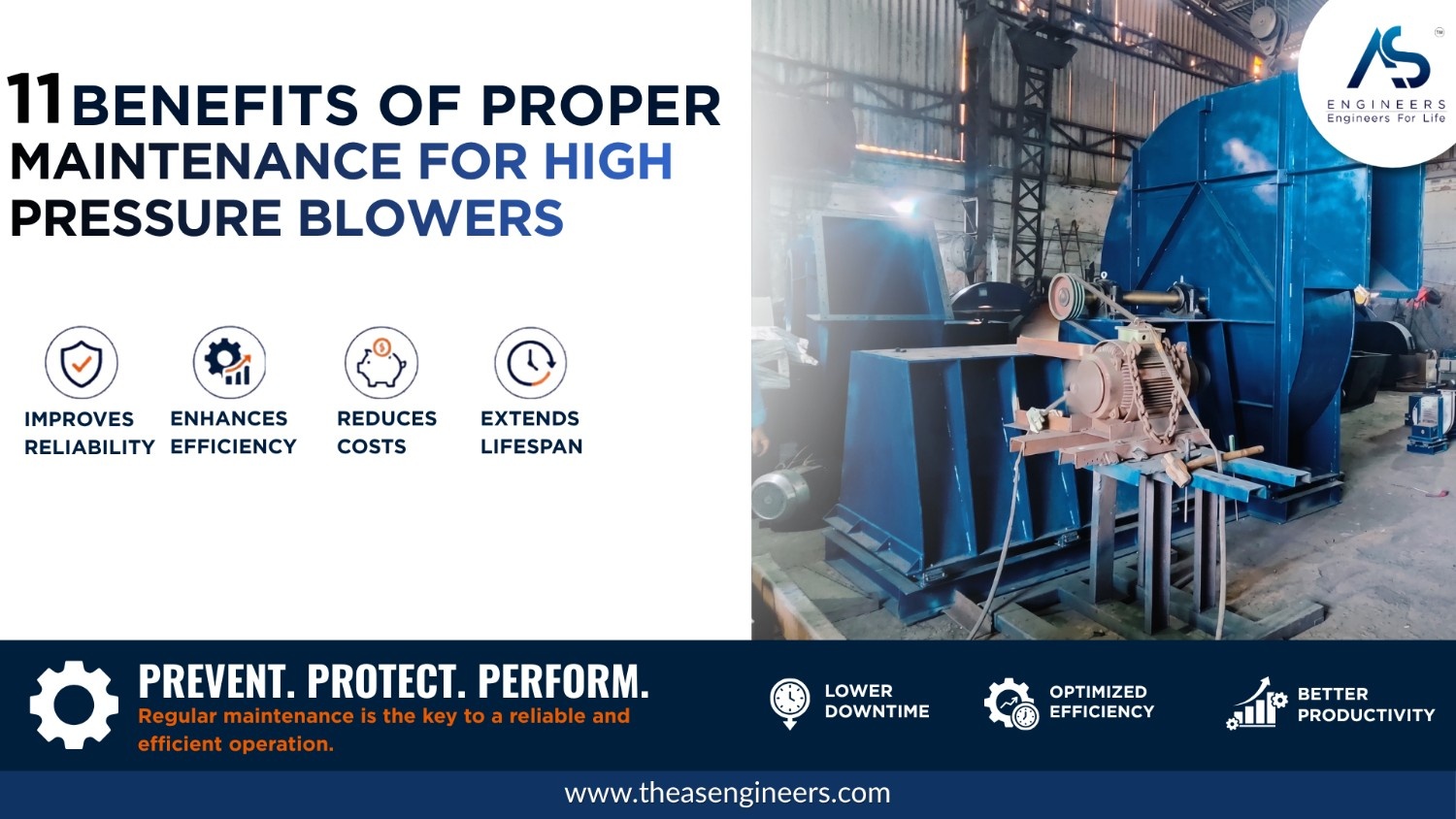
Proper maintenance for high pressure blowers protects airflow, static pressure, energy use, safety, product quality, and plant uptime. In practical terms, it helps maintenance teams detect bearing wear, vibration, belt tension issues, dust buildup, filter choking, seal leakage, and motor overload before they turn into unplanned shutdowns.
A high pressure blower is not just a rotating machine. It is part of a process system. If the blower loses efficiency, the problem may appear somewhere else first, such as weak combustion air, poor dust extraction, unstable pneumatic conveying, low aeration, hot motor current, poor product drying, or repeated tripping.
This is why a maintenance plan should not only ask, “Is the blower running?” It should ask, “Is the blower still delivering the duty point safely and consistently?” For a practical starting point, plant teams can also review these 7 tips for maintaining your high pressure blower before creating their site checklist.
What Changes When a High Pressure Blower Is Maintained Properly?
A maintained blower stays closer to its intended operating condition. The main improvement is not only longer equipment life, but more predictable process performance.
| Maintenance Area | What Is Checked | Main Benefit for the Plant |
|---|---|---|
| Bearings | Lubrication, temperature, noise, looseness | Lower failure risk and smoother running |
| Impeller | Dust buildup, erosion, corrosion, imbalance | Stable airflow and reduced vibration |
| Belts and coupling | Tension, wear, alignment, slippage | Better power transfer and less energy waste |
| Motor | Current, heat, cleanliness, mounting | Lower overload and trip risk |
| Inlet filter or suction path | Choking, pressure drop, blockage | Better air delivery and less motor strain |
| Ducting and dampers | Leakage, restriction, wrong position | Correct static pressure and process flow |
| Foundation and fasteners | Looseness, cracks, vibration transfer | Reduced mechanical stress |
| Safety guards and access doors | Fitment, interlocks, closure | Safer inspection and operation |
The most common mistake is treating maintenance as a calendar activity only. The better method is condition-based maintenance supported by readings: vibration, bearing temperature, motor current, pressure, airflow, and visual inspection notes.
11 Benefits of Proper Maintenance for High Pressure Blowers
1. Better Energy Efficiency
A blower wastes energy when the impeller is dirty, the belts slip, the inlet filter is choked, the damper is wrongly positioned, or the system pressure has drifted from the original duty point. Regular maintenance keeps the air path clean and the drive system efficient.
This is especially important in plants where blowers run for long hours. Even a small mechanical loss can become a large monthly power cost. For more efficiency-focused checks, read 10 tips for maximizing efficiency with high pressure blowers.
2. Lower Risk of Unexpected Breakdown
Bearings, belts, seals, fasteners, and impellers normally give warning signs before failure. The warning may be a change in sound, temperature, vibration, current, or airflow. Proper maintenance gives the team a chance to act before a planned stoppage becomes an emergency stoppage.
A blower breakdown can stop more than one machine. In dust collection, combustion air, drying, aeration, or fume extraction, one blower failure can disturb the full process line.
3. Longer Blower Service Life
The life of a high pressure blower depends heavily on operating conditions. Dust load, temperature, humidity, corrosion, gas density, altitude, and impeller design all influence wear. AS Engineers considers factors such as application, density, temperature, dust load, humidity, site location, altitude, material of construction, impeller blade design, and motor mounting arrangement while selecting blowers.
Maintenance protects that design intent. A well-selected blower can still fail early if the bearings are over-greased, belts are over-tightened, the impeller is allowed to build up dust, or vibration is ignored. For lifecycle thinking, see maximizing lifespan with regular maintenance for high pressure blowers.
4. Stable Airflow and Static Pressure
A blower may keep rotating but still fail to deliver the required airflow or pressure. This happens when the suction path is blocked, the impeller is worn, the damper is not positioned correctly, the ducting has leakage, or the system resistance has changed.
Maintenance should include pressure and airflow checks wherever test points are available. Do not rely only on motor running status. A motor can run normally while the process receives less air than required.
5. Reduced Vibration and Mechanical Stress
Vibration is one of the clearest early warnings in a high pressure blower. It can come from impeller imbalance, bearing wear, shaft misalignment, loose foundation bolts, cracked supports, belt issues, or material buildup.
The practical rule is simple: vibration should be trended, not guessed. If the reading increases over time, the machine is telling you something has changed. AS Engineers provides centrifugal blower services including performance analysis, engineering surveys, retrofitment, repair, on-site balancing, on-site alignment, customized engineering, AMC, and site-based design.
6. Safer Operation for Maintenance Teams
High pressure blowers involve rotating parts, electrical power, suction force, discharge pressure, hot surfaces in some applications, and moving belts or couplings. Proper maintenance improves safety because guards, access doors, fasteners, isolation points, and abnormal vibration are checked before work begins.
No inspection should be done casually around rotating equipment. Lockout, isolation, cooling, and trained personnel are essential. If the blower handles hot gas, chemical fumes, dust, or contaminated air, the maintenance method must match the process risk.
7. Better Product and Process Quality
In many industrial processes, blower performance directly affects final output. In a dryer, unstable airflow can affect moisture removal. In a furnace, poor air delivery can affect combustion. In a dust collector, low suction can affect capture efficiency. In pneumatic conveying, unstable pressure can affect material movement.
The hidden cost of poor maintenance is often not the blower repair cost. It is the process loss created before the machine finally fails.
8. Lower Spare Parts Panic
Good maintenance gives the plant enough warning to plan bearings, belts, seals, gaskets, couplings, motor mounts, or impeller repair before breakdown. This is important for imported machines, custom-built blowers, high-temperature fans, and critical process lines.
AS Engineers supplies centrifugal blower spare parts such as impellers, bearings, shafts, motor mounts, seals, gaskets, belts, and V-belts. The right spare strategy should be based on criticality, running hours, operating condition, and replacement history.
9. Cleaner Air Path and Reduced Dust Buildup
Dust, fibers, powder, fumes, moisture, or sticky deposits can disturb impeller balance and reduce airflow. In some applications, buildup also increases vibration and can damage the casing, liners, shaft seals, and ducting.
Cleaning is not cosmetic maintenance. It is performance maintenance. For plants handling dust or particulate-heavy air, read the importance of regular cleaning for high pressure blowers.
10. Better Compliance and Documentation
Many plants need maintenance records for safety audits, customer audits, environmental compliance, insurance review, or internal reliability tracking. A proper maintenance log shows what was checked, what readings were observed, what corrective action was taken, and when the next inspection is due.
A weak maintenance log creates a problem after failure because nobody can confirm whether the issue was sudden, gradual, repeated, or caused by operating changes.
11. More Confident Maintenance Planning
A maintained blower gives plant heads and maintenance managers better control. They can schedule shutdowns, plan spares, assign technicians, and avoid last-minute firefighting.
This is where preventive maintenance becomes a management advantage. Instead of reacting to noise, heat, trips, and vibration, the team works with a predictable inspection rhythm.
How Does Maintenance Improve Blower Efficiency?
Maintenance improves blower efficiency by reducing mechanical losses and system restrictions. The biggest improvement usually comes from keeping the impeller clean, maintaining correct belt or coupling alignment, preventing inlet restriction, checking bearing condition, and confirming that the blower is operating near the required duty point.
Do not assume a high motor HP means better performance. A blower with the wrong system resistance, dirty inlet, or worn impeller can consume power without delivering useful airflow. The important question is whether the blower is giving the required CFM and static pressure at the process point.
If the existing blower repeatedly needs adjustment, the issue may not be maintenance alone. It may be wrong selection, system change, ducting restriction, or process condition drift. In that case, compare the installation against 8 key factors to consider when choosing a high pressure blower.
Which Maintenance Checks Give the Highest Return?
The highest-return maintenance checks are the ones that detect failure early and protect process continuity. For most high pressure blower installations, these checks should be prioritized:
- Vibration readings at fixed points
- Bearing temperature and lubrication condition
- Belt tension, wear, and pulley alignment
- Coupling alignment in direct-driven blowers
- Impeller dust buildup, corrosion, erosion, or rubbing
- Motor current against normal running baseline
- Foundation bolts, casing bolts, and guard fitment
- Inlet filter condition and suction restriction
- Damper position and duct leakage
- Abnormal sound during startup, full load, and shutdown
A maintenance technician should not only tick a checklist. They should compare readings with the previous inspection. A number by itself has limited value. A trend tells the real story.
For more field-level practices, see these expert tips for maintaining high pressure blowers.
What Should Plant Teams Track in a Blower Maintenance Log?
A useful blower maintenance log should record operating data, not just inspection dates. At minimum, include blower tag number, application, running hours, airflow or pressure reading if available, motor current, vibration reading, bearing temperature, lubrication action, belt or coupling condition, cleaning status, spare parts replaced, and technician remarks.
For critical blowers, add process notes. Was the dust load higher than normal? Was the inlet air hotter? Was the plant running at partial load? Was a damper changed? Was ducting modified? These details often explain why a blower begins to behave differently.
When troubleshooting repeat problems, maintenance logs help separate three possibilities:
| Symptom | Possible Maintenance Cause | Possible System Cause |
|---|---|---|
| Low airflow | Dirty impeller, clogged inlet, belt slip | Duct restriction or wrong damper position |
| High vibration | Imbalance, bearing wear, loose base | Resonance or poor foundation |
| Motor overload | Belt tension, bearing drag, wrong speed | Higher system pressure or density change |
| Noise | Bearing issue, rubbing, loose parts | Turbulence or poor inlet condition |
| Frequent belt failure | Misalignment or wrong tension | Pulley mismatch or overload |
For deeper fault diagnosis, connect this article with troubleshooting common issues with high pressure blowers.
When Should You Call a Blower Service Engineer?
Call a service engineer when the blower shows repeated vibration, abnormal bearing temperature, frequent belt failure, rising motor current, poor airflow despite cleaning, casing rubbing, impeller damage, shaft seal leakage, or performance loss after process changes.
You should also call a specialist before modifying speed, impeller, motor, drive arrangement, material of construction, ducting, or damper strategy. These changes affect the full blower system. A quick site adjustment can create a bigger reliability problem if pressure, density, temperature, dust load, and motor load are not reviewed together.
AS Engineers manufactures and supports industrial centrifugal blowers including backward curved, backward inclined, high pressure radial blade, exhauster radial, high temperature plug, and exhauster air handling blower designs. For new or replacement duty evaluation, review the centrifugal blower range from AS Engineers.
Maintenance Mistakes That Still Damage Good Blowers
A good blower can fail early when maintenance is done without system understanding. These are the mistakes I would watch closely:
- Greasing bearings without knowing the correct type or quantity
- Tightening belts too much and overloading bearings
- Cleaning the outside but ignoring impeller buildup
- Resetting overload trips without checking motor current
- Replacing belts without checking pulley alignment
- Ignoring foundation looseness because the blower still runs
- Running after abnormal vibration becomes obvious
- Changing speed without checking power and pressure impact
- Treating dust, temperature, humidity, and corrosion as minor details
- Not recording readings after each inspection
The most expensive maintenance mistake is assuming that a running blower is a healthy blower. A blower can run every day and still drift away from its intended performance point.
Simple RFQ Checklist for Blower Maintenance or Service Support
Before asking for blower maintenance, balancing, alignment, retrofitment, or repair support, prepare this information:
- Blower type and tag number
- Application and process duty
- Airflow and static pressure requirement
- Motor HP, RPM, voltage, and drive arrangement
- Gas or air temperature
- Dust load, humidity, corrosion, or abrasive particles
- Current problem: vibration, noise, heat, low airflow, high power, or repeated failure
- Photos of blower, motor, belts, coupling, foundation, inlet, outlet, and nameplate
- Last maintenance date and replaced parts
- Available readings: vibration, current, pressure, temperature
If the concern is quality or performance validation, also review the importance of testing your high pressure blower for quality and performance.
FAQs
1. How often should high pressure blowers be maintained?
High pressure blowers should be inspected on a schedule based on running hours, dust load, temperature, humidity, vibration history, and process criticality. A clean-air blower in light duty may need less frequent attention than a blower handling hot, dusty, corrosive, or moisture-laden air. Critical blowers should also have routine vibration, current, and bearing temperature trending.
2. What is the most important maintenance check for a high pressure blower?
The most important check depends on the failure pattern, but vibration, bearing condition, belt or coupling alignment, impeller cleanliness, and motor current are usually the highest-value checks. These points reveal early signs of imbalance, drag, misalignment, overload, or process restriction before complete failure.
3. Can proper maintenance reduce blower power consumption?
Yes, proper maintenance can reduce avoidable power loss by keeping the air path clean, preventing belt slip, reducing bearing drag, correcting alignment, and avoiding operation against unnecessary system resistance. The exact saving depends on blower size, running hours, process condition, and how far the machine had drifted from its intended duty point.
4. What are signs that a blower needs balancing or alignment?
Common signs include rising vibration, abnormal noise, bearing heating, coupling wear, belt dust, repeated belt failure, loose foundation bolts, and vibration that increases with speed or load. If the impeller has dust buildup, erosion, or repair marks, balancing should be checked before long operation.
5. Should blower maintenance be handled in-house or by a specialist?
Daily visual checks, cleaning, basic lubrication logs, and simple belt inspection can often be handled in-house by trained maintenance teams. Specialist support is recommended for vibration analysis, laser alignment, on-site balancing, impeller repair, performance analysis, material identification, retrofitment, and repeated failure diagnosis.
A high pressure blower maintenance plan should be built around actual site conditions, not a generic calendar. If your blower is showing vibration, high current, bearing heating, low airflow, repeated belt failure, or performance loss, share the application details, photos, nameplate, and available readings with the AS Engineers team.
For inspection, balancing, alignment, retrofitment, repair, AMC, or application-specific support, contact AS Engineers for centrifugal blower service support.

Karan Dargode is Head of Operations at AS Engineers, where he supports manufacturing, assembly, commissioning, and operational execution for industrial equipment including paddle dryers, sludge dryers, centrifugal blowers, industrial fans, and pollution control systems. His role connects shop-floor manufacturing discipline with practical site commissioning, EHS compliance, and process reliability for industrial clients.