
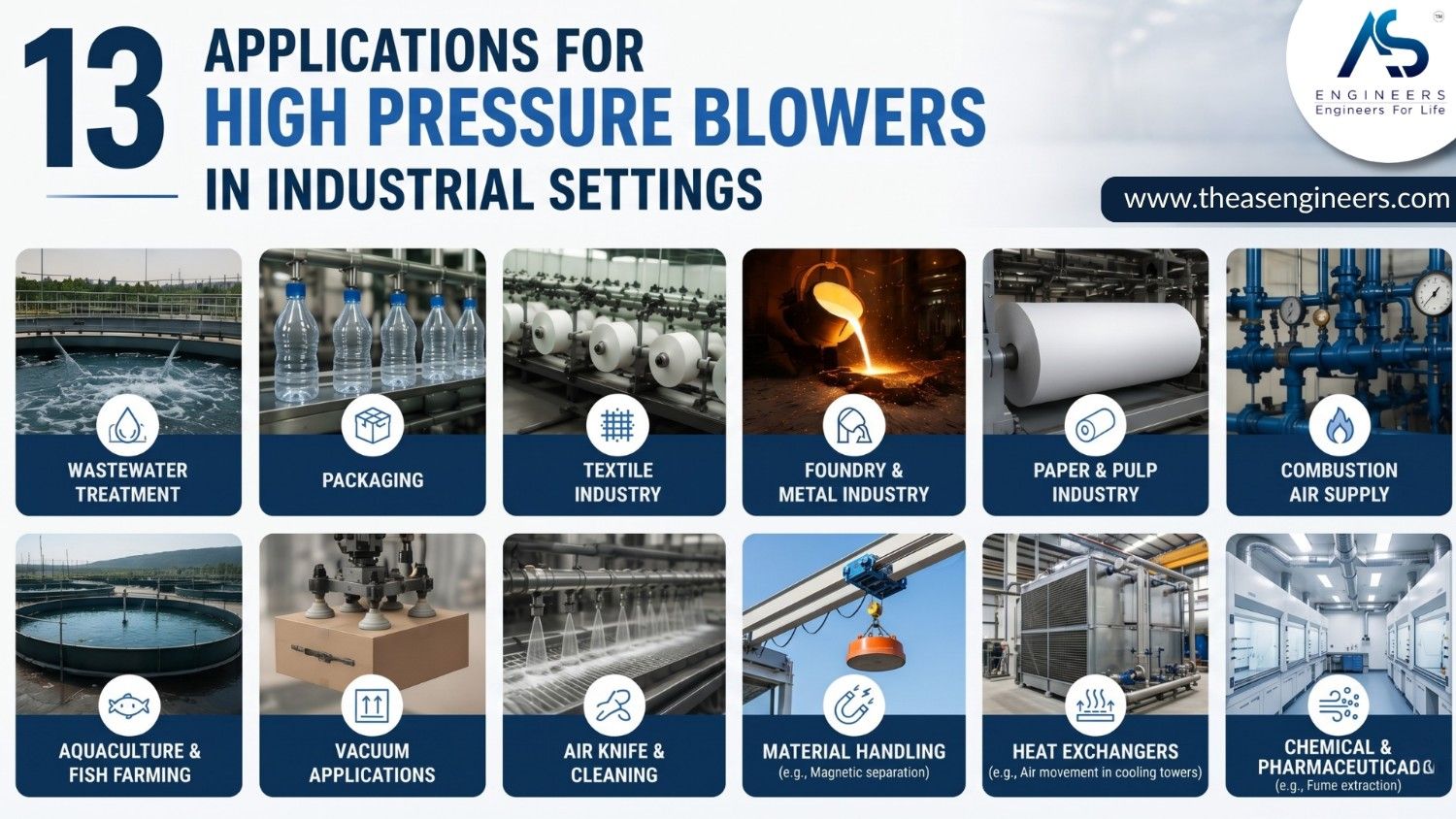
High pressure blower applications are common wherever a plant must move air, fumes, dust, gas, or process air against resistance from ducts, filters, scrubbers, heaters, cyclones, bag filters, or long pipeline layouts. In practical terms, the blower is not selected only for “air movement.” It is selected for airflow plus pressure plus process condition.
For industrial buyers, the real question is not “Where can a blower be used?” The better question is: what resistance must the blower overcome, and what is present in the airstream?
A clean ventilation duty, a bag filter duty, a boiler FD fan duty, and a hot gas handling duty may all require air movement, but they do not require the same blower design. The wrong assumption here leads to high motor load, vibration, poor suction, dust carryover, bearing problems, or repeated impeller imbalance.
AS Engineers manufactures industrial centrifugal blowers for demanding air movement duties, including backward curved blowers, backward inclined blowers, high pressure radial blade blowers, exhauster radial blowers, high temperature plug blowers, and exhauster air handling blowers. Available blower ranges include airflow from 300 CFM to 200,000+ CFM, pressure up to 1700 mmWG, fan speed from 300 RPM to 4500 RPM, and motor power from 0.5 HP to 500 HP.
For basic blower design understanding, see this guide on the science of high pressure blower design.
What Are the 13 Main High Pressure Blower Applications?
High pressure blower applications include dust collection, pneumatic conveying, aeration, drying, cooling, ventilation, fume extraction, dehumidification, evaporative cooling support, combustion air, vacuum or suction duty, induced draft, and process gas handling. The duty may look simple on paper, but each one changes blower selection.
- Dust collection
High pressure blowers create suction or draft to move dust-laden air toward cyclones, bag filters, or dust collectors. For dirty airstreams, impeller design matters because buildup on blades can create imbalance and performance loss. - Pneumatic conveying
In pneumatic conveying, the blower moves dry bulk material through pipelines using air pressure or suction. The selection must consider material density, pipeline length, bends, pickup velocity, and abrasion risk. - Aeration
Aeration duties are common in ETP, STP, aquaculture, and process tanks. The blower must overcome liquid depth, diffuser resistance, piping losses, and continuous operating hours. For wastewater-specific context, read about high pressure blowers in the wastewater treatment industry. - Industrial drying
Blowers support hot air drying, moisture removal, and air circulation in dryers. The important variables are temperature, humidity, residence time, and whether the air contains fines or sticky particles. - Cooling of equipment or process material
Cooling blowers supply air to motors, generators, panels, ovens, hot products, or process lines. Oversizing is a common mistake because excess air can disturb the process or increase noise without improving cooling. - General industrial ventilation
Ventilation blowers move fresh or exhaust air across enclosed plant areas. The selection changes when the duty includes fumes, heat, dust, humidity, or corrosive vapours. - Fume extraction
Fume extraction requires controlled suction from hoods, tanks, chemical lines, welding areas, or process vessels. Poor duct layout near the fan inlet can reduce real performance even if the catalogue capacity looks correct. - Dehumidification support
Blowers support air circulation in drying rooms, coating lines, storage areas, or process zones where moisture control matters. The blower is only one part of the system, so coil, heater, duct, and exhaust design must be checked together. - Evaporative cooling support
In evaporative cooling systems, blowers move air through wetted media or process areas. The plant should check dust load and water carryover because both can affect ducting, filters, and fan life. - Combustion air and fuel air supply
Boilers, furnaces, hot air generators, kilns, and burners need controlled air supply. Forced draft duties should be selected carefully because unstable air supply affects combustion quality, temperature control, and fuel efficiency. For related applications, see high pressure blowers in the boilers industry and high pressure blowers in the hot air generator industry. - Vacuum or suction generation
Some applications use a blower to create suction for holding, conveying, extraction, cleaning, or light material handling. This is not the same as deep vacuum duty, so the required vacuum level must be confirmed before selection. - Induced draft duty
ID fans and blowers pull flue gas, hot air, or process gas through furnaces, boilers, pollution control equipment, or stacks. Temperature, dust load, corrosion, shaft sealing, and impeller wear become major selection points. - Process gas and air handling
Some plants use blowers for air separation support, gas circulation, scrubber duty, reactor ventilation, or process exhaust. Here, gas composition, leakage risk, flammability, corrosion, and material of construction must be reviewed before finalizing the design.
How Do You Match Each Application to the Right Blower Design?
The correct blower design depends on airflow, pressure, temperature, dust load, humidity, density, altitude, material of construction, impeller blade design, and motor mounting arrangement. Industrial fan selection should begin with airflow rates, pressure requirements, airstream properties, temperature, and system layout, not only motor HP or inlet size.
| Application condition | Better selection direction | Buyer warning |
|---|---|---|
| Clean air, high volume | Backward curved or backward inclined blower | Do not oversize only for future expansion. It can increase noise and poor efficiency. |
| Dust-laden air | High pressure radial blade or exhauster radial design | Dust buildup can create imbalance, vibration, and bearing load. |
| Hot gas or furnace duty | High temperature plug blower | Confirm gas temperature at fan inlet, not only furnace temperature. |
| Bag filter or scrubber duty | ID fan, radial blade, or custom centrifugal blower | Check pressure drop across filter media, ducting, bends, dampers, and stack. |
| Corrosive fumes | Suitable MOC, coating, or corrosion-resistant design | Leakage and shaft seal requirements must be discussed early. |
| Variable process condition | Design with operating range and control method | Avoid operation near unstable regions of the fan curve. |
For a detailed purchase framework, use this guide on how to choose the right high pressure blower. For equipment range, see AS Engineers’ industrial centrifugal blowers and high pressure radial blade blower.
Which Industries Depend Heavily on High Pressure Blowers?
Industries with high dust load, high temperature, long ducting, combustion air, pollution control, or process ventilation depend heavily on high pressure blowers. The most common sectors include cement, steel, power, chemical, food processing, wastewater, automobile, textile, and air pollution control systems.
In cement plants, blowers support raw mill fans, cooler fans, coal mill ID fans, bag filter fans, and process exhaust. Dust and abrasion are major risks, so impeller design and wear allowance matter. Read more about high pressure blowers in the cement industry.
In chemical processing, blowers are used for fume extraction, scrubber systems, reactor ventilation, drying, and process gas movement. Corrosion and leakage control are often more important than catalogue airflow. See this application guide for high pressure blowers in the chemical processing industry.
In air pollution control, blowers and ID fans move contaminated air through cyclones, scrubbers, bag filters, and stacks. Pressure drop can increase as filters load with dust, so the blower must be selected for real operating resistance, not clean-filter resistance only. For more context, read about high pressure blowers in the air pollution control industry.
In food processing, blowers support drying, cooling, oven exhaust, burner air, material circulation, and ventilation. Hygiene, temperature control, and cleanability should be reviewed along with airflow. See AS Engineers’ page on centrifugal blowers and fans for food processing.
What Mistakes Cause High Pressure Blower Underperformance?
The most common blower mistakes are selecting by motor HP, ignoring system pressure losses, underestimating dust load, placing elbows too close to the fan, and failing to check the operating point on the fan curve. A blower that looks correct in a quotation can still fail after installation if the site layout changes the airflow.
The U.S. Department of Energy notes that operating a fan near its best efficiency point improves performance and reduces wear, while moving away from that point increases bearing loads and noise. This is why “extra margin” is not always safe. Oversizing can create unstable operation, high noise, damper losses, and unnecessary power consumption.
AMCA explains that system effect occurs when real installation conditions create turbulence, swirl, or non-uniform flow at the fan inlet or outlet. It can reduce installed performance, increase vibration, raise noise, and lead to premature impeller or bearing failure.
Before blaming the blower, check these points:
- Has the duct route changed after blower selection?
- Are there elbows, dampers, or transitions close to the inlet or outlet?
- Is the filter pressure drop higher than expected?
- Is dust sticking to the impeller?
- Is the blower running away from the selected operating point?
- Is vibration caused by imbalance, misalignment, foundation, or duct stress?
For maintenance-side checks, use this guide on troubleshooting common high pressure blower issues. For service support, AS Engineers provides centrifugal blower services, including performance analysis, engineering surveys, repair, retrofitment, on-site alignment, on-site balancing, customized engineering, AMC, and site-based design.
What Should You Share Before Requesting a High Pressure Blower Quote?
A serious blower RFQ should include process conditions, not only airflow and motor HP. The supplier needs to understand what the blower is moving, where it is installed, and what resistance it must overcome.
Share these details before requesting a quotation:
- Required airflow in CFM or m³/hr
- Required static pressure or total pressure
- Application type, such as dust collection, FD fan, ID fan, drying, cooling, or scrubber duty
- Air or gas temperature at blower inlet
- Dust load, particle type, stickiness, and abrasiveness
- Humidity, moisture, or condensable vapours
- Gas composition, corrosion risk, or flammability concern
- Duct length, bends, dampers, filters, cyclones, scrubbers, and stack details
- Installation altitude and ambient temperature
- Required MOC, impeller preference, drive arrangement, and motor mounting
- Operating hours, control method, and future capacity variation
For high temperature applications, AS Engineers offers a high temperature plug blower. For broader equipment selection, the article on maximizing air flow with high pressure blowers can help you understand the relationship between pressure, airflow, and system resistance.
FAQs
1. What are high pressure blowers used for in industrial plants?
High pressure blowers are used for dust collection, pneumatic conveying, aeration, drying, cooling, ventilation, fume extraction, combustion air, induced draft, scrubber duty, bag filter systems, vacuum or suction duty, and process gas handling. The correct design depends on airflow, pressure, temperature, dust load, and duct layout.
2. Which blower is best for dust collection?
For dust collection, radial blade, radial tip, or exhauster-type centrifugal blowers are often preferred because they handle dirty airstreams better than clean-air blower designs. The final choice depends on dust quantity, particle size, abrasiveness, moisture, filter pressure drop, and whether the fan is placed before or after the dust collector.
3. Can one high pressure blower handle both hot air and dust?
Sometimes yes, but it must be designed for both conditions. Hot air affects material strength and fan speed limits, while dust affects impeller wear and balancing. A blower selected only for temperature may fail in dusty service, and a blower selected only for dust may not be suitable for elevated temperature.
4. How do I know the correct blower capacity?
You need required airflow, system pressure, gas temperature, density correction, duct layout, filter or scrubber pressure drop, and process variation. Motor HP alone is not enough. A correct selection should identify the operating point on the fan curve and confirm that the blower can run safely under real site conditions.
5. Are high pressure blowers used in pollution control systems?
Yes. High pressure blowers and ID fans are widely used in pollution control systems such as scrubbers, cyclones, bag filters, dust collectors, and exhaust stacks. In these duties, the fan must be selected for actual pressure drop, dust load, corrosive gases, temperature, and maintenance access.
High pressure blower applications look similar only at the surface. In real plant operation, a dust collector blower, combustion air blower, hot gas fan, and scrubber ID fan all behave differently because the airstream and system resistance are different.
If you are selecting a blower for dust collection, drying, cooling, combustion air, ventilation, scrubber duty, or process exhaust, share your airflow, pressure, temperature, dust load, ducting layout, and operating condition with AS Engineers. Their engineering team can review the duty and suggest the right blower type, impeller design, MOC, mounting arrangement, and service support.
For application-specific blower selection or retrofit support, contact AS Engineers.

Karan Dargode is Head of Operations at AS Engineers, where he supports manufacturing, assembly, commissioning, and operational execution for industrial equipment including paddle dryers, sludge dryers, centrifugal blowers, industrial fans, and pollution control systems. His role connects shop-floor manufacturing discipline with practical site commissioning, EHS compliance, and process reliability for industrial clients.