
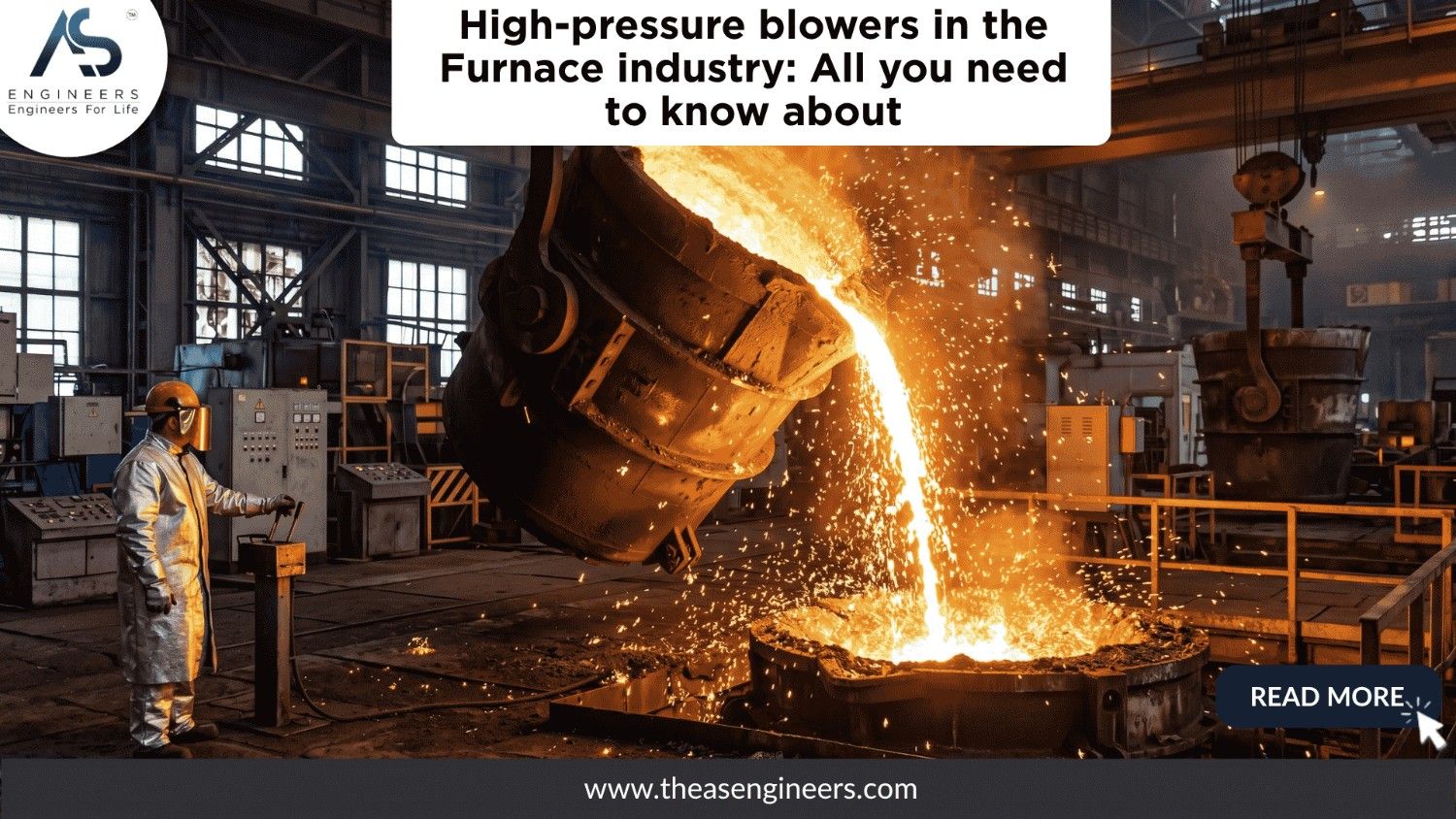
High pressure blowers in the furnace industry control combustion air, furnace draft, exhaust gas movement, cooling air and hot air circulation. The real selection question is not only “how much airflow?” It is whether the blower can maintain stable pressure under heat, duct resistance, damper movement, dust load and changing furnace operating conditions.
In furnace applications, a blower may work as a forced draft fan, induced draft fan, combustion air blower, booster fan, exhaust fan, recirculation fan or cooling air fan. Each duty has a different risk. A forced draft blower must supply air to the burner reliably. An induced draft fan must pull flue gas without creating excessive negative pressure. A recirculation fan must handle temperature and flow uniformity. A cooling air blower must protect equipment without disturbing the process.
The most common buyer mistake is comparing blower capacity only by motor HP. In furnace systems, motor HP is the result of airflow, pressure, temperature, gas density, duct layout, efficiency and operating margin. Start with the process requirement, then select the blower.
For a deeper foundation, see our guide on understanding the science of high pressure blower design.
Where Are Furnace Blowers Used?
Furnace blowers are used anywhere controlled air movement affects heat generation, heat distribution, gas removal or equipment protection. In practical plant language, the blower is often part of the combustion and draft control system.
| Furnace duty | Blower role | Main operating concern | Selection cue |
|---|---|---|---|
| Combustion air | Supplies air to burner | Air-fuel ratio stability | Confirm required air volume, pressure and burner demand |
| Forced draft | Pushes air into furnace | Over-airing, pressure fluctuation | Match blower curve with damper and control logic |
| Induced draft | Pulls flue gas to stack or treatment system | Negative pressure, leakage, heat loss | Check flue gas temperature, dust and duct pressure drop |
| Balanced draft | Uses FD and ID fans together | Furnace pressure balance | Coordinate both fans, dampers and interlocks |
| Hot air circulation | Moves heated air inside process | Temperature uniformity | Check recirculation temperature and impeller suitability |
| Exhaust and fumes | Removes gases from furnace zone | Heat, dust, corrosive vapours | Select MOC, bearing arrangement and access points |
| Cooling air | Protects burners, scanner, seals or equipment | Reliability during operation | Consider redundancy and alarm logic |
The Bureau of Energy Efficiency describes mechanical draft as draft produced by fans, where forced draft pushes air into the furnace and induced draft draws gases toward the chimney. It also notes that combustion controls regulate fuel supply, air supply and gas removal for efficiency and safety.
This is why furnace blower selection should involve the furnace OEM, burner supplier, combustion engineer and blower manufacturer, not procurement alone.
Which Blower Type Is Best for Furnace Applications?
For many furnace duties, centrifugal blowers are preferred because they can develop useful pressure against duct resistance, burner pressure drop, dampers, heat exchangers, pollution control equipment and stack systems. In furnace applications, the right design may be a backward curved blower, backward inclined blower, high pressure radial blade blower, exhauster radial blower or high temperature plug blower.
AS Engineers’ industrial centrifugal blower range includes backward curved, backward inclined, high pressure radial blade, exhauster radial, high temperature plug and exhauster air handling blowers. The verified range covers airflow from 300 CFM to 200,000+ CFM, pressure up to 1700 mmWG, fan speed from 300 RPM to 4500 RPM and motor power from 0.5 HP to 500 HP, with final selection based on application, density, temperature, dust load, humidity, site location, altitude, MOC, impeller design and motor mounting arrangement.
For furnace zones with high inlet temperature, the high temperature plug blower is usually more relevant than a general-purpose blower. For general furnace air movement and industrial draft duties, review the centrifugal blower range.
The key point: do not select the blower type by name alone. Select it by gas temperature, flow, pressure, gas composition, dust loading, drive arrangement, control method and maintenance access.
How Do FD Fans, ID Fans and Balanced Draft Systems Differ?
A forced draft fan supplies air to the furnace. An induced draft fan pulls combustion gases out of the furnace. A balanced draft system uses both to control air supply and exhaust gas removal together.
For furnace buyers, the difference matters because each fan affects pressure in a different part of the system. An oversized FD fan can push too much air into the furnace and disturb combustion. An oversized ID fan can pull the furnace too negative, drawing cold air through openings, doors and leakage points. A weak ID fan can cause poor exhaust removal, gas accumulation or unstable draft.
The U.S. Department of Energy notes that excess oxygen in flue gas indicates too much excess air, and flame stability can indicate improper fuel-air control. It also recommends determining the best excess air level and setting combustion ratio controls accordingly.
In practical terms, the blower should support combustion, not fight it. A good furnace blower selection checks:
- Burner air requirement at minimum, normal and peak firing.
- Furnace pressure requirement at the reference point.
- Flue gas temperature and density.
- Pressure drop across ducts, dampers, heat recovery, filters, scrubbers or stack.
- Control method, such as damper control or VFD.
- Safety interlocks and airflow proving logic.
For a related technical guide, see AS Engineers’ page on ID and FD fans.
What Are the Main Selection Factors for Furnace Blowers?
The main selection factors for furnace blowers are airflow, static pressure, gas temperature, gas density, dust load, corrosion risk, impeller design, MOC, motor mounting arrangement, drive type and site conditions.
Airflow should match the actual process demand, not a rough plant estimate. Pressure should include duct losses, burner pressure drop, dampers, bends, filters, heat exchangers, silencers and emission control equipment. Temperature matters because gas density changes with heat. A blower selected at ambient air conditions may underperform when the actual gas stream is hot.
| Selection factor | Why it matters in furnace duty | Buyer check before RFQ |
|---|---|---|
| Airflow | Controls combustion, exhaust or circulation rate | Provide required CFM or m³/hr at operating condition |
| Static pressure | Determines whether air reaches the process point | Include duct, damper, burner and equipment losses |
| Temperature | Affects gas density, impeller stress and bearings | Provide continuous and peak temperature |
| Dust load | Causes erosion, imbalance and buildup | Mention ash, scale, soot, metal dust or particulate |
| Gas composition | May require special MOC or sealing | Mention fumes, acidity, humidity or vapours |
| Furnace pressure | Affects leakage and combustion stability | Define positive, negative or balanced pressure target |
| Control method | Impacts efficiency and stability | Confirm VFD, damper or fixed-speed operation |
| Maintenance access | Reduces downtime during cleaning or balancing | Check access doors, guards and bearing locations |
The DOE sourcebook explains that negative pressure created by natural draft or an ID fan can draw cold air through furnace openings, causing heat loss, possible oxidation issues and higher fuel use. It recommends sealing leaks, controlling furnace pressure and using draft gauges where needed.
This is why the best blower is not always the largest blower. The best blower is the one that maintains stable duty at the actual process point.
What Furnace Problems Can a Wrong Blower Create?
A wrong furnace blower can create unstable flame, excess air, high fuel consumption, poor heat transfer, uneven furnace temperature, dust carryover, duct vibration, bearing failure, impeller erosion, motor overload and unsafe draft conditions.
In furnace work, small errors become expensive. Too much air may cool the furnace and increase flue gas loss. Too little air may cause incomplete combustion. Too much negative pressure may pull cold air through doors or cracks. Poor impeller selection may lead to dust buildup and vibration.
Watch for these field symptoms:
- Furnace reaches temperature slowly even when burner capacity seems adequate.
- Flame pattern changes when dampers open or doors are operated.
- Oxygen level in flue gas stays higher than expected.
- Operator keeps adjusting dampers manually.
- Motor current fluctuates sharply during process changes.
- Bearings run hot near high-temperature zones.
- Dust builds up inside the impeller or casing.
- Vibration increases after a few operating weeks.
- Stack draft changes after bag filter, scrubber or duct cleaning.
If your plant already sees these symptoms, read our guide on troubleshooting common issues with high pressure blowers.
For furnace-linked boiler and draft systems, our boiler industry blower guide is also useful.
When Should You Use a High Temperature Plug Blower?
Use a high temperature plug blower when the blower is exposed to hot air or hot process gas and the application requires thermal durability, proper bearing isolation, stable impeller performance and service access. A standard ambient-duty blower should not be forced into a high-temperature furnace position unless the process conditions are clearly within its safe operating range.
Typical furnace-linked applications include hot air circulation, oven exhaust, furnace exhaust, burner air support, drying lines, hot gas handling and heat treatment systems. The selection changes when the gas carries scale, ash, fumes, moisture or corrosive vapour. Temperature alone is not the full specification.
A practical rule: if the gas is hot, dirty or chemically aggressive, ask for engineering selection. Do not use a catalogue fan as a shortcut.
NFPA 86 guidance for ovens and furnaces states that exhaust or recirculation fans should be designed for the maximum oven temperature and for the materials and vapours released during heating. It also requires attention to duct construction, access for cleaning, guarding of hot fan casings and tight ductwork.
For hot air systems beyond furnace duty, see our guide on high pressure blowers in hot air generator applications.
How Should Furnace Blower Buyers Prepare an RFQ?
A furnace blower RFQ should give enough operating data for engineering selection. If the RFQ says only “need 10 HP blower for furnace,” the supplier has to guess, and guessed duty points usually create site problems.
Share these details before asking for a quotation:
- Application: FD, ID, combustion air, exhaust, recirculation or cooling.
- Furnace type: melting, heat treatment, reheating, forging, drying, oven, kiln or incinerator.
- Airflow requirement at operating condition.
- Static pressure requirement or complete duct layout.
- Gas temperature, continuous and peak.
- Gas composition, dust, fumes, humidity and corrosion risk.
- Furnace pressure target, positive, negative or balanced.
- Burner details and air-fuel control method.
- Ducting, dampers, bends, silencers, filters, bag filters, scrubbers or stack details.
- Motor power supply, voltage, frequency and control method.
- Site altitude and ambient temperature.
- Preferred MOC, if already specified by consultant or OEM.
- Space restrictions and maintenance access.
- Any vibration, noise or previous failure history.
AS Engineers provides blower-related services such as performance analysis, engineering surveys, retrofitment, repair, material identification, on-site alignment, on-site balancing, customized engineering, AMC, expedited shipping and site-based design. For service and retrofit needs, use centrifugal blower services.
How Are Furnace Blowers Connected to Pollution Control Systems?
Furnace blowers often connect directly or indirectly to pollution control equipment. An ID fan may pull flue gas through ducting, cyclones, scrubbers, bag filters or stacks. If pressure loss across pollution control equipment increases, the blower operating point changes.
This matters in furnace plants because dust collection and emission control systems do not stay clean forever. Bag filter differential pressure, scrubber pressure drop, duct deposits and damper position can all shift the fan duty. A fan that performed well during commissioning may overload later if the system resistance rises.
AS Engineers’ centrifugal blower applications include waste gas fans, de-dusting fans, cooling air fans, exhaust gas fans, scrubber ID fans and booster fans for blast furnace applications in steel and metals. The same database also identifies ID and FD fan uses in refinery, petrochemical, cement, power and process industries.
For related reading, see our pages on high pressure blowers in bag filter systems, high pressure blowers in power generation and high pressure blowers in cement plants.
What Maintenance Practices Matter Most?
The most important furnace blower maintenance practices are vibration monitoring, bearing temperature checks, impeller inspection, coupling or belt inspection, damper movement checks, motor current tracking, foundation bolt inspection and cleaning of dust deposits.
Furnace blowers work in harsh conditions. Heat affects bearings and alignment. Dust affects balance. Expansion affects duct loads. Poor sealing affects draft. If maintenance teams check only lubrication, they may miss the real failure cause.
Use this maintenance logic:
| Check | Why it matters | Action trigger |
|---|---|---|
| Vibration | Detects imbalance, misalignment and bearing issues | Rising trend after cleaning or process change |
| Bearing temperature | Shows lubrication, load or heat transfer issue | Temperature rise above normal baseline |
| Motor current | Indicates flow, pressure or damper change | Current drift after duct/filter change |
| Impeller condition | Dust buildup causes imbalance and erosion | Clean, balance or inspect MOC suitability |
| Foundation and guards | Prevents mechanical looseness and safety issues | Tighten, realign and recheck vibration |
| Damper/VFD response | Controls process stability | Calibrate if furnace pressure fluctuates |
| Duct leakage | Impacts draft and energy use | Seal leaks and verify pressure again |
For a full maintenance framework, use 7 tips for maintaining your high pressure blower and expert tips for maintaining high pressure blowers.
Buyer Verdict: How to Choose the Right Furnace Blower
Choose a furnace blower by duty point, gas condition, pressure control need, temperature, dust load, operating margin and maintenance access. Do not choose by HP, casing size or lowest quoted price first.
For a new furnace project, involve the blower manufacturer during ducting and burner system planning. For retrofit projects, measure actual airflow, pressure, temperature, motor current, vibration and system resistance before replacing the old blower. If a furnace has recurring draft issues, the problem may be duct leakage, damper control, wrong fan curve, dust buildup or poor balancing, not only blower capacity.
A good furnace blower selection should answer five questions clearly:
- What is the blower’s exact duty, FD, ID, exhaust, recirculation or cooling?
- What is the duty point at actual operating temperature and density?
- What happens when the furnace moves from low fire to high fire?
- What happens when duct resistance increases due to dust or filters?
- How will maintenance teams inspect, clean, align and balance the unit?
When these answers are clear, the blower becomes part of a controlled furnace system, not just another rotating machine installed near the process.
FAQs
1. What is the role of a high pressure blower in a furnace?
A high pressure blower supplies combustion air, supports forced draft, removes exhaust gas, circulates hot air or provides cooling air depending on the furnace design. Its role is to maintain stable airflow and pressure so the furnace can operate with controlled combustion, heat transfer and gas movement.
2. What is the difference between FD fan and ID fan in furnace applications?
An FD fan pushes air into the furnace, usually for combustion or draft support. An ID fan pulls flue gas or exhaust gas out of the furnace and toward the stack or pollution control system. Many large furnace systems use both to maintain balanced draft.
3. Can a standard blower be used for a high temperature furnace?
A standard blower should be used only if the gas temperature, dust load, gas composition and pressure requirement are within its approved design limits. High-temperature furnace applications often need suitable impeller design, bearing arrangement, casing design, MOC and service access.
4. Why does furnace blower selection affect fuel consumption?
Furnace blower selection affects air supply, excess air, draft balance and leakage. Too much excess air can carry heat out through flue gas, while excessive negative pressure can draw cold air into the furnace through openings. Both conditions can increase energy loss and reduce process stability.
5. What information should I provide before buying a furnace blower?
Provide the furnace type, blower duty, airflow, static pressure, gas temperature, gas composition, dust load, duct layout, damper or VFD control method, furnace pressure target, site conditions, motor power details and any previous failure history. This allows the manufacturer to select the blower based on real process conditions.
If your furnace blower has draft fluctuation, high motor current, overheating bearings, unstable combustion air or repeated vibration, do not replace it only by matching the old HP rating. Share the actual furnace duty, temperature, pressure loss, airflow requirement, dust condition and control method.
For furnace-duty centrifugal blowers, high temperature plug blowers, ID fans, FD fans and retrofit support, connect with AS Engineers for application-based blower selection.

Karan Dargode is Head of Operations at AS Engineers, where he supports manufacturing, assembly, commissioning, and operational execution for industrial equipment including paddle dryers, sludge dryers, centrifugal blowers, industrial fans, and pollution control systems. His role connects shop-floor manufacturing discipline with practical site commissioning, EHS compliance, and process reliability for industrial clients.