
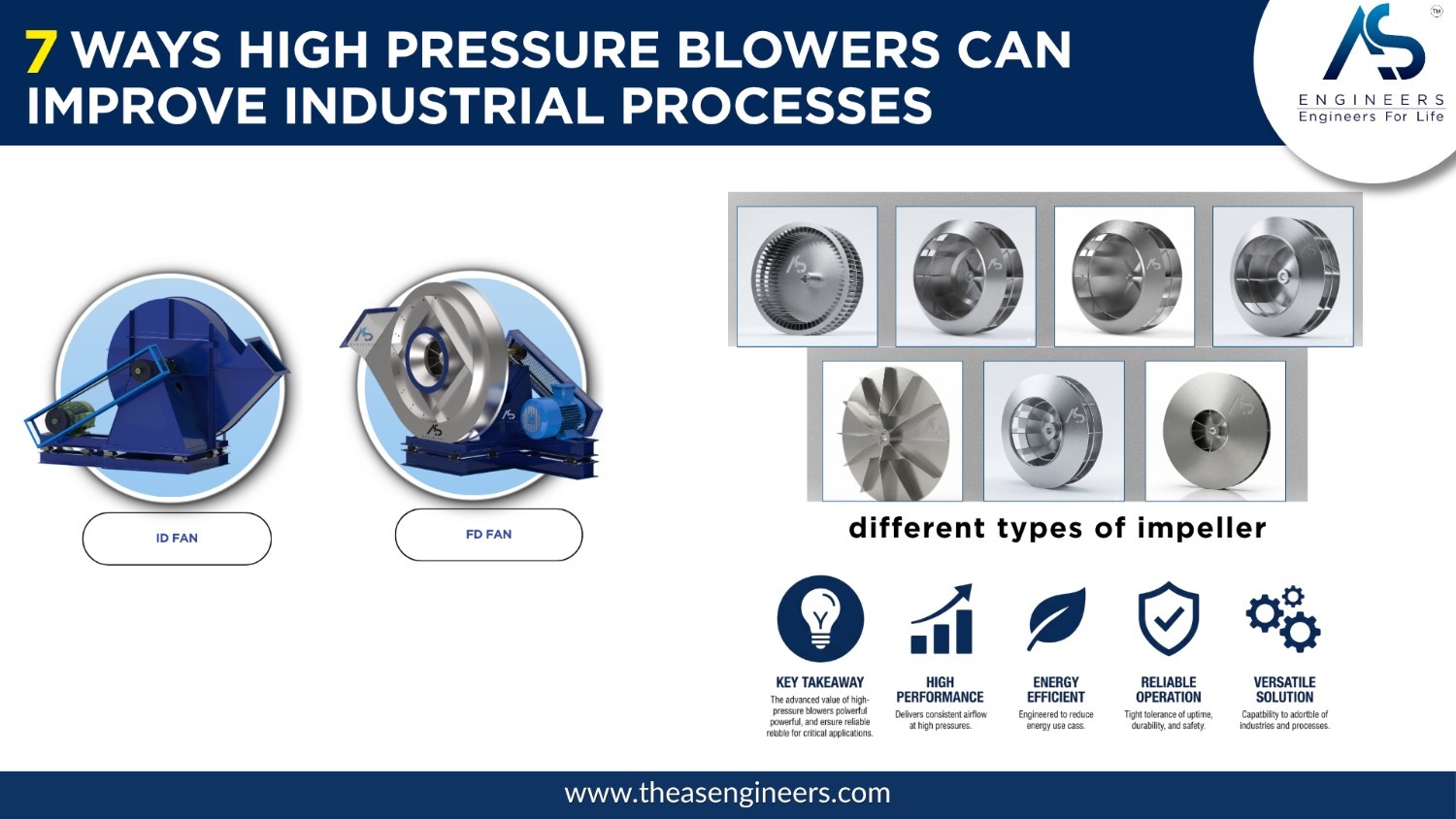
High pressure blowers improve industrial processes by delivering controlled air or gas movement against system resistance. They support combustion, drying, cooling, dust collection, fume extraction, pneumatic conveying, pollution control, and process ventilation when airflow, pressure, temperature, dust load, and material conditions are correctly matched.
A high pressure blower is not just an air-moving machine. In many plants, it becomes the difference between stable production and continuous process variation. The same blower can improve output quality in a dryer, control fumes in a chemical plant, support combustion in a furnace, or maintain suction in a bag filter system.
The buyer mistake is assuming that “more airflow” automatically means better performance. In real plant conditions, the right question is different: what airflow is required at the actual operating pressure, temperature, density, dust load, duct resistance, and duty cycle?
AS Engineers designs industrial centrifugal blowers with airflow capacity from 300 CFM to 200,000+ CFM, pressure up to 1700 mmWG, fan speeds from 300 RPM to 4500 RPM, and motor power from 0.5 HP to 500 HP, depending on application needs.
For a deeper technical base, refer to understanding the science of high pressure blower design before finalizing blower size or impeller type.
1st Way: Better Airflow and Pressure Stability
Answer capsule: High pressure blowers improve process stability by maintaining the required airflow against ducting, filters, dampers, cyclones, scrubbers, heaters, and other system resistance. Stable pressure prevents underperformance in connected equipment.
In industrial plants, air does not move through a clean open path. It passes through bends, long ducts, dampers, filters, nozzles, heat exchangers, scrubbers, cyclones, and process equipment. Every component adds resistance. If the blower cannot overcome this resistance at the required flow, the process suffers.
This matters in applications such as:
| Process Area | Blower Role | Risk If Airflow Is Unstable |
|---|---|---|
| Bag filter systems | Maintains suction across filter media | Dust escape, poor filtration, high differential pressure |
| Furnace systems | Supplies combustion or circulation air | Temperature variation, incomplete combustion |
| Drying systems | Moves hot air or exhaust air | Uneven moisture removal |
| Scrubbers | Maintains gas flow through pollution control stages | Poor gas-liquid contact |
| Pneumatic conveying | Moves material through pipelines | Choking, product breakage, inconsistent transfer |
A correctly selected industrial centrifugal blower should be chosen around the real duty point, not only the nameplate capacity. The plant team should verify static pressure, total pressure, temperature, inlet density, altitude, and duct layout before approving the final model.
For selection logic, also see 8 key factors to consider when choosing a high pressure blower.
2nd Way: Lower Energy Waste When the Blower Is Selected Around the Duty Point
Answer capsule: High pressure blowers can reduce energy waste when the blower, impeller, motor, drive, and control method are selected for the actual duty point instead of oversizing the equipment for safety.
Energy saving does not come only from buying an “efficient blower.” It comes from matching the blower curve to the system curve. If the blower is oversized, the plant may waste energy through throttling, damper losses, excess pressure, or operation away from the best efficiency region.
For global buyers, duty-point-based efficiency is becoming more important. AMCA Standard 208 defines Fan Energy Index as an energy efficiency metric for fans inclusive of motors and drives, providing a basis to compare fan energy performance at a given fan duty point. AMCA also explains that FEI changes with airflow and pressure, which is why the specific operating point matters during fan selection.
In practical terms, plant engineers should check:
- Required CFM or CMH at operating temperature
- Static pressure and total pressure requirement
- Motor margin without unnecessary oversizing
- VFD requirement for variable load conditions
- Impeller type and efficiency at the expected operating point
- System losses caused by poor ducting or sharp bends
A backward curved blower can be suitable where efficiency and stable airflow are important, while a radial blade design may be better where dust or abrasive particles are present.
For more operational guidance, read 10 tips for maximizing efficiency with high pressure blowers.
3rd Way: Cleaner Air, Better Dust Capture, and Safer Work Areas
Answer capsule: High pressure blowers improve air quality by moving dust, fumes, hot gases, smoke, vapors, and contaminated air toward collection or treatment equipment such as bag filters, scrubbers, cyclones, chimneys, or exhaust ducts.
In many factories, air quality problems are not caused by one machine. They come from small leakages, poor suction points, blocked filters, undersized ducting, or an exhaust fan that cannot handle the system resistance. When this happens, dust stays around transfer points, fumes move toward operators, and heat accumulates near equipment.
High pressure blowers support cleaner operation in:
- Cement and mineral handling
- Chemical processing
- Food processing
- Shot blasting plants
- Furnaces and hot air generators
- Bag filter and cyclone systems
- Scrubber and air pollution control systems
- ETP, STP, and wastewater treatment plants
AS Engineers’ blower application matrix includes steel and metals, automobile, power plants, fertilizer and chemical, refinery and petrochemicals, cement, and food processing applications.
The hidden question buyers should ask is: where exactly must suction be created? A blower may be correctly sized on paper but still fail if the hood design, duct velocity, filter loading, or inlet losses are ignored.
For pollution control applications, connect this topic with high pressure blowers in the air pollution control industry and AS Engineers’ pollution control equipment.
4th Way: Better Temperature, Drying, Cooling, and Combustion Control
Answer capsule: High pressure blowers improve process control by supplying, circulating, or exhausting air at the right rate during heating, drying, cooling, combustion, and ventilation cycles.
In thermal processes, the blower does not only move air. It influences temperature distribution, residence time, evaporation rate, combustion support, and exhaust removal. A weak blower can create dead zones. An oversized blower can remove heat too quickly or disturb the process.
Important examples include:
| Application | How the Blower Helps | What to Verify |
|---|---|---|
| Hot air generator | Moves heated air to the process | Temperature, duct resistance, insulation loss |
| Furnace | Supports combustion or circulation | Air-fuel ratio, heat zone, motor temperature |
| Spray dryer | Moves drying air and exhaust air | Inlet/outlet temperature and powder carryover |
| Food processing oven | Maintains hot or cold air circulation | Hygiene, airflow balance, humidity |
| Boiler system | Supports FD, ID, or exhaust duty | Draft requirement and gas temperature |
For furnace-ready high-temperature applications, a standard blower is not always enough. Bearings, shaft, impeller, insulation, motor position, sealing, and material selection must match the heat condition. This is where a high temperature plug blower may be relevant.
For connected topics, review high pressure blowers in the hot air generator industry and high pressure blowers in the furnace industry.
5th Way: Faster Material Movement and More Reliable Conveying
Answer capsule: High pressure blowers improve material movement by creating the air velocity and pressure needed for pneumatic conveying, transfer lines, suction systems, and process feeding where mechanical conveying is difficult or space-limited.
In many plants, material movement becomes the bottleneck. Powders, granules, fines, dust, and lightweight materials may need to move across floors, between process stages, or into collection systems. A blower can help, but only when material behavior is understood.
The wrong design can create three common problems:
- Pipeline choking because velocity is too low
- Product degradation because velocity is too high
- Excess wear because abrasive dust is handled with the wrong impeller or material of construction
For conveying and suction applications, a high pressure radial blade blower is often considered when the process needs higher pressure and tougher duty handling. But the final choice should depend on dust load, particle size, abrasiveness, temperature, moisture, and layout.
AS Engineers also considers application, density, temperature, dust load, humidity, site location, altitude, MOC, impeller blade design, and motor mounting arrangement during blower selection.
For a wider list of use cases, see 13 applications for high pressure blowers in industrial settings.
6th Way: Reduced Downtime Through Application-Specific Design and Maintenance
Answer capsule: High pressure blowers reduce downtime when they are designed for the actual plant condition and maintained through alignment checks, balancing, bearing inspection, vibration monitoring, cleaning, and performance testing.
A blower usually does not fail suddenly without warning. It gives signals: rising vibration, unusual sound, motor overload, reduced suction, high bearing temperature, dust buildup, impeller imbalance, belt slippage, or unstable pressure.
The maintenance mistake is replacing parts without finding the operating cause. If dust is accumulating on the impeller, the problem may be process carryover or filtration. If the motor is overloaded, the reason may be wrong damper position, changed duct resistance, temperature variation, or operation away from the expected curve.
AS Engineers provides blower services including performance analysis, engineering surveys, retrofitment, repair, material identification, on-site alignment, on-site balancing, customized engineering, AMC, expedited shipping, and site-based design. For service support, refer to AS Engineers’ centrifugal blower services.
A practical downtime checklist includes:
- Check vibration trend, not only one reading
- Inspect impeller deposits or erosion
- Verify belt tension and pulley alignment
- Confirm bearing lubrication condition
- Check motor current against expected load
- Measure suction and discharge pressure
- Compare actual airflow with process requirement
- Inspect duct leakage and filter choking
Related maintenance guides include 7 tips for maintaining your high pressure blower and troubleshooting common issues with high pressure blowers.
7th Way: Better Safety and Compliance Support
Answer capsule: High pressure blowers support safety by moving hazardous fumes, hot gases, dust, smoke, and contaminated air away from operators and toward controlled treatment or discharge points.
Safety improvement depends on system design. A blower alone cannot make a process safe if the hood, duct, filter, scrubber, chimney, isolation damper, motor protection, and maintenance practice are weak.
The U.S. Department of Energy defines a fan or blower as a rotary bladed machine that converts electrical or mechanical power to air power and includes key components such as impeller, shaft, bearings, driver, housing, and sometimes transmission, motor controller, or motor. That definition is useful because safety checks must cover the complete rotating system, not only the casing.
In industrial process plants, safety-oriented blower selection should consider:
| Safety Risk | Blower Design Concern | Buyer Check |
|---|---|---|
| Hot gas handling | Temperature-rated design | Bearing, shaft, motor position, insulation |
| Dust exposure | Correct suction and filtration | Hood design, filter loading, duct velocity |
| Corrosive fumes | MOC and coating selection | Gas composition and humidity |
| Abrasive particles | Impeller and casing wear | Dust load and particle hardness |
| Explosion-sensitive zones | Electrical and process safety review | Site-specific compliance review |
For hazardous, high-temperature, corrosive, or dust-heavy processes, do not select only from catalogue capacity. Get the site condition reviewed before purchase.
Which Blower Design Fits Which Process Improvement Goal?
Answer capsule: The best blower design depends on whether the process needs energy efficiency, high pressure, dust handling, high-temperature service, ventilation, or exhaust duty. The improvement goal should drive the impeller and construction choice.
| Process Improvement Goal | Suitable Blower Direction | Why It Helps |
|---|---|---|
| Reduce energy waste | Backward curved or backward inclined blower | Better fit where clean-air efficiency matters |
| Handle high pressure | High pressure radial blade blower | Suitable for demanding pressure duty |
| Exhaust light dust | Exhauster radial blower | Useful for fresh air and light dust applications |
| Handle hot air or furnace duty | High temperature plug blower | Designed around thermal operating conditions |
| Improve ventilation | Axial fan or suitable centrifugal fan | Depends on pressure resistance and airflow volume |
| Support pollution control | ID fan, scrubber fan, bag filter fan | Maintains gas movement through treatment stages |
The right choice is rarely based on motor HP first. Motor HP is the result of the airflow, pressure, efficiency, temperature, density, and drive arrangement. Start with the duty point and process risk, then select the machine.
For mechanical background, read a technical overview of the mechanics of high pressure blowers.
When Should You Not Choose a High Pressure Blower?
Answer capsule: Do not choose a high pressure blower when the application only needs low-pressure general ventilation, when compressed air is required, when system resistance is not calculated, or when the gas stream needs special safety review before equipment selection.
High pressure blowers are valuable, but they are not the answer for every air movement problem.
Avoid or re-check the selection when:
- The application only needs open-area ventilation with very low resistance
- The process requires compressed air rather than blower air
- The gas contains explosive, toxic, or highly corrosive compounds without safety review
- The duct layout is unknown
- Filter loading or scrubber pressure drop is not calculated
- The buyer cannot provide temperature, density, dust load, and humidity details
- The plant expects one blower to serve multiple changing processes without controls
This honest boundary protects the buyer. A wrongly selected blower can consume more energy, increase noise, reduce process quality, damage filters, overload the motor, or fail early due to heat, dust, or corrosion.
RFQ Checklist Before Buying a High Pressure Blower
Answer capsule: A serious RFQ should include airflow, pressure, temperature, gas composition, dust load, humidity, altitude, process duty, operating hours, MOC preference, motor requirements, drive type, and site layout.
Before requesting a quotation, share these details:
| RFQ Detail | Why It Matters |
|---|---|
| Required airflow | Defines process capacity |
| Static and total pressure | Determines system resistance |
| Inlet temperature | Affects density, material, bearing, and motor decisions |
| Gas composition | Important for corrosion and safety |
| Dust load and particle type | Affects impeller and casing selection |
| Humidity or moisture | Affects corrosion and buildup risk |
| Altitude and site location | Affects air density and blower performance |
| Duty cycle | Continuous and batch processes need different margins |
| Duct layout | Bends, length, dampers, and filters create pressure loss |
| Control method | Damper, VFD, or process control logic affects efficiency |
| Existing blower issue | Helps diagnose retrofit or replacement needs |
For plant-level selection, connect this checklist with how to choose the right high pressure blower for your needs and the role of high pressure blowers in industrial processes.
FAQs
1. How do high pressure blowers improve industrial processes?
High pressure blowers improve industrial processes by providing controlled airflow and pressure for drying, cooling, combustion, dust collection, fume extraction, ventilation, conveying, and pollution control. The improvement depends on correct selection around the real duty point, not only on airflow capacity.
2. Are high pressure blowers energy efficient?
They can be energy efficient when selected correctly. Efficiency depends on blower type, impeller design, motor efficiency, drive arrangement, duct resistance, control method, and operating point. An oversized blower with damper throttling can waste energy even if the blower itself is efficient.
3. Which industries use high pressure blowers?
High pressure blowers are used in steel, cement, chemical, power, food processing, automobile, textile, wastewater treatment, furnace, boiler, spray dryer, hot air generator, bag filter, scrubber, and air pollution control applications.
4. What information is needed to select the right high pressure blower?
The key information includes airflow, pressure, temperature, gas type, dust load, humidity, altitude, duty cycle, duct layout, material of construction, impeller type, motor mounting arrangement, and process purpose. Missing these details increases the risk of wrong selection.
5. Can one blower improve productivity, safety, and energy use together?
Yes, but only if the blower is correctly matched to the process. A well-selected blower can stabilize airflow, improve suction, reduce energy waste, support cleaner air, and reduce unplanned downtime. A poorly selected blower can create the opposite result.
A high pressure blower improves industrial performance only when the selection starts from site conditions, not from catalogue capacity alone. If your plant is facing unstable suction, poor dust capture, high energy use, uneven drying, overheating, motor overload, or repeated blower maintenance, the next step is to review the actual duty point and process layout.
For application-specific blower selection, retrofitment, balancing, repair, or new equipment planning, connect with the AS Engineers contact team and share your airflow, pressure, temperature, dust load, and process details.

Karan Dargode is Head of Operations at AS Engineers, where he supports manufacturing, assembly, commissioning, and operational execution for industrial equipment including paddle dryers, sludge dryers, centrifugal blowers, industrial fans, and pollution control systems. His role connects shop-floor manufacturing discipline with practical site commissioning, EHS compliance, and process reliability for industrial clients.