
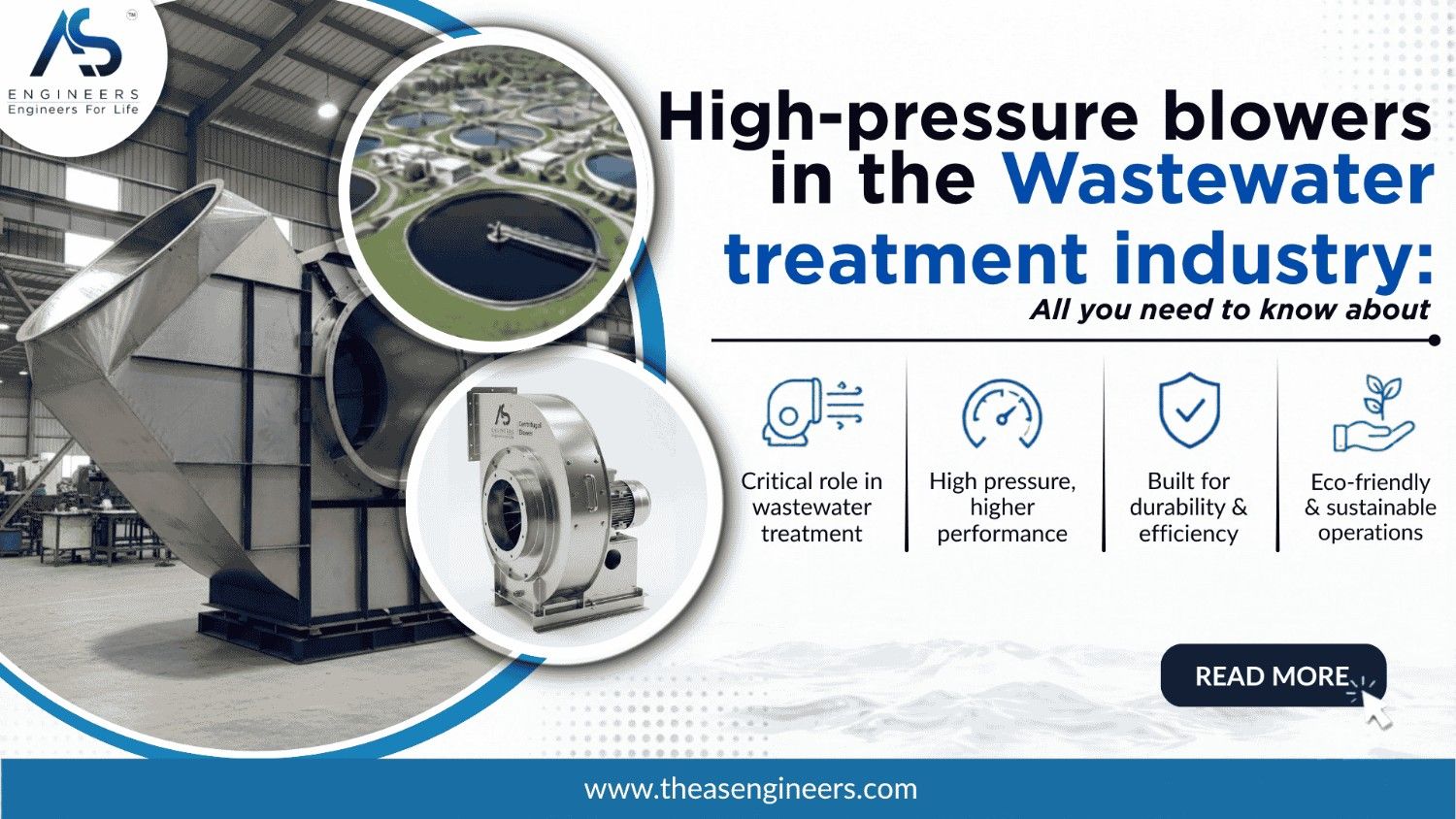
High pressure blowers in wastewater treatment supply the controlled airflow required for aeration, biological treatment, mixing, odour control, sludge handling support, and pollution-control equipment. In an ETP, STP or CETP plant, the blower is not an accessory. It directly affects dissolved oxygen stability, biological treatment efficiency, power cost, diffuser performance, and long-term plant reliability.
The most expensive mistake is not always selecting a smaller blower. It is selecting a blower without confirming actual air demand, tank depth, diffuser back-pressure, wastewater load variation, humidity, and site operating conditions.
For wastewater plants, aeration is one of the most energy-sensitive stages. The U.S. EPA notes that pumping and aeration are energy-intensive processes that should be prioritised when improving water and wastewater facility efficiency. That is why blower selection must be treated as an engineering decision, not only as a motor HP or quotation comparison.
AS Engineers manufactures industrial centrifugal blowers for demanding air movement duties, with verified blower ranges covering 300 CFM to 200,000+ CFM airflow, pressure up to 1700 mmWG, 300 RPM to 4500 RPM fan speed, and 0.5 HP to 500 HP motor power. For wastewater projects, the final selection depends on aeration duty, tank configuration, diffuser type, air quality, corrosion exposure, operating hours, and site constraints.
For deeper technical background, see understanding the science of high pressure blower design.
How does a blower support biological wastewater treatment?
A blower supports biological wastewater treatment by supplying air to the aeration tank so aerobic microorganisms can break down organic load. The air must reach the diffuser system at the required flow and pressure, otherwise dissolved oxygen drops and treatment performance becomes unstable.
In an activated sludge process, the blower pushes air through headers, pipelines, valves and diffusers. The diffuser releases air bubbles into the wastewater. Oxygen transfers from those bubbles into the mixed liquor, supporting bacteria that consume BOD and COD.
The hidden buyer question is this: can the blower maintain stable air delivery when the plant is not operating at design load?
Wastewater plants rarely run at one perfect operating point. Industrial ETP load changes with production shifts, cleaning cycles, chemical discharge, batch dumping and seasonal water usage. Municipal STP load changes between morning, afternoon and night peaks. CETP systems face even more variation because multiple industries discharge into a common treatment system.
A reliable blower selection must therefore consider:
| Blower selection parameter | Why it matters in wastewater treatment |
|---|---|
| Airflow requirement | Determines whether enough oxygen reaches the biological process |
| Static pressure | Depends on tank depth, diffuser pressure drop, pipeline loss and valve loss |
| Diffuser type | Fine-bubble diffusers usually need stable pressure and clean air |
| Wastewater load variation | Affects oxygen demand and blower turndown requirement |
| Humidity and ambient condition | Influences air density, motor load and condensation risk |
| Dust or chemical exposure | Influences impeller design, casing material and maintenance plan |
| Operating hours | Continuous-duty aeration needs stronger efficiency and reliability logic |
| Redundancy requirement | Critical plants may need standby blower capacity |
A plant should not finalise the blower until tank depth, diffuser layout, pipeline route and peak oxygen demand are known. For broader selection logic, refer to 8 key factors to consider when choosing a high-pressure blower.
Where are high pressure blowers used in ETP, STP and CETP plants?
High pressure blowers are used in aeration tanks, equalisation tanks, MBBR systems, SBR systems, sludge handling areas, odour-control systems, scrubbers, bag filters, and other air movement duties inside wastewater treatment facilities. Each duty has a different pressure, airflow and contamination profile.
In wastewater treatment, one blower type does not fit every duty.
For clean-air diffused aeration, a centrifugal blower is often evaluated for medium and large systems where continuous airflow and energy efficiency matter. For deep tanks, fine-bubble diffuser systems, or higher back-pressure conditions, the blower must be checked against the actual system resistance instead of only the tank volume.
Common wastewater applications include:
| Wastewater application | Blower role | Selection warning |
|---|---|---|
| Aeration tank | Supplies oxygen for biological treatment | Do not size only by tank capacity. Check BOD/COD load and diffuser pressure |
| Equalisation tank | Provides mixing and prevents settling | Airflow may be driven by mixing demand, not oxygen demand |
| MBBR / biofilm reactor | Supplies air and keeps media moving | Air distribution must prevent dead zones |
| SBR system | Supports timed aeration cycles | Controls and turndown are important |
| Sludge holding tank | Prevents septic conditions and odour | Air demand depends on retention time and sludge characteristics |
| Odour control scrubber | Moves contaminated air through scrubber system | Material compatibility and corrosion risk matter |
| Bag filter / dust system near sludge drying | Supports pollution-control airflow | Dust load changes impeller and maintenance requirements |
For connected pollution-control duties, read high pressure blowers in the air pollution control industry and high pressure blowers in the bag filter industry.
Which blower type is suitable for wastewater aeration?
The suitable blower type depends on airflow, pressure, air cleanliness, tank depth, diffuser system, site conditions and energy target. In many wastewater projects, backward curved, backward inclined or high pressure radial blade centrifugal blowers are considered depending on the duty.
A backward curved blower is generally preferred where the air stream is clean and the project needs efficient continuous air delivery. This is useful for large clean-air aeration systems where energy cost becomes a long-term operating concern.
A backward inclined blower can be suitable where the duty needs a practical balance between airflow, efficiency and tolerance to minor moisture or particulate exposure.
A high pressure radial blade blower is considered where higher static pressure, ruggedness or more difficult operating conditions are present.
The decision should not be made from brochure names alone. In wastewater treatment, a blower curve must be checked against the system curve. If the operating point is too far from the efficient zone, the plant may face high power draw, unstable air delivery, vibration, noise or shortened bearing life.
What information is required before selecting a wastewater treatment blower?
Before selecting a wastewater treatment blower, provide tank depth, airflow requirement, diffuser type, pipeline layout, operating pressure, wastewater load, ambient temperature, humidity, altitude, duty cycle and redundancy requirement. Without these inputs, blower sizing becomes a risky estimate.
A serious RFQ should include:
| RFQ input | What to provide |
|---|---|
| Plant type | ETP, STP, CETP, MBBR, SBR, ASP, lagoon, sludge handling or odour control |
| Flow capacity | KLD, MLD or process flow rate |
| Organic load | BOD, COD and peak load condition if available |
| Tank details | Length, width, water depth and number of tanks |
| Diffuser details | Fine bubble, coarse bubble, diffuser quantity and submergence |
| Airflow required | Total air demand and air demand per tank |
| Pressure estimate | Tank water depth, diffuser loss, pipeline loss and valve loss |
| Site condition | Ambient temperature, altitude, humidity and dust exposure |
| Operation mode | Continuous, batch, cyclic, duty/standby or VFD-controlled |
| Existing blower data | Motor HP, RPM, airflow, pressure, vibration history and failure pattern |
For an existing plant, do not replace the blower only by matching old motor HP. Many older systems run with hidden losses from clogged diffusers, undersized pipelines, valve throttling or air leakage. First measure the actual pressure at the blower discharge and compare it with pressure at the tank header.
This is where an engineering survey can save money. AS Engineers offers blower-related services such as performance analysis, engineering surveys, retrofitment, repair, on-site alignment, on-site balancing, material identification, customized engineering, AMC, expedited shipping and site-based design. For service requirements, visit centrifugal blower services.
For general buying guidance, see how to choose the right high-pressure blower for your needs.
Why pressure calculation is critical in aeration blower sizing
Pressure calculation is critical because the blower must overcome water depth, diffuser pressure drop, piping friction, valve losses and header losses before air can enter the wastewater. If pressure is underestimated, airflow will fall below requirement even when the motor appears to be running normally.
A common mistake is assuming that airflow alone defines aeration performance. In reality, the blower must deliver airflow at the required static pressure. A plant with deep tanks and fine-bubble diffusers may need a different blower than a shallow tank with coarse-bubble diffusers, even if both have similar wastewater flow.
Key pressure contributors include:
| Pressure component | Practical impact |
|---|---|
| Water depth | Deeper submergence increases discharge pressure requirement |
| Diffuser loss | Fine-bubble diffusers can add meaningful resistance |
| Pipe length and bends | Long headers, bends and undersized lines create friction losses |
| Valves and non-return valves | Poorly selected valves increase pressure drop |
| Diffuser fouling | Fouled diffusers raise back-pressure over time |
| Air leakage | Reduces oxygen transfer and forces operators to overrun the blower |
The practical warning is simple: design pressure should include clean-condition and dirty-condition thinking. A blower that works during commissioning may struggle after diffuser fouling, scaling or sludge-side changes.
How can blowers reduce energy cost in wastewater treatment?
Blowers can reduce wastewater treatment energy cost when they are correctly sized, operated near the efficient zone, controlled with appropriate turndown, maintained properly, and matched with the right diffuser and pipeline system. Energy saving is not only a blower-efficiency issue. It is a full aeration-system issue.
The EPA states that water and wastewater utilities can save 15% to 30% through energy-efficiency practices. Another EPA wastewater infrastructure example notes that aeration fans can use as much as 50% of total energy use in some facilities. These numbers explain why aeration blower decisions should be evaluated on lifecycle cost, not only initial purchase cost.
Energy can be wasted when:
- The blower is oversized and controlled by valve throttling.
- Diffusers are clogged and increase back-pressure.
- Air headers leak.
- The plant maintains excess dissolved oxygen.
- The blower runs continuously at peak design capacity.
- The impeller is worn, dirty or out of balance.
- The motor and drive arrangement are not aligned with actual duty.
For continuous-duty wastewater aeration, even a small efficiency difference can become expensive over years of operation. The correct question is not “Which blower has the lowest price?” The better question is “Which blower delivers the required air at the required pressure with stable energy use under real plant variation?”
What maintenance problems affect wastewater blowers?
Wastewater blowers commonly face bearing wear, belt issues, vibration, impeller fouling, misalignment, high discharge temperature, diffuser back-pressure, air leakage, corrosion exposure and noise complaints. Many of these problems begin outside the blower but appear as blower failure.
A maintenance team should track:
| Symptom | Likely area to inspect |
|---|---|
| Rising discharge pressure | Diffuser clogging, valve restriction, pipeline blockage |
| Falling airflow | Belt slip, air leakage, impeller fouling, incorrect speed |
| Higher vibration | Impeller imbalance, bearing wear, foundation issue, misalignment |
| High motor current | Excess pressure, poor lubrication, mechanical drag, wrong operating point |
| Noise increase | Bearing issue, surge, loose mounting, duct resonance |
| Frequent trips | Electrical overload, VFD settings, motor heating, high process resistance |
A buyer mistake is treating the blower as an isolated machine. In wastewater plants, blower health depends on the diffuser grid, air header, valves, control logic and maintenance discipline.
Recommended checks include:
- Record discharge pressure and motor current daily.
- Inspect belts, bearings, coupling and lubrication schedule.
- Check air filter cleanliness.
- Monitor vibration trend, not only one-time vibration value.
- Inspect diffuser back-pressure periodically.
- Check for air leakage in headers and joints.
- Confirm that standby blowers are actually exercised.
For deeper support content, read 7 tips for maintaining your high pressure blower, the importance of testing your high-pressure blower for quality and performance, and troubleshooting common issues with high-pressure blowers.
When should you not choose a standard wastewater blower?
You should not choose a standard wastewater blower when the application has high corrosion risk, abrasive dust, chemical vapour exposure, deep-tank pressure, high humidity, hazardous gas risk, frequent load swings, or strict redundancy needs. In these conditions, blower design must be customized to the process.
For example, a municipal STP clean-air aeration duty may allow a more efficiency-focused blower. An industrial ETP near chemical handling may need stronger attention to MOC, coating, inlet filtration, sealing, motor location and corrosion protection. A CETP may need more robust design because load variation is high and operators may not control the incoming wastewater quality from every member unit.
Do not finalise a blower until these questions are answered:
- Will the blower handle clean ambient air only, or contaminated air?
- Is there any possibility of chemical vapour near the blower inlet?
- Is the tank deep enough to push the pressure requirement beyond standard selection?
- Will the plant operate 24/7?
- Is standby capacity required?
- Is VFD control needed?
- What happens if one blower fails during peak load?
- Is the plant in a high-humidity, coastal, dusty or high-temperature area?
The safest selection is the one that matches actual site conditions, not the one that looks good in a standard comparison table.
Practical buyer decision table for ETP, STP and CETP projects
Use this table before requesting a final quotation. It helps separate basic aeration needs from more demanding wastewater blower applications.
| Buyer situation | Recommended direction | Reason |
|---|---|---|
| Large clean-air STP aeration system | Evaluate backward curved centrifugal blower | Efficiency matters in continuous operation |
| Industrial ETP with variable load | Check backward inclined or radial blade options | Load variation and site conditions may need robust design |
| Deep tank with fine-bubble diffusers | Prioritise pressure calculation | Water depth and diffuser loss can dominate selection |
| Existing plant with high electricity bill | Audit blower curve, DO control and diffuser pressure | Energy waste may come from system mismatch |
| Frequent blower vibration | Check balancing, alignment, foundation and operating point | Vibration is often a symptom, not the root cause |
| Odour-control or scrubber duty | Confirm air chemistry and MOC | Corrosion and contamination risk affect durability |
| CETP with mixed industrial discharge | Add redundancy and operating flexibility | Load variation and compliance risk are higher |
| Sludge drying or dust-control area | Link blower selection with bag filter, cyclone or scrubber duty | Dust and vapour load change equipment requirements |
AS Engineers, based in GIDC Vatva, Ahmedabad, manufactures industrial blowers and supports buyers with performance analysis, engineering surveys, retrofitment, repair, on-site balancing, on-site alignment, AMC and customized engineering. The company has 25+ years of experience, ISO 9001:2015 TUV India certification, CE certification, 500+ clients and 1500+ projects.
For wastewater treatment buyers, that matters because blower performance is not a catalogue decision. It needs site-level thinking.
FAQs
1. What is the role of a high pressure blower in wastewater treatment?
A high pressure blower supplies air to aeration tanks, diffusers, equalisation tanks, odour-control systems and other wastewater treatment equipment. In biological treatment, the blower helps maintain oxygen supply for microorganisms that break down organic matter. Correct airflow and pressure are essential for stable treatment performance.
2. Which blower is best for STP and ETP aeration?
The best blower depends on tank depth, airflow requirement, diffuser type, pressure loss, operating hours and site condition. Backward curved centrifugal blowers are often suitable for clean-air continuous aeration. Backward inclined or high pressure radial blade blowers may be selected where pressure, humidity, load variation or robustness requirements are higher.
3. How do I calculate blower capacity for an aeration tank?
Blower capacity should be calculated from oxygen demand, wastewater flow, BOD/COD load, diffuser oxygen transfer efficiency, tank depth, pipeline loss and diffuser pressure drop. Do not size the blower only from tank volume or motor HP. For accurate sizing, provide process and site data to the blower manufacturer or engineering consultant.
4. Why does my wastewater blower consume too much power?
High power consumption can result from oversized blowers, valve throttling, clogged diffusers, air leaks, high back-pressure, incorrect operating point, poor maintenance, worn bearings, belt slip or inefficient control. A blower energy audit should check the blower, piping, diffuser grid and dissolved oxygen control together.
5. How often should wastewater treatment blowers be maintained?
Maintenance frequency depends on operating hours, dust level, humidity, temperature and duty severity. Continuous-duty ETP, STP and CETP blowers should be inspected regularly for pressure, vibration, motor current, bearing condition, belt condition, lubrication, air filter cleanliness and leakage. Vibration trend monitoring is especially useful for preventing sudden failure.
If you are selecting a blower for an ETP, STP, CETP, aeration tank, scrubber, sludge handling area or wastewater retrofit project, share your airflow requirement, tank depth, diffuser details, operating pressure, site condition and existing blower data with AS Engineers.
For technical support, blower sizing, retrofitment, repair, on-site balancing or engineered selection, contact AS Engineers with your wastewater treatment application details.

Karan Dargode is Head of Operations at AS Engineers, where he supports manufacturing, assembly, commissioning, and operational execution for industrial equipment including paddle dryers, sludge dryers, centrifugal blowers, industrial fans, and pollution control systems. His role connects shop-floor manufacturing discipline with practical site commissioning, EHS compliance, and process reliability for industrial clients.