
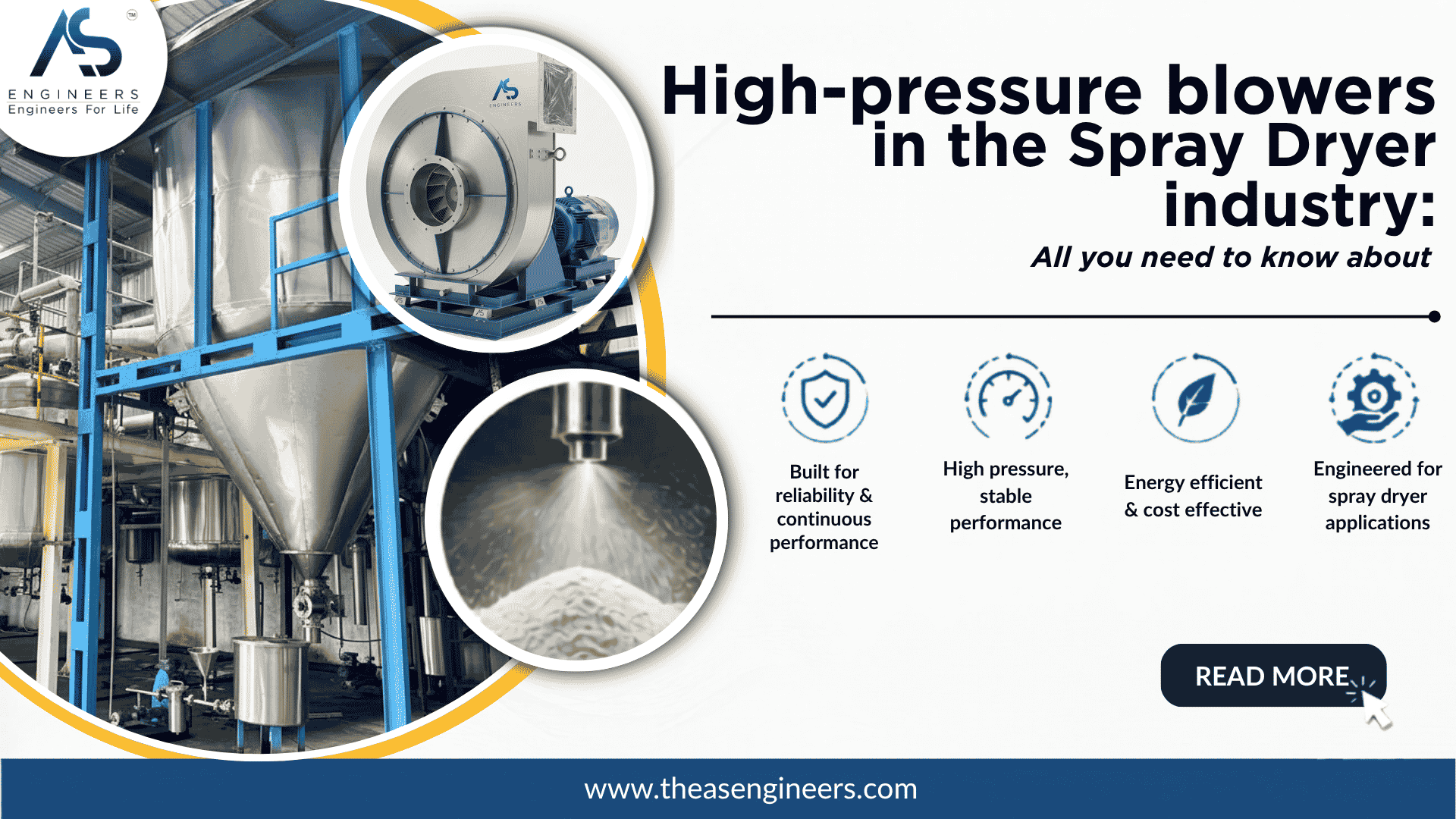
High pressure blowers in the spray dryer industry are not only air-moving accessories. They help maintain the airflow, static pressure, drying air movement, exhaust handling, and powder recovery conditions that decide whether a spray dryer produces stable powder or creates wall deposits, moisture variation, dust carryover, and downtime.
A spray dryer converts liquid feed, slurry, suspension, or emulsion into powder by atomizing the feed into droplets and contacting those droplets with hot air. After evaporation, the dry powder must be separated from the exhaust air through equipment such as a cyclone separator, bag filter, or scrubber system. The blower system supports this air path from inlet to exhaust.
The common buyer mistake is to ask for “one blower for spray dryer” without defining where the blower will work. A blower before the hot air generator has a different duty from an induced draft fan after the cyclone or bag filter. The first handles clean or heated air. The second may see moisture, fine powder, sticky particles, corrosive vapour, and changing pressure drop.
For a deeper base on impeller and pressure logic, refer to the science of high pressure blower design.
What Does a Blower Actually Do in a Spray Drying System?
A blower in a spray dryer controls air movement through the drying chamber, heater, ducts, powder separation system, and exhaust path. In many plants, a forced draft blower supplies or pushes drying air, while an induced draft fan pulls moist exhaust air through cyclones, bag filters, scrubbers, and the stack.
The blower is not always responsible for feed atomization. In nozzle spray dryers, atomization may depend on feed pressure or compressed air. In rotary atomizer spray dryers, atomization comes from the atomizer disc. The blower’s main responsibility is to create the correct air-side condition so droplet drying, powder transport, and exhaust separation remain stable.
In practical terms, the blower affects:
- Drying air velocity inside the chamber
- Residence time of droplets and powder
- Negative or positive pressure balance
- Carryover of fine powder into the collector
- Cyclone and bag filter performance
- Exhaust removal after moisture evaporation
- Energy consumption across the full drying line
The hidden question buyers should ask is not “What is the blower capacity?” It is “What total pressure drop must the blower overcome when the dryer, ducts, cyclone, bag filter, dampers, and stack are all operating at process load?”
Where Are High Pressure Blowers Used in Spray Dryer Plants?
A spray dryer may use more than one blower or fan depending on plant design. The selection must match the duty point, gas condition, temperature, dust load, and material behavior.
| Blower Location | Typical Duty | Main Design Concern | Buyer Mistake to Avoid |
|---|---|---|---|
| Fresh air or FD blower | Supplies air toward heater or drying chamber | Air volume, static pressure, efficiency | Selecting by motor HP instead of required airflow and pressure |
| Hot air generator support | Combustion or hot air movement | Temperature, burner stability, duct losses | Ignoring inlet temperature and density changes |
| ID fan after chamber | Pulls moist exhaust air | Moisture, fine powder, negative pressure | Using a clean-air blower for dust-laden exhaust |
| Cyclone / bag filter exhaust | Maintains collection airflow | Pressure drop across separator and filter | Not allowing pressure margin as filter resistance rises |
| Cooling / ventilation fan | Removes heat or supports plant ventilation | Heat load and airflow path | Treating ventilation as process exhaust |
| Pneumatic conveying support | Moves powder where required | Powder characteristics and line resistance | Ignoring abrasion and product degradation risk |
For powder collection and filtration context, see the page on high pressure blowers in the bag filter industry and the AS Engineers page for bag filter manufacturers.
Which Blower Type Fits Spray Dryer Duty?
The right blower type depends on whether the air is clean, hot, dusty, humid, corrosive, or powder-laden. A spray dryer plant can require different centrifugal blower designs at different points in the same system.
A backward curved blower is often a strong starting point for clean air and energy-efficient air supply duties. It is useful where the process needs stable airflow and comparatively clean gas handling.
A high pressure radial blade blower is more suitable when the system has higher static pressure demand or when the airstream may contain fines. Radial blade designs are commonly considered where dust load, powder carryover, and cleaning behavior matter more than peak clean-air efficiency.
A high temperature plug blower may be relevant near hot air systems, furnaces, ovens, or heat-processing duties where temperature and thermal expansion must be considered. For standard spray dryer exhaust, the engineer still needs actual inlet temperature, gas composition, moisture load, and downstream resistance before final selection.
The decision should not be made from a product name. It should come from the duty point, air path, temperature, powder behavior, and pressure drop.
How Should Airflow and Pressure Be Selected?
Airflow and pressure for a spray dryer blower should be selected from the process requirement, not from a standard catalog table. The engineering team needs evaporation load, inlet and outlet temperature targets, chamber design, duct length, separator type, filter pressure drop, site altitude, gas density, and powder characteristics.
AS Engineers’ verified centrifugal blower range covers airflow from 300 CFM to 200,000+ CFM, pressure up to 1700 mmWG, fan speed from 300 RPM to 4500 RPM, and motor power from 0.5 HP to 500 HP. The final selection still depends on application, density, temperature, dust load, humidity, site location, altitude, material of construction, impeller design, and motor mounting arrangement.
The pressure side is where many selection errors begin. A plant may calculate only chamber airflow and forget pressure losses across bends, ducts, dampers, cyclone, bag filter, scrubber, silencer, stack, and future dust loading. When the system resistance increases, the blower may operate away from its design point. That can reduce drying performance, increase power draw, or cause unstable exhaust.
For broader selection logic, use the guide on how to choose the right high pressure blower.
What Operating Conditions Create Spray Dryer Blower Problems?
Spray drying is sensitive because airflow, heat, moisture evaporation, and powder separation happen together. A small change in feed solids, viscosity, droplet size, or outlet moisture can change the load on the air system.
| Operating Condition | Effect on Blower / Fan Selection | Engineering Check |
|---|---|---|
| High inlet temperature | Changes gas density and motor load | Confirm fan inlet temperature, not only chamber temperature |
| Fine powder carryover | Can cause abrasion and imbalance | Select impeller and MOC for dust duty |
| Sticky or hygroscopic powder | Can create deposition in ducts and filters | Review duct velocity, cleaning access, and filter loading |
| Corrosive vapour | Can attack casing, impeller, and shaft seal area | Confirm gas composition and suitable MOC |
| Rising bag filter pressure drop | Reduces airflow if fan margin is weak | Include dirty-filter pressure drop in selection |
| Site altitude | Changes air density and performance | Correct duty point for actual site condition |
| Solvent-bearing exhaust | Adds safety and recovery requirements | Do not treat as normal open-air exhaust |
This is why high pressure blowers in chemical processing and spray dryer blowers often need more detailed engineering than general ventilation fans.
What Mistakes Cause Poor Spray Dryer Blower Performance?
The most common mistake is selecting the blower after the dryer layout is already frozen. The blower should be part of the dryer system design because duct routing, cyclone position, bag filter sizing, damper location, and stack height all affect static pressure.
Avoid these mistakes:
- Selecting only by motor HP instead of airflow and static pressure.
- Ignoring pressure drop across cyclone, bag filter, scrubber, and ducting.
- Using a clean-air impeller where powder fines may enter the exhaust stream.
- Ignoring temperature correction and gas density at the fan inlet.
- Not checking vibration risk from powder build-up on impeller blades.
- Using undersized access doors or duct layouts that make cleaning difficult.
- Assuming higher airflow always improves drying. Excess airflow can reduce residence time, disturb powder separation, and increase energy cost.
- Not planning maintenance for bearings, alignment, balancing, and filter resistance.
For maintenance planning, see expert tips for maintaining high pressure blowers.
How Do Spray Dryer Applications Change Blower Selection?
Spray dryers are used in food, dairy, coffee, flavours, pharmaceuticals, chemicals, dyes, pigments, ceramics, salts, and effluent-related applications. The blower selection changes with each product group because the air is not carrying the same risk.
In food processing, clean air handling, hygiene, temperature stability, and powder recovery are important. A blower serving a milk powder or instant coffee dryer should not be evaluated only on pressure. The air path must protect product quality and reduce contamination risk. For related context, see high pressure blowers in the food processing industry.
In chemical and pigment drying, the airstream may include corrosive vapours, fine particles, or abrasive dust. MOC, impeller design, sealing, inspection access, and downstream pollution control become more important.
In fluidized spray dryer or two-stage drying arrangements, airflow may interact with final drying and powder agglomeration. If your process includes post-drying or fluid bed finishing, compare it with high pressure blowers in the fluid bed dryer industry.
In pollution-control-heavy spray dryer systems, the blower must work with cyclone separators, scrubbers, bag filters, and stack conditions. For that side of the system, review high pressure blowers in air pollution control and AS Engineers’ pollution control equipment.
What Data Should You Share Before Selecting a Spray Dryer Blower?
A serious blower enquiry should include process data. Without this, the supplier can only guess, and guessing in spray drying usually shows up later as moisture variation, high power draw, powder loss, or maintenance issues.
| RFQ Data | Why It Matters |
|---|---|
| Required airflow | Establishes process volume and chamber air movement |
| Static pressure requirement | Confirms resistance across dryer, ducts, collectors, and stack |
| Fan inlet temperature | Changes gas density, shaft load, bearing selection, and MOC |
| Gas composition | Identifies corrosion, solvent, humidity, or contamination risk |
| Dust or powder load | Affects impeller type, erosion risk, and cleaning requirement |
| Product behavior | Sticky, hygroscopic, abrasive, heat-sensitive, or fine powder behavior changes selection |
| Separator type | Cyclone, bag filter, scrubber, or combined system changes pressure drop |
| Site altitude and location | Corrects performance for real air density |
| Preferred drive arrangement | Helps decide belt drive, direct drive, maintenance access, and layout |
| Documentation needs | Important for inspection, quality, export, or regulated industry projects |
For buyer-side preparation, the article on 8 key factors to consider when choosing a high pressure blower is a useful checklist.
When Should You Avoid a Standard Blower?
A standard blower should not be selected when the spray dryer exhaust contains high dust load, sticky powder, corrosive vapour, solvent, high temperature, or abrasive particles. These applications need engineering review before the blower is finalized.
Use extra caution when:
- The feed contains solvent or oxygen-sensitive material.
- The exhaust may require closed-loop operation or recovery.
- Powder fines are combustible or require safety review.
- The system includes scrubbers, condensers, or high-resistance filters.
- The product is sticky at outlet temperature.
- The duty has frequent batch changes.
- The plant already has vibration, bearing failure, or low airflow issues.
For solvent-bearing, combustible, or explosive-risk powder systems, do not treat blower selection as a normal fan enquiry. Safety review, process hazard assessment, and qualified engineering approval are required before final design.
How AS Engineers Supports Spray Dryer Blower Projects
AS Engineers manufactures industrial centrifugal blowers and air movement equipment from its Ahmedabad manufacturing base. The company’s verified credibility stack includes 25+ years of experience, ISO 9001:2015 certification by TUV India, CE certification, 500+ clients, and 1500+ projects.
For spray dryer-related air systems, AS Engineers can support blower selection, performance analysis, engineering surveys, retrofitment, repair, material identification, on-site alignment, on-site balancing, customized engineering, AMC, expedited shipping, and site-based design.
The benefit for a spray dryer buyer is practical: the blower can be evaluated as part of the air path, not as a disconnected rotating machine. That matters when the system includes hot air generation, a drying chamber, cyclone separator, bag filter, scrubber, ducting, and powder handling.
For product-level enquiry, start with AS Engineers’ industrial centrifugal blowers. For spray dryer system context within the group ecosystem, refer to the AS Engineers page on spray dryer manufacturer Acmefil.
FAQs
1. Are High Pressure Blowers Used for Atomization in Spray Dryers?
Sometimes, but not always. In many spray dryers, atomization is handled by a rotary atomizer, pressure nozzle, or two-fluid nozzle. The blower’s main job is usually to control drying air, exhaust air, pressure balance, and powder recovery. Never assume the blower is the atomizing device without checking the dryer design.
2. Is an FD Blower or ID Fan More Important in a Spray Dryer?
Both can be important. The FD blower supports air supply toward the heater or drying chamber. The ID fan pulls moist exhaust air through the cyclone, bag filter, scrubber, and stack. If the ID fan is under-selected, the dryer can face poor exhaust removal, unstable chamber pressure, and powder collection issues.
3. Which Blower Is Better for Spray Dryer Exhaust With Fine Powder?
A radial blade or exhauster-type centrifugal blower is often considered when the exhaust contains fines, dust, or powder carryover. The final choice depends on dust concentration, powder abrasiveness, moisture, temperature, corrosion risk, and system pressure drop.
4. What Information Is Needed to Size a Spray Dryer Blower?
Share airflow, static pressure, fan inlet temperature, gas composition, dust load, humidity, site altitude, duct layout, cyclone or bag filter details, scrubber details, material of construction requirement, and drive preference. If this data is missing, the blower may not perform correctly after installation.
5. Can an Existing Spray Dryer Blower Be Retrofitted?
Yes, in many cases. Retrofitment may be possible if the issue is changed production load, higher pressure drop, impeller wear, vibration, poor balancing, duct modification, or process expansion. A site survey and performance analysis should be done before deciding between repair, retrofitment, or replacement.
A spray dryer blower should be selected from the real process condition, not from a generic airflow number. Share your dryer duty, exhaust path, powder behavior, pressure drop, temperature, and filtration arrangement with AS Engineers’ team, and they can evaluate the right blower type, impeller design, MOC, drive arrangement, and service approach.
For technical discussion, start with AS Engineers’ centrifugal blower enquiry page.

Karan Dargode is Head of Operations at AS Engineers, where he supports manufacturing, assembly, commissioning, and operational execution for industrial equipment including paddle dryers, sludge dryers, centrifugal blowers, industrial fans, and pollution control systems. His role connects shop-floor manufacturing discipline with practical site commissioning, EHS compliance, and process reliability for industrial clients.