
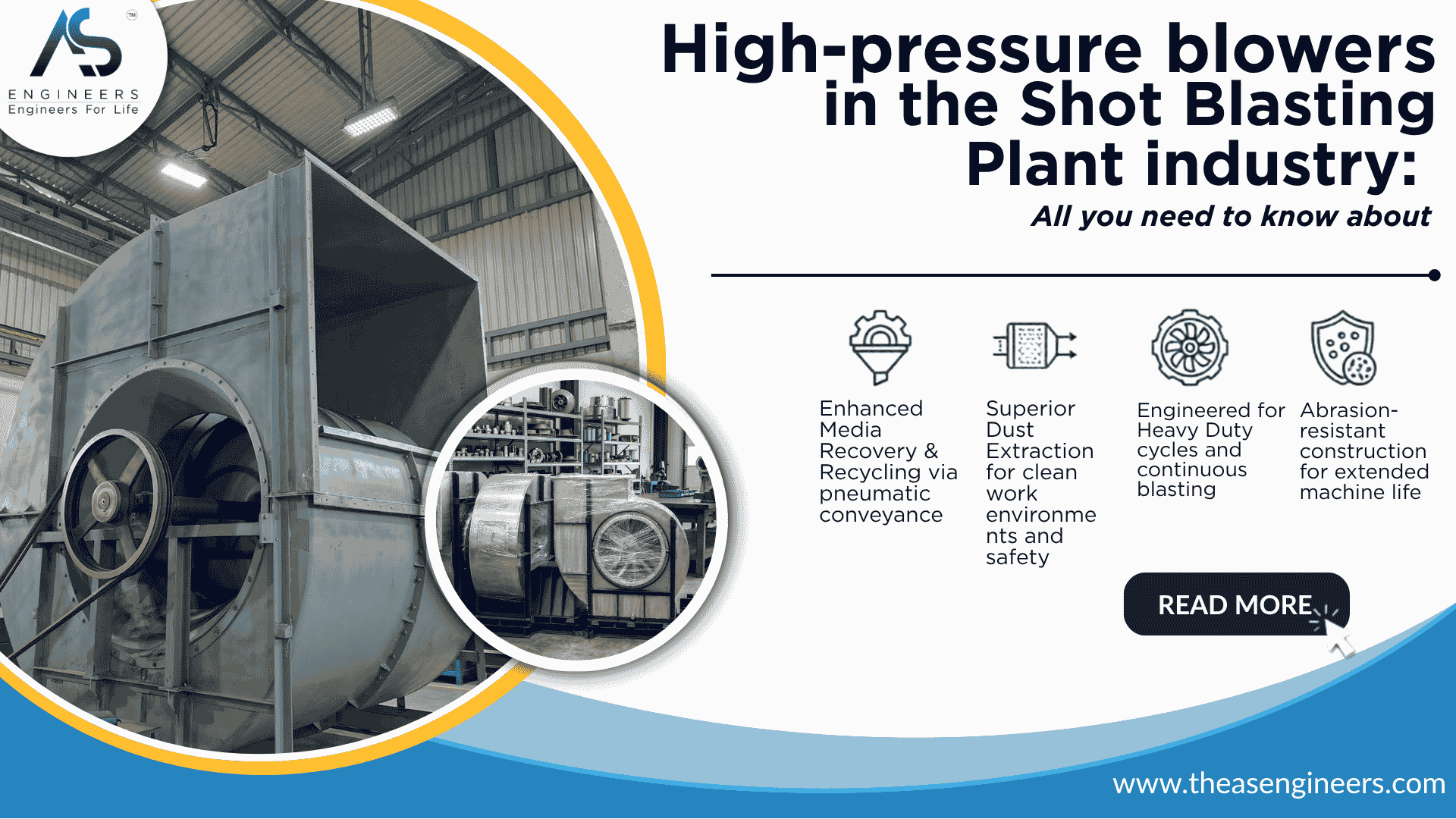
High pressure blowers in shot blasting plants are mainly used for dust extraction, booth or cabinet ventilation, abrasive separator airflow, filter cleaning support, and safe discharge of dust-laden air through dust collectors. In many wheel-blast machines, the blower does not propel the shot directly. It keeps the blasting chamber under controlled suction and helps separate reusable abrasive from dust and fines.
Shot blasting is a high-energy surface preparation process used to remove rust, mill scale, paint, foundry sand, burrs and surface contaminants from castings, forgings, fabricated steel, automotive parts, pipes, cylinders and structural components. Abrasive blasting uses high-velocity media to treat a surface, and common media include steel shot, steel grit, aluminium oxide and other abrasive materials. Dust, noise and airborne contamination are practical safety concerns in these operations.
The blower’s job is not just “moving air.” It must maintain enough suction across the blasting enclosure, separator, ducts and filter unit so dust does not escape into the shop floor. OSHA’s ventilation rule for abrasive blasting says exhaust must be sufficient to clear dust-laden air after blasting, exhausted air should pass through dust collecting equipment, and pressure drop in exhaust ducts should be checked at installation and periodically thereafter.
For a plant buyer, the practical question is simple: will the blower maintain stable airflow when the dust collector loads, the filters age, the duct layout changes and abrasive fines increase? If the answer is no, the shot blasting machine may still run, but visibility, cleaning quality, filter life and operator safety will start suffering.
For broader blower fundamentals, refer to understanding the science of high pressure blower design.
Where is the blower used inside a shot blasting system?
Answer capsule: A shot blasting plant normally needs controlled airflow at the blasting enclosure, dust collector, abrasive recovery line, air-wash separator and exhaust stack. The blower is selected after checking the full resistance of the system, not only the chamber size.
In a typical shot blasting setup, dusty air is pulled from the blasting chamber or cabinet into ducts and then sent to a dust collector such as a bag filter, cartridge filter, cyclone pre-separator or combined pollution control system. In abrasive recovery systems, air movement also supports separation of good abrasive from broken media, dust, scale and foreign particles.
The air-wash abrasive separator is an important point. It uses controlled airflow, sieves and gravity to remove contaminants from reusable abrasive. Poor air balance in this section can allow dust and fines to stay in the abrasive mix, which increases wear and reduces surface finish consistency. Winoa describes the air separator as a key component where dust collector airflow works with the separator to maintain the right airspeed through the shot curtain.
The blower may serve these functions:
| Blower duty area | What the blower supports | Selection risk if ignored |
|---|---|---|
| Blasting chamber suction | Captures dust and fines during blasting | Dust leakage, poor visibility, unsafe work zone |
| Dust collector exhaust | Pulls air through filters and discharge stack | Filter choking, high pressure drop, low airflow |
| Abrasive separator airflow | Helps remove fines from reusable media | Dirty abrasive mix, poor surface finish, high wear |
| Recovery and duct network | Moves dust-laden air through bends and branches | Uneven suction, abrasive settlement in ducts |
| Ventilation discharge | Removes cleaned air safely from the system | Backpressure, recirculation and compliance risk |
A common buyer mistake is asking only for “blower HP.” Motor power is a result, not the selection starting point. The correct starting point is required airflow, static pressure, dust load, temperature, abrasive nature, duct route, collector type and desired chamber pressure.
For dust-collection-specific context, see high pressure blowers in the air pollution control industry.
Which blower type is suitable for shot blasting dust extraction?
Answer capsule: Centrifugal blowers are usually the practical choice for shot blasting dust extraction because they can handle industrial airflow and static pressure better than simple axial ventilation fans. For abrasive or dirty-air duty, radial blade or exhauster-type centrifugal designs are often safer than clean-air backward curved designs.
Shot blasting dust is not gentle. It may contain metal scale, abrasive fines, rust particles, paint residue, casting sand and fine dust from the workpiece surface. The blower must be selected according to whether it is installed on the clean-air side or dirty-air side of the dust collector.
If the fan is located after the dust collector, the air is comparatively cleaner and a backward curved or backward inclined centrifugal blower may be suitable, depending on pressure and efficiency requirements. If the fan handles dust-laden air directly, abrasive-duty construction becomes more important. In that case, high pressure radial blade blowers or exhauster air handling blowers are more suitable because they tolerate dust and particulate loading better.
AS Engineers manufactures centrifugal blower types including backward curved blowers, backward inclined blowers, high pressure radial blade blowers, exhauster radial blowers, high temperature plug blowers and industrial exhauster air handling blowers. For shot blasting plants, the final choice depends on air volume, static pressure, dust load, duct layout, impeller design, material of construction and whether the fan sees clean or dirty air.
A practical selection rule is this: do not choose the most efficient impeller if the air stream is abrasive enough to damage it. Efficiency matters, but reliability matters more in dirty-air shot blasting duty.
Relevant AS Engineers product references include centrifugal blowers, high pressure radial blade blowers and industrial exhauster air handling blowers.
How should airflow and pressure be selected for shot blasting plants?
Answer capsule: Airflow should be selected from enclosure size, dust generation rate, capture points and required air changes. Pressure should be calculated from duct losses, filter resistance, cyclone or bag filter pressure drop, bends, dampers and stack losses. Guessing either value leads to unstable suction.
In shot blasting blower selection, airflow and pressure must be treated separately.
Airflow decides how much dusty air the system can capture and move. Static pressure decides whether the blower can overcome resistance across ducts, elbows, hoods, dampers, separator, filter media and discharge stack. A blower with high airflow but insufficient pressure will fail after the filter loads. A blower with excessive pressure but poor airflow balance may waste energy and disturb abrasive separation.
Before finalizing the blower, collect these inputs:
- Blasting chamber, cabinet or room size.
- Number of blast wheels or nozzles.
- Abrasive media type and expected fines generation.
- Dust collector type and clean/dirty pressure drop.
- Duct diameter, length, bends and branch points.
- Required negative pressure at enclosure openings.
- Operating hours per day and cleaning cycle frequency.
- Temperature, humidity and site altitude.
- Whether dust has combustible, toxic or coating-related risk.
- Clean-air-side or dirty-air-side fan location.
OSHA also notes that abrasive blasting systems should not rely on the exhaust ventilation system alone to remove fines from recirculated abrasive; an abrasive separator should be provided. This matters because buyers sometimes oversize the exhaust fan to compensate for poor abrasive separation, which increases energy use but does not solve media contamination.
AS Engineers’ verified centrifugal blower range covers airflow from 300 CFM to 200,000+ CFM, pressure up to 1700 mmWG, fan speeds from 300 RPM to 4500 RPM and motor power from 0.5 HP to 500 HP. For shot blasting plants, the useful range should be confirmed against actual dust collector pressure drop and plant layout, not selected from a catalogue line alone.
For selection discipline, use 8 key factors to consider when choosing a high pressure blower.
What mistakes cause blower failure in shot blasting plants?
Answer capsule: The most common mistakes are undersized pressure, wrong impeller choice, ignoring dust collector pressure drop, poor duct layout, abrasive carryover into the fan, weak balancing practice and delayed filter maintenance. These issues usually appear as low suction, vibration, high power draw or repeated impeller wear.
A shot blasting blower usually fails gradually before it fails mechanically. Operators first notice dust leakage, poor cabinet visibility, slow cleaning, filter choking, unusual vibration or increasing motor load. By the time the blower trips, the system has often been operating outside its design point for weeks.
The major mistakes are:
| Mistake | What happens in the plant | Better engineering decision |
|---|---|---|
| Selecting by HP only | Wrong airflow or pressure despite large motor | Calculate system resistance first |
| Clean-air fan used on dirty air | Impeller erosion and imbalance | Use abrasive-duty impeller or relocate fan |
| Long duct with sharp bends | High pressure loss and dust settlement | Improve duct geometry and velocities |
| No pressure drop monitoring | Filter choking goes unnoticed | Track static pressure across collector |
| Poor abrasive separator setting | Fine dust recirculates with media | Balance separator airflow and baffles |
| No balancing after wear | Vibration damages bearings and foundation | Schedule on-site balancing |
| Ignoring dust hazard | Fire, explosion or exposure risk increases | Review dust properties and safety controls |
Combustible dust needs special care. CCOHS recommends appropriate dust extraction systems with inlets close to the dust-producing process, regular inspection of ducts and ventilation systems, and dust collection systems designed for the specific hazard. It also warns that unsuitable fans can stir dust into the air and worsen the condition.
This is why blower selection should include dust characterization. Metallic dust, coating dust, foundry sand, rust scale and paint residue do not behave the same way. The same fan that works well for a light-duty blasting cabinet may be wrong for a heavy fabrication blasting room.
For troubleshooting symptoms, refer to troubleshooting common issues with high pressure blowers.
How do dust collectors and bag filters affect blower performance?
Answer capsule: The dust collector is often the biggest pressure variable in a shot blasting plant. As filter bags or cartridges load with dust, resistance increases. The blower must be selected with enough pressure margin to maintain airflow across the complete cleaning cycle.
A new dust collector may show good suction during trial, but plant performance can drop after a few weeks if the blower was selected only for clean-filter resistance. Shot blasting generates continuous fine dust. If pulse-jet cleaning, bag shaking, hopper discharge or compressed-air cleaning is weak, pressure drop rises and the airflow falls.
For bag filters and cartridge collectors, the blower should be checked against:
- Initial filter pressure drop.
- Normal operating pressure drop.
- Maximum allowable dirty-filter pressure drop.
- Hopper dust discharge arrangement.
- Pulse cleaning frequency and compressed-air quality.
- Abrasive pre-separation by cyclone or separator.
- Stack height and discharge resistance.
A well-designed shot blasting dust system often uses a cyclone or separator before final filtration when heavier particles are present. This reduces direct loading on the filter and helps protect the fan if it is downstream.
AS Engineers offers pollution control equipment including scrubbers, cyclones and bag filters. For shot blasting plants, the dust collector and blower should be treated as one air system, not two separate purchases. This avoids mismatch between filter pressure drop and blower capability.
Relevant references include high pressure blowers in the bag filter industry and AS Engineers’ bag filter solutions.
What should buyers check before ordering a shot blasting blower?
Answer capsule: Buyers should share process duty, machine type, chamber size, dust collector data, duct layout, abrasive media, dust properties, operating hours and required suction points before ordering. Without these details, the quotation may be technically incomplete.
A serious RFQ for a shot blasting blower should not say only “required blower for shot blasting machine.” That is not enough. The supplier needs duty conditions.
Use this RFQ checklist:
| RFQ input | Why it matters |
|---|---|
| Shot blasting type | Wheel blast, air blast, cabinet, room or drum machine changes airflow need |
| Workpiece material | Castings, steel structures, pipes or forgings produce different dust loads |
| Abrasive media | Steel shot, steel grit or other media affects wear and carryover |
| Dust collector type | Bag filter, cartridge, cyclone or combined system changes pressure |
| Fan location | Clean-air side or dirty-air side changes impeller and MOC |
| Duct layout | Length, bends and branches decide static pressure |
| Existing suction issue | Helps diagnose whether airflow, pressure or filter choking is the problem |
| Operating schedule | Continuous duty needs stronger reliability margin |
| Site condition | Temperature, humidity, altitude and corrosion affect selection |
| Maintenance access | Impeller cleaning, bearing access and belt tensioning need space |
The hidden question buyers should ask is: “What happens when filters are half-loaded and abrasive fines increase?” If the blower is selected only for ideal clean conditions, the system may pass initial trial but fail during production.
For general buying logic, see how to choose the right high pressure blower for your needs.
How should shot blasting blowers be maintained?
Answer capsule: Maintenance should focus on pressure drop checks, impeller wear inspection, bearing condition, belt tension, vibration, duct leakage, filter cleaning and abrasive buildup. In shot blasting duty, imbalance and erosion are bigger risks than in clean-air ventilation.
Shot blasting blowers need a more disciplined maintenance schedule because the air system carries dust and abrasive fines. Even small buildup on the impeller can create imbalance. Abrasive erosion can reduce blade thickness and change fan performance. Loose belts can reduce speed and suction. Choked filters can move the operating point away from the design condition.
Recommended checks include:
- Record suction pressure and filter pressure drop weekly.
- Check abnormal vibration, noise and bearing temperature.
- Inspect ducts for abrasive settlement and leakage.
- Clean or replace filters based on pressure drop, not guesswork.
- Check impeller wear and dust buildup.
- Confirm damper position has not been changed casually.
- Inspect flexible connections and foundation bolts.
- Schedule balancing after impeller cleaning or wear correction.
- Verify motor current against expected load.
- Keep dust hoppers empty and discharge valves functional.
OSHA’s abrasive blasting ventilation rule specifically refers to checking pressure drop at exhaust ducts after installation and periodically thereafter, and cleaning systems when pressure drop changes indicate blockage. That is a practical maintenance principle, not only a compliance sentence.
AS Engineers provides centrifugal blower services including performance analysis, engineering surveys, repair, retro-fitment, material identification, on-site alignment, on-site balancing, customized engineering, AMC, expedited shipping and site-based design. For plants already facing low suction or vibration, a site survey is usually better than replacing the blower blindly.
Useful related guides include 7 tips for maintaining your high pressure blower and the importance of testing your high pressure blower for quality and performance.
When should a shot blasting plant upgrade or retrofit the blower?
Answer capsule: A blower upgrade is needed when the plant has persistent dust leakage, low cabinet visibility, high filter pressure drop, repeated bearing failure, impeller wear, vibration, motor overloading or increased production load. Retrofitment should start with system measurement, not replacement guesswork.
Not every suction problem means the blower is too small. Sometimes the issue is a clogged filter, undersized duct, poor separator setting, leaking enclosure, blocked hopper or wrong damper position. The first step is performance diagnosis.
Upgrade or retrofit may be justified when:
- Production rate has increased beyond original design.
- Additional blast wheels or chambers were added.
- Ducts were extended without recalculating pressure loss.
- Dust collector was modified or filters were changed.
- Existing blower runs near overload.
- Abrasive carryover has damaged the impeller.
- Vibration returns even after bearing replacement.
- Dust leakage continues despite filter cleaning.
- Energy cost is high due to wrong fan operating point.
The better retrofit route is to measure airflow, pressure drop, motor current, duct velocity, filter condition and vibration. Then decide whether the plant needs a new impeller, new blower, balancing, duct correction, collector repair or complete air-system redesign.
AS Engineers’ centrifugal blower services are relevant for performance analysis, repair, retrofitment, alignment and balancing.
FAQs
1. Are high pressure blowers used to propel shot in shot blasting plants?
In most industrial wheel-blast shot blasting machines, the shot is thrown by blast wheels, not by the blower. The blower is mainly used for dust extraction, ventilation, abrasive separation support and dust collector exhaust. In air blasting systems, compressed air propels the abrasive, while the blower still supports ventilation and dust collection.
2. Which blower is best for a shot blasting dust collector?
A centrifugal blower is usually preferred for shot blasting dust collectors because it can handle industrial airflow and static pressure. If the blower is on the clean-air side, backward curved or backward inclined designs may work. If it handles dusty or abrasive air, radial blade or exhauster-type construction is usually safer.
3. Why does suction reduce after a few days of shot blasting operation?
Suction usually reduces because filter pressure drop increases, ducts collect abrasive dust, hoppers are not emptied, dampers shift, or the impeller develops dust buildup. The system should be checked with pressure readings across the collector and ducts before replacing the blower.
4. Can the same blower be used for all shot blasting machines?
No. A small cabinet, tumble blast machine, hanger type machine, pipe blasting machine and full blasting room all have different airflow and pressure requirements. Blower selection must consider enclosure size, abrasive media, dust load, duct layout, collector type and operating schedule.
5. What information should I send for a shot blasting blower quotation?
Send chamber size, machine type, abrasive media, workpiece material, dust collector details, duct layout, required suction points, operating hours, existing blower data if available, and site conditions. For retrofit cases, also share symptoms such as dust leakage, vibration, motor overload or poor visibility.
A shot blasting blower should be selected as part of the complete air system: enclosure, separator, ducts, dust collector, fan, stack and maintenance access. The safest buying decision is not the largest motor or the lowest quotation. It is the blower that maintains stable airflow at real plant conditions, including loaded filters, abrasive fines and production dust.
AS Engineers manufactures industrial centrifugal blowers and provides performance analysis, retrofitment, repair, on-site alignment, on-site balancing and AMC support for demanding plant applications. For a shot blasting plant blower selection or retrofit review, share your machine details, dust collector data and duct layout with AS Engineers.

Karan Dargode is Head of Operations at AS Engineers, where he supports manufacturing, assembly, commissioning, and operational execution for industrial equipment including paddle dryers, sludge dryers, centrifugal blowers, industrial fans, and pollution control systems. His role connects shop-floor manufacturing discipline with practical site commissioning, EHS compliance, and process reliability for industrial clients.