
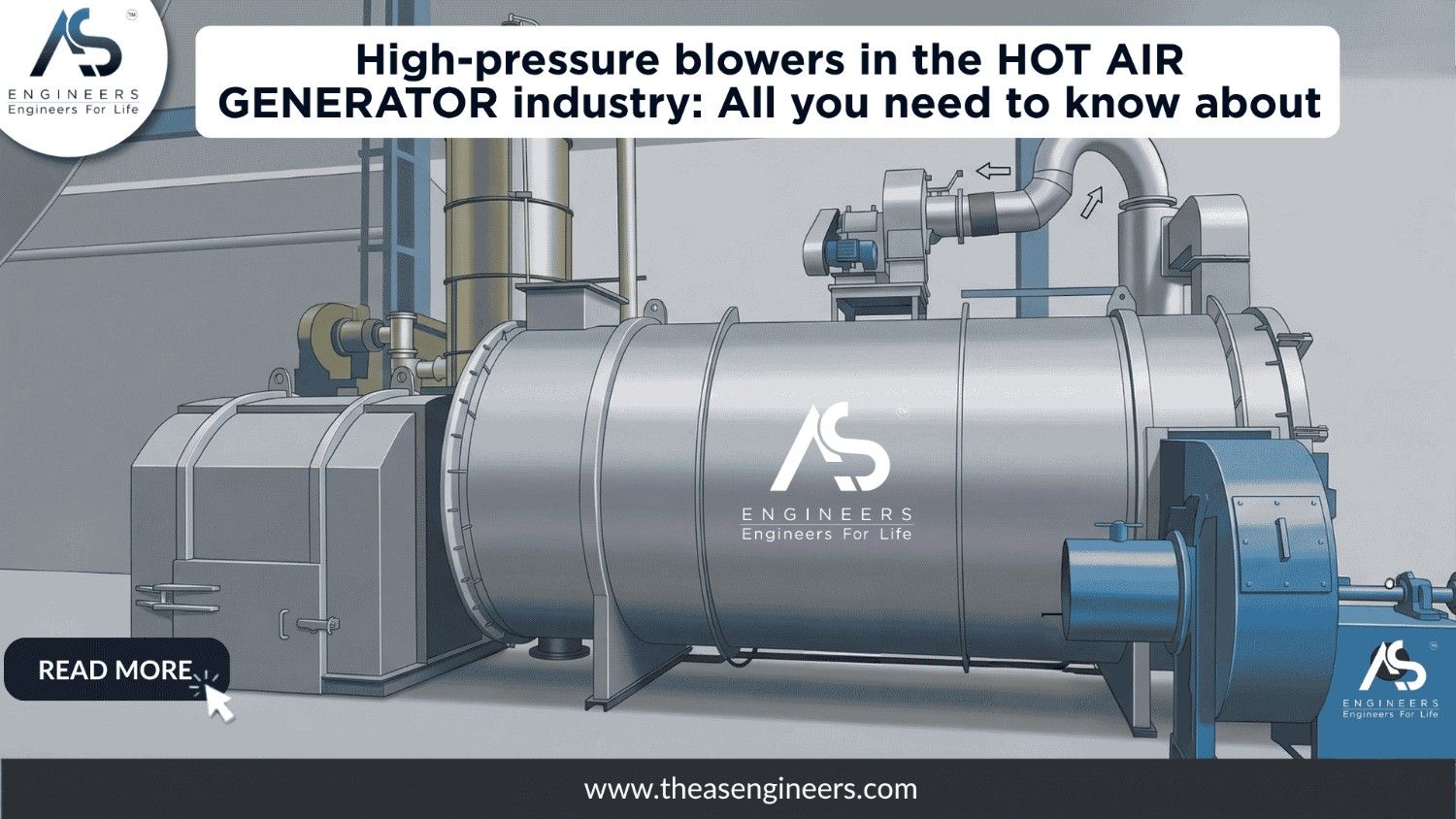
High pressure blowers in hot air generator industry applications control the air movement that carries heat from the generator to the process. In a hot air generator, the blower is not just an accessory. It decides whether heated air reaches the dryer, oven, coating line, textile machine, food process, or chemical process at the required airflow and pressure. A typical hot air generator uses a heat source, heat exchanger, blower unit, and control system, with the blower forcing air through the system at controlled rates.
The common mistake is selecting the hot air generator capacity first and treating the blower as a standard add-on. In actual plant operation, the blower must match duct length, bends, filters, dampers, heat exchanger resistance, outlet temperature, air density, and process back pressure. A technically correct blower selection improves drying consistency, heat distribution, fuel efficiency, and uptime.
For related industrial heating applications, also review high pressure blowers in the furnace industry and high pressure blowers in the boilers industry.
How does a blower work inside a hot air generator system?
A blower draws ambient or recirculated air, pushes it across the heat exchanger or heating zone, and delivers heated air through ducts to the application point. In fuel-based systems, heat may come from combustion. In electric systems, heating elements transfer energy to the air. The blower then maintains the air path from intake to heating section to distribution duct.
In direct-fired systems, the process may receive heated air mixed with combustion products, depending on design. In indirect-fired systems, air is heated through a heat exchanger without direct flame contact. This difference matters because the blower duty changes with air cleanliness, temperature, pressure drop, and material compatibility.
For most industrial hot air generator installations, centrifugal blowers are preferred because they can handle useful static pressure across ducts, bends, dampers, heaters, filters, and distribution nozzles. AS Engineers manufactures centrifugal blower solutions across 300 CFM to 200,000+ CFM airflow and pressure up to 1700 mmWG, with design selection based on application, density, temperature, dust load, humidity, site location, altitude, MOC, impeller design, and motor mounting arrangement.
Which blower type is suitable for hot air generator applications?
The correct blower depends on whether the hot air generator needs combustion air, process air circulation, exhaust support, recirculation, or hot air delivery to a dryer or oven. A centrifugal blower is usually the practical starting point for industrial hot air systems because these applications need controlled airflow against real system resistance.
| Hot Air Generator Duty | Better Blower Fit | Why It Fits | Selection Warning |
|---|---|---|---|
| Combustion air supply | High pressure radial blade blower | Handles pressure demand and heavy-duty operation | Confirm burner air requirement and control method |
| Hot air circulation | Backward curved blower | Useful for efficient air movement in ducted systems | Do not oversize airflow without checking residence time |
| High-temperature zone support | High temperature plug blower | Suitable when heat exposure is part of the duty | Confirm actual inlet temperature, not only outlet temperature |
| Dryer air supply | Backward inclined or backward curved blower | Good for volume and pressure balance | Include filter, heater, cyclone, and duct losses |
| Dusty exhaust or contaminated air | Exhauster radial / air handling blower | Better suited for light dust or process exhaust | MOC and impeller wear risk must be checked |
A positive displacement blower is not automatically better just because the word “pressure” appears in the requirement. Hot air generator systems usually need airflow and static pressure balance, not compressed air behavior. Axial fans may work for high-volume, low-pressure ventilation, but they often become weak when duct resistance increases.
What selection data should buyers share before asking for a quote?
The blower cannot be selected correctly from motor HP alone. The minimum RFQ data should include airflow, static pressure, inlet air temperature, outlet hot air temperature, duct layout, fuel type, process application, air cleanliness, humidity, altitude, and control requirement.
A buyer should share these details before final selection:
| RFQ Data Point | Why It Matters |
|---|---|
| Required airflow at process point | Confirms drying, heating, or curing capacity |
| Static pressure including duct losses | Prevents underperformance after installation |
| Blower inlet temperature | Impacts density, impeller design, bearing safety, and motor selection |
| Dust or fumes in air stream | Decides impeller type, MOC, sealing, and maintenance interval |
| Duct length, bends, dampers, filters | Determines real system resistance |
| Direct-fired or indirect-fired design | Changes air cleanliness and temperature exposure |
| Batch or continuous operation | Affects duty cycle and control requirement |
| Site altitude and ambient condition | Changes air density and actual fan performance |
| VFD or damper control | Impacts energy use and process stability |
AMCA explains that temperature, pressure, gas mix, humidity, and altitude affect air or gas density, and density affects fan and system performance. This is why two plants with the same hot air generator capacity may need different blower selections.
For broader selection logic, use this guide on how to choose the right high pressure blower.
Why do airflow, static pressure and ducting decide actual performance?
A hot air generator blower must overcome the resistance of the complete air path, not only the heater. Pressure losses come from ducts, bends, reducers, dampers, filters, heat exchangers, silencers, outlet nozzles, and process equipment. AMCA describes the fan’s role as supplying pressure differential energy to maintain airflow through system resistance.
This is where many hot air systems fail after installation. The blower may be correct on paper, but the ducting may create turbulence, swirl, or extra loss near the fan inlet or outlet. AMCA calls this “system effect,” which means installed fan performance can differ from laboratory-tested performance because of poor inlet or outlet conditions.
The practical rule is simple: do not select a blower only against the hot air generator nameplate. Select it against the full system curve. If the duct is later modified, the operating point changes. If filters choke, the pressure drop rises. If outlet dampers are misused for control, energy consumption rises and vibration may increase.
This is also relevant in dryer applications such as high pressure blowers in the spray dryer industry and high pressure blowers in the fluid bed dryer industry.
6. How do temperature and fuel type affect blower selection?
Temperature changes air density. Lower-density hot air affects pressure, flow behavior, motor load, and fan curve interpretation. The blower’s inlet temperature is more important than many buyers realize because fan performance is normally referenced to standard air conditions, while hot air generator systems operate under actual site conditions.
Fuel type also changes the engineering review. Gas, diesel, biomass, coal, wood, briquette, and electric heating systems create different combustion control, ash, dust, fouling, and air distribution concerns. In energy audits of conventional hot air generators, poor draught design, improper combustion air flow, weak fuel firing control, poor insulation, and temperature overshoot were identified as performance problems.
From a blower selection point of view, this means the buyer should not hide the fuel and combustion arrangement. A biomass or wood-fired system may have different dust and ash concerns than an electric or gas-fired generator. A chemical dryer may need material compatibility checks. A food dryer may need cleaner air handling and hygiene-focused ducting.
For process-specific context, read high pressure blowers in the food processing industry and high pressure blowers in the chemical processing industry.
What are the common blower selection mistakes in hot air generator systems?
The most common mistake is oversizing airflow to “be safe.” In drying and curing applications, too much airflow can disturb residence time, increase heat loss, reduce control stability, and waste power. The better approach is to define the required heat duty and air delivery condition, then select the blower at the actual operating point.
Other mistakes include selecting by HP, ignoring air density, using tight elbows near the blower inlet, placing dampers incorrectly, ignoring filter choking margin, assuming all centrifugal blowers can handle heat, and not checking vibration after installation.
A few decisions need engineering discipline:
| Buyer Decision | Wrong Approach | Better Approach |
|---|---|---|
| Motor HP | “Use bigger HP for safety” | Confirm airflow, pressure, density, and fan curve |
| Blower type | “Any centrifugal blower will work” | Match impeller to pressure, dust, temperature, and duty |
| Ducting | “Fit it wherever space is available” | Avoid inlet turbulence and account for system effect |
| Controls | “Use damper only” | Evaluate VFD where process variation exists |
| Maintenance | “Run until vibration starts” | Set inspection, alignment, and balancing schedule |
The U.S. Department of Energy notes that fan systems can achieve energy and cost savings through good energy management and efficient equipment selection. In plant terms, the lowest-price blower is rarely the lowest-cost blower if it operates away from the right point.
When should you choose a customized blower instead of a standard unit?
Choose a customized blower when temperature, pressure, dust load, duct layout, MOC, motor mounting, vibration limits, or site constraints are not standard. Hot air generator installations often look simple in a brochure, but real plants have space limitations, long duct routes, existing foundations, uneven discharge points, and process-specific moisture targets.
AS Engineers supports blower selection with performance analysis, engineering surveys, retrofitment, repair, material identification, on-site alignment, on-site balancing, customized engineering, AMC, expedited shipping, and site-based design. For non-standard duties, a make-to-order blower may be safer than forcing a catalogue unit into a difficult system.
Do not choose a standard blower blindly when the process handles corrosive fumes, abrasive dust, high inlet temperature, high humidity, or variable load. In those cases, the blower should be reviewed with duct layout, control philosophy, service access, and maintenance risk.
How should maintenance teams keep hot air generator blowers reliable?
A hot air generator blower should be inspected for vibration, bearing condition, belt tension or coupling alignment, impeller deposits, inlet blockage, damper position, motor current, abnormal noise, and temperature near bearings. Hot air systems often run continuously, so small imbalance or duct fouling can become a production stoppage.
Maintenance teams should also record operating pressure and airflow trends. If the process takes longer to dry, the first assumption should not be “heater problem.” The issue may be reduced airflow due to filter choking, damper drift, duct leakage, impeller deposit, or system effect.
Use these supporting guides for maintenance planning: 7 tips for maintaining your high pressure blower and troubleshooting common issues with high pressure blowers. For plant-level support, AS Engineers also provides centrifugal blower services including field service and support for industrial blower systems.
FAQs
1. Are centrifugal blowers suitable for hot air generators?
Yes, centrifugal blowers are commonly suitable for industrial hot air generator systems because they can provide useful airflow against duct, heater, filter, damper, and process resistance. The final selection should be based on airflow, static pressure, inlet temperature, air density, dust load, and duty cycle, not only motor HP.
2. Can the same blower be used for combustion air and hot air circulation?
Sometimes, but it should not be assumed. Combustion air, process air circulation, exhaust, and recirculation can have different pressure, temperature, cleanliness, and control requirements. A combustion air blower must match burner needs, while a circulation blower must match process airflow and duct resistance.
3. What is the biggest cause of poor blower performance in hot air generator systems?
The biggest practical cause is mismatch between blower selection and actual system resistance. Tight duct bends, poor inlet conditions, clogged filters, wrong damper positions, long duct runs, and unaccounted heat exchanger losses can shift the blower away from the intended operating point.
4. Should I use VFD control for a hot air generator blower?
VFD control is useful when airflow demand changes by batch, product, moisture load, or process temperature requirement. It is not automatically required for every system. The decision should compare process stability, energy use, control range, motor compatibility, and the required operating curve.
5. What details should I send before buying a blower for a hot air generator?
Send airflow requirement, static pressure, inlet and outlet temperature, fuel type, direct-fired or indirect-fired design, duct layout, dust/fume condition, humidity, altitude, operation hours, control method, and available space. These details allow the manufacturer to select a blower that fits the actual site, not just the catalogue range.
A hot air generator blower should be selected from the process requirement backward: required heat duty, airflow, pressure, temperature, duct losses, control method, and maintenance access. If your dryer, oven, coating line, textile process, food process, or chemical process is facing uneven heating, slow drying, high power use, or repeated blower vibration, the issue may be in blower selection or system layout, not only in the heater.
For a site-specific review, share your airflow, pressure, temperature, duct layout, and process details with AS Engineers. Their team can help evaluate blower type, impeller design, MOC, motor arrangement, and service requirements for your hot air generator application.

Karan Dargode is Head of Operations at AS Engineers, where he supports manufacturing, assembly, commissioning, and operational execution for industrial equipment including paddle dryers, sludge dryers, centrifugal blowers, industrial fans, and pollution control systems. His role connects shop-floor manufacturing discipline with practical site commissioning, EHS compliance, and process reliability for industrial clients.