
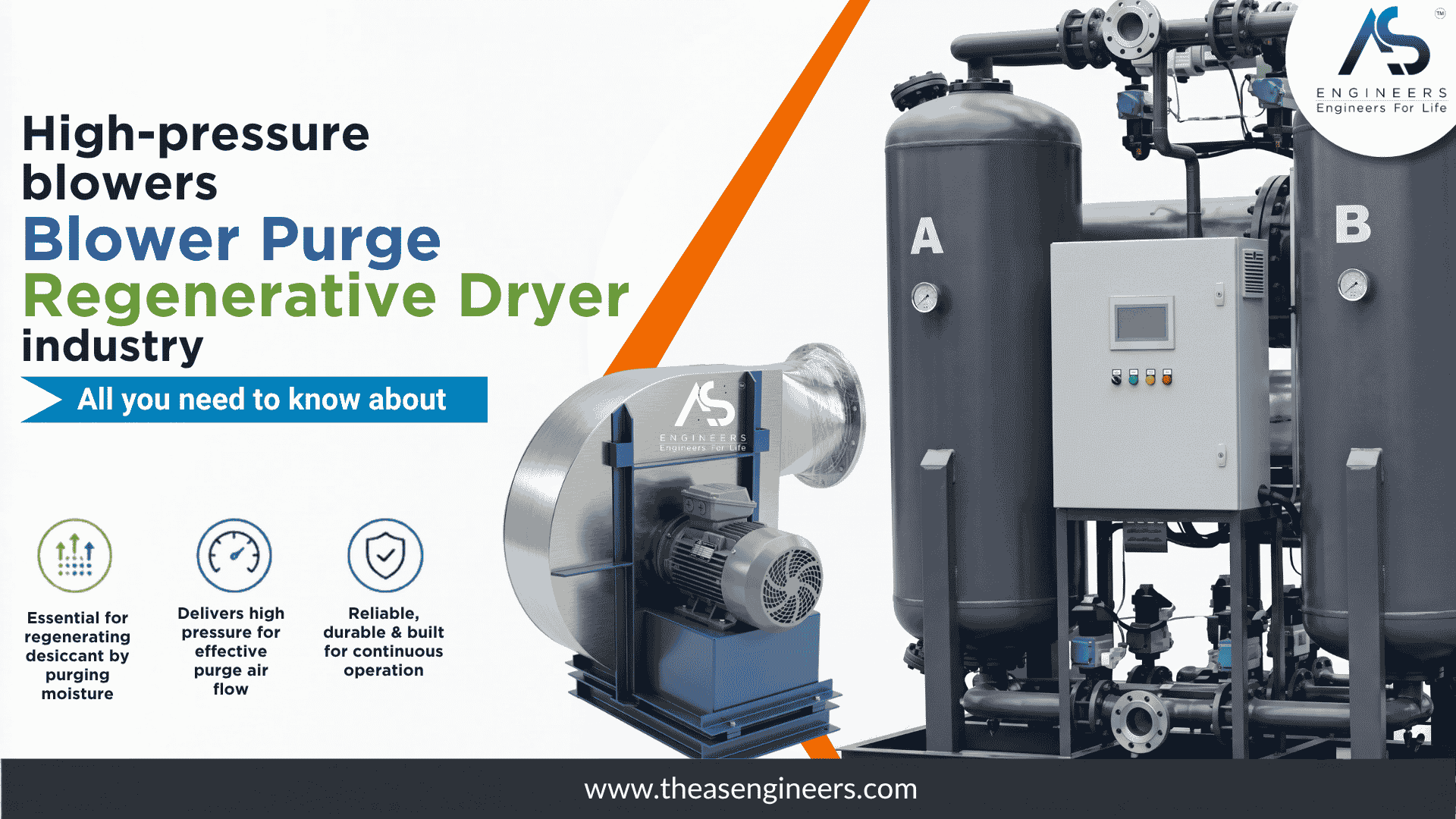
A high pressure blower in a blower purge regenerative dryer supplies regeneration airflow through the off-line desiccant tower so moisture can be driven out of the saturated desiccant bed. In simple terms, one tower dries the compressed air while the other tower is regenerated using heated blower air.
This is different from a normal plant ventilation blower. The blower must handle resistance from intake filters, heater sections, ducting, valves, silencers, diffusers and the desiccant bed. If airflow is unstable, the dryer may still run, but dew point stability, desiccant life and energy consumption can suffer.
In a regenerative desiccant dryer, the desiccant adsorbs water vapour from compressed air. CAGI describes regenerative desiccant dryers as twin-tower systems where one tower dries air while the other regenerates, and notes that blower purge dryers use an external blower and heater to drive hot atmospheric air through the regenerating desiccant bed.
The practical buyer question is not only “Which blower HP is required?” The better question is: “Can this blower deliver the required regeneration airflow against real system pressure drop, at the site’s temperature, humidity, altitude and duty cycle?”
For a deeper foundation on fan mechanics, this article on the mechanics of high pressure blowers is useful before final blower selection.
Why are blower purge regenerative dryers used?
Blower purge regenerative dryers are used where compressed air must remain very dry, especially in applications where moisture can cause corrosion, instrument malfunction, product contamination, valve freezing, powder sticking, or production downtime.
Common use cases include:
| Application area | Why dry air matters | Blower-related concern |
|---|---|---|
| Instrument air | Prevents moisture-related control failure | Stable regeneration airflow |
| Food and pharma utilities | Reduces moisture contamination risk | Clean filtered inlet air |
| Chemicals and process plants | Protects pneumatic valves and process lines | Corrosion-resistant MOC if required |
| Electronics and packaging | Reduces condensation and surface defects | Low vibration and stable duty |
| Paint booths and surface finishing | Prevents moisture defects in finish quality | Consistent dryer performance |
| Outdoor or cold-area compressed air lines | Prevents freezing in downstream piping | Dew point reliability |
CAGI notes that selecting the right dryer depends on dew point requirement, ambient temperature, operating pressure, operating temperature, utilities and site-specific conditions. This is exactly why the blower should not be selected only from a generic catalogue line.
In many plants, the expensive mistake is assuming that the dryer manufacturer’s nominal blower rating will match the actual installed condition. In reality, duct layout, inlet dust, heater resistance, tower pressure drop and silencer losses can shift the blower away from its intended operating point.
How does the blower purge regeneration cycle work?
A blower purge regenerative dryer usually works with two desiccant towers. One tower remains online and dries compressed air. The other tower is depressurized and regenerated. The blower pulls or pushes ambient air through a heater, then sends hot air through the off-line tower to remove moisture from the desiccant.
The cycle normally includes four functional stages:
- Drying through the online tower.
- Heating and regeneration of the saturated off-line tower.
- Cooling of the regenerated desiccant bed.
- Repressurization before tower changeover.
The blower’s performance affects stages 2 and 3 directly. If regeneration air is insufficient, moisture may remain in the bed. If cooling airflow is poor, the dryer can show a dew point spike when the regenerated tower comes online. If airflow is excessive, energy use, noise and desiccant attrition can increase.
A common field mistake is to treat the blower as a simple air mover. It is actually part of the dryer’s dew point control logic. The blower interacts with heater capacity, bed resistance, tower switching, purge valves, inlet filtration and exhaust path. This is why the final selection should consider the full system curve, not just CFM.
For engineering teams comparing fan types, AS Engineers’ guide on centrifugal blower design can help clarify how impeller and casing choices affect pressure and airflow behaviour.
Which blower type is suitable for blower purge regenerative dryers?
Centrifugal blowers are commonly preferred for blower purge regenerative dryer packages because they can deliver controlled airflow against moderate-to-high system resistance with better stability than a simple axial ventilation fan in many ducted regeneration systems.
The best blower type depends on the actual regeneration duty:
| Blower option | Best fit | Caution |
|---|---|---|
| Backward curved centrifugal blower | Clean air, stable flow, energy-focused operation | Not ideal if dust or fibres enter the inlet |
| Backward inclined blower | Higher volume with controlled pressure | Needs correct operating point selection |
| Radial blade blower | Dustier or harsher air path where ruggedness matters | Usually less efficient than backward curved designs |
| Regenerative blower | Lower-flow, compact packages | May not suit larger pressure/flow requirements |
| Positive displacement blower | Specific pressure-driven applications | Noise, pulsation and maintenance must be reviewed |
AS Engineers manufactures industrial centrifugal blowers including backward curved, backward inclined, high pressure radial blade, exhauster radial, high temperature plug and exhauster air handling designs. For broader blower selection context, see industrial centrifugal blowers.
For blower purge regenerative dryers, the most important decision is not the label of the blower type. It is whether the blower curve intersects the dryer system curve at the required flow, pressure, temperature and duty condition.
The buyer mistake to avoid: selecting the lowest motor HP because the blower runs “only for regeneration.” In many dryer packages, regeneration performance decides whether the outlet dew point stays stable under real load.
What data is required to size a blower for a regenerative dryer?
A blower for a blower purge regenerative dryer should be selected from actual operating data, not only from the dryer’s nominal CFM. The minimum RFQ data should include regeneration airflow, total static pressure, air temperature, ambient condition, cycle timing and available layout space.
Use this checklist before requesting a quote:
| Data point | Why it matters |
|---|---|
| Required regeneration airflow | Defines blower volume duty |
| Total static pressure | Covers tower bed, heater, filters, valves, silencer and duct losses |
| Ambient air temperature and humidity | Affects regeneration load and air density |
| Site altitude | Changes air density and blower performance |
| Heater outlet temperature | Affects material selection and safety margins |
| Desiccant type and bed depth | Influences pressure drop |
| Operating cycle | Defines duty, motor sizing and thermal stability |
| Inlet filtration level | Protects heater and desiccant bed |
| Noise limit | Decides silencer and isolation requirements |
| Available footprint | Affects blower arrangement and motor mounting |
AS Engineers’ verified blower range covers airflow from 300 CFM to 200,000+ CFM, pressure up to 1700 mmWG, fan speed from 300 RPM to 4500 RPM and motor power from 0.5 HP to 500 HP. Final selection still depends on application, density, temperature, dust load, humidity, site location, altitude, material of construction, impeller blade design and motor mounting arrangement.
For a wider selection framework, use 8 key factors to consider when choosing a high pressure blower along with the dryer OEM’s regeneration data.
How does blower performance affect dew point stability?
Blower performance affects dew point stability because regeneration quality determines how much moisture remains in the desiccant before the tower returns online. If regeneration is incomplete, the dryer may show poor pressure dew point even when valves, heaters and controls appear functional.
ISO 7183:2007 identifies test methods for compressed-air dryer parameters including pressure dew point, flow rate, pressure drop, compressed-air loss, power consumption and noise emission. These are not only dryer test points. They are also clues for blower selection, because airflow, pressure drop, power and noise are directly influenced by the blower package.
Three blower-related problems often show up as dryer issues:
| Symptom | Possible blower-side cause | What to check |
|---|---|---|
| Dew point spike after tower changeover | Poor cooling airflow or incomplete regeneration | Cooling cycle airflow, blower curve, valve leakage |
| High regeneration time | Low blower flow against actual pressure drop | Filter condition, bed pressure drop, duct restriction |
| High power consumption | Oversized blower or poor operating point | Damper position, VFD setting, system resistance |
| Excess noise | High tip speed, turbulence or poor silencing | Blower speed, inlet duct, exhaust silencer |
| Desiccant dust carryover | High velocity or poor flow distribution | Bed velocity, after-filter, diffuser condition |
CAGI’s compressed air purity guidance explains that ISO 8573-1 classifies compressed air contaminants by particles, water and oil, and that the three-number class format represents solid content, water content and oil content. For plants that specify a strict water class, regeneration airflow cannot be treated casually.
What are the main selection mistakes buyers should avoid?
The biggest mistake is buying a blower by airflow only. In blower purge regenerative dryers, airflow without pressure context is incomplete. The blower must overcome the full installed resistance while staying inside a stable and efficient region of its performance curve.
Avoid these selection errors:
| Mistake | Why it causes trouble | Better approach |
|---|---|---|
| Comparing motor HP first | HP does not prove correct airflow at pressure | Compare blower curve and duty point |
| Ignoring heater and tower pressure drop | Actual resistance becomes higher than assumed | Calculate full system static pressure |
| Not considering ambient humidity | Regeneration load changes by season and location | Share site condition data |
| Using poor inlet filtration | Dust can foul heater and desiccant path | Add suitable inlet protection |
| Oversizing for safety | Can increase noise, energy use and bed stress | Use calculated margin, not guesswork |
| Ignoring VFD compatibility | Fixed speed may waste energy under variable duty | Review VFD and control logic |
| Skipping vibration checks | Bearing and impeller issues can damage uptime | Plan alignment and balancing |
If the dryer package is being installed in a chemical, pharma, food or process plant, material compatibility should also be checked. Ambient air may contain corrosive fumes, dust or vapours. In such cases, MOC, coating, bearing protection and inlet location become important.
For related process applications where airflow and drying performance interact, read about high pressure blowers in spray dryer applications and high pressure blowers in fluid bed dryer applications.
What maintenance does a regenerative dryer blower need?
A regenerative dryer blower needs periodic inspection of inlet filters, belts or coupling, bearings, impeller cleanliness, vibration, alignment, motor current, damper position, VFD settings and duct leakage. Maintenance should be tied to dryer performance, not only calendar intervals.
A practical maintenance schedule includes:
| Frequency | Checkpoint | Why it matters |
|---|---|---|
| Daily or shift-wise | Abnormal noise, temperature, motor current | Early warning of overload or bearing issue |
| Weekly | Inlet filter condition and duct leakage | Prevents airflow loss and contamination |
| Monthly | Belt tension, coupling guard, mounting bolts | Avoids slip, vibration and mechanical failure |
| Quarterly | Vibration trend and bearing condition | Protects impeller and motor life |
| Shutdown-based | Impeller cleaning and internal inspection | Restores airflow and balance |
| Annual | Performance review against dryer dew point trend | Confirms blower is supporting dryer duty |
CAGI also notes that regenerative desiccant dryers need protection from compressor lubricant because oil can contaminate desiccant, and downstream particulate filtration is needed to protect equipment from desiccant dust or fines. From a blower perspective, that means air cleanliness and filtration are not optional details.
For plant maintenance teams, this guide on maintaining your high pressure blower is a useful companion to the dryer OEM manual.
How should engineers prepare an RFQ for this blower?
A strong RFQ for a blower purge regenerative dryer blower should include the dryer duty, regeneration airflow, pressure drop, operating cycle, temperature, humidity, altitude, layout drawing, inlet filtration, noise limit and control requirement. Without this data, the quotation may look cheaper but fail at site.
Share these details with the blower manufacturer:
- Dryer capacity and compressed air flow.
- Required regeneration blower airflow.
- Total static pressure or pressure drop breakdown.
- Heater details and regeneration temperature.
- Ambient air temperature and humidity range.
- Site altitude and location.
- Desiccant tower pressure drop.
- Duct length, bends, valves and silencers.
- Required MOC or coating.
- Motor voltage, frequency and enclosure.
- VFD requirement.
- Noise limit near operator area.
- Space and mounting arrangement.
- Maintenance access requirements.
- Dew point target and duty cycle.
AS Engineers supports blower-related services including performance analysis, engineering surveys, retrofitment, repair, material identification, on-site alignment, on-site balancing, customized engineering, AMC, expedited shipping and site-based design. For buyers comparing options, this AS Engineers resource on centrifugal blower selection is a practical next step.
A good RFQ does not ask only for “one blower for dryer.” It tells the engineer what the dryer must achieve, what the blower must overcome and what site conditions can change the duty.
When should you choose a custom high pressure blower?
Choose a custom high pressure blower when the dryer package has unusual airflow, higher pressure drop, limited footprint, corrosive ambient air, high noise restrictions, non-standard mounting, VFD control, retrofit constraints or repeated dew point instability.
Custom engineering becomes more important when:
- The existing blower is underperforming.
- The desiccant dryer shows unstable dew point.
- The site has high dust, humidity or corrosive fumes.
- The dryer has long ducting or multiple bends.
- Heater and tower pressure drop are higher than expected.
- A compact skid layout restricts blower orientation.
- The plant needs lower noise near operating areas.
- The blower must integrate with PLC or VFD logic.
For general blower science, you can also review understanding the science of high pressure blower design and how to choose the right high pressure blower.
AS Engineers brings 25+ years of industrial engineering experience, ISO 9001:2015 TUV India certification, CE certification, 500+ clients and 1500+ projects. For regenerative dryer applications, the value is not only manufacturing the blower. The value is matching airflow, pressure, impeller design, motor arrangement and serviceability to the dryer’s regeneration duty.
FAQs
1. What is a blower purge regenerative dryer?
A blower purge regenerative dryer is a desiccant compressed air dryer that uses an external blower, usually with a heater, to regenerate the off-line desiccant tower. One tower dries compressed air while the other tower is regenerated so the dryer can provide continuous dry air.
2. Is a high pressure blower better than a normal blower for regenerative dryers?
A high pressure blower is better when the dryer system has meaningful resistance from desiccant beds, heaters, filters, valves, ducts and silencers. A normal ventilation blower may deliver airflow in open air but fail to deliver the required flow against the actual dryer pressure drop.
3. What causes dew point problems in a blower purge dryer?
Dew point problems can come from undersized regeneration airflow, heater faults, high inlet moisture load, valve leakage, oil-contaminated desiccant, blocked filters, poor cooling, incorrect cycle timing or excessive pressure drop. The blower should be checked along with the dryer controls and filtration system.
4. Can VFD control improve blower purge dryer efficiency?
Yes, VFD control can improve efficiency when the dryer control system supports variable regeneration airflow. It must be engineered carefully because too little airflow can leave moisture in the desiccant bed, while excessive airflow can increase noise, energy use and mechanical stress.
5. What information should I give before selecting a dryer blower?
Share regeneration airflow, total static pressure, dryer capacity, cycle timing, heater temperature, ambient temperature, humidity, altitude, duct layout, filtration level, noise limit, motor requirements and available space. This helps the blower manufacturer select the correct duty point instead of guessing from motor HP.
A blower purge regenerative dryer depends on stable regeneration airflow. If your dryer is showing dew point fluctuation, high energy use, excessive noise, or repeated blower maintenance issues, review the blower duty before replacing major dryer components.
AS Engineers can support blower selection, retrofitment, performance analysis, on-site alignment, on-site balancing and custom blower engineering for demanding industrial dryer applications. Share your dryer duty, airflow, pressure drop and site conditions with the team through the AS Engineers page for industrial centrifugal blowers.

Karan Dargode is Head of Operations at AS Engineers, where he supports manufacturing, assembly, commissioning, and operational execution for industrial equipment including paddle dryers, sludge dryers, centrifugal blowers, industrial fans, and pollution control systems. His role connects shop-floor manufacturing discipline with practical site commissioning, EHS compliance, and process reliability for industrial clients.