
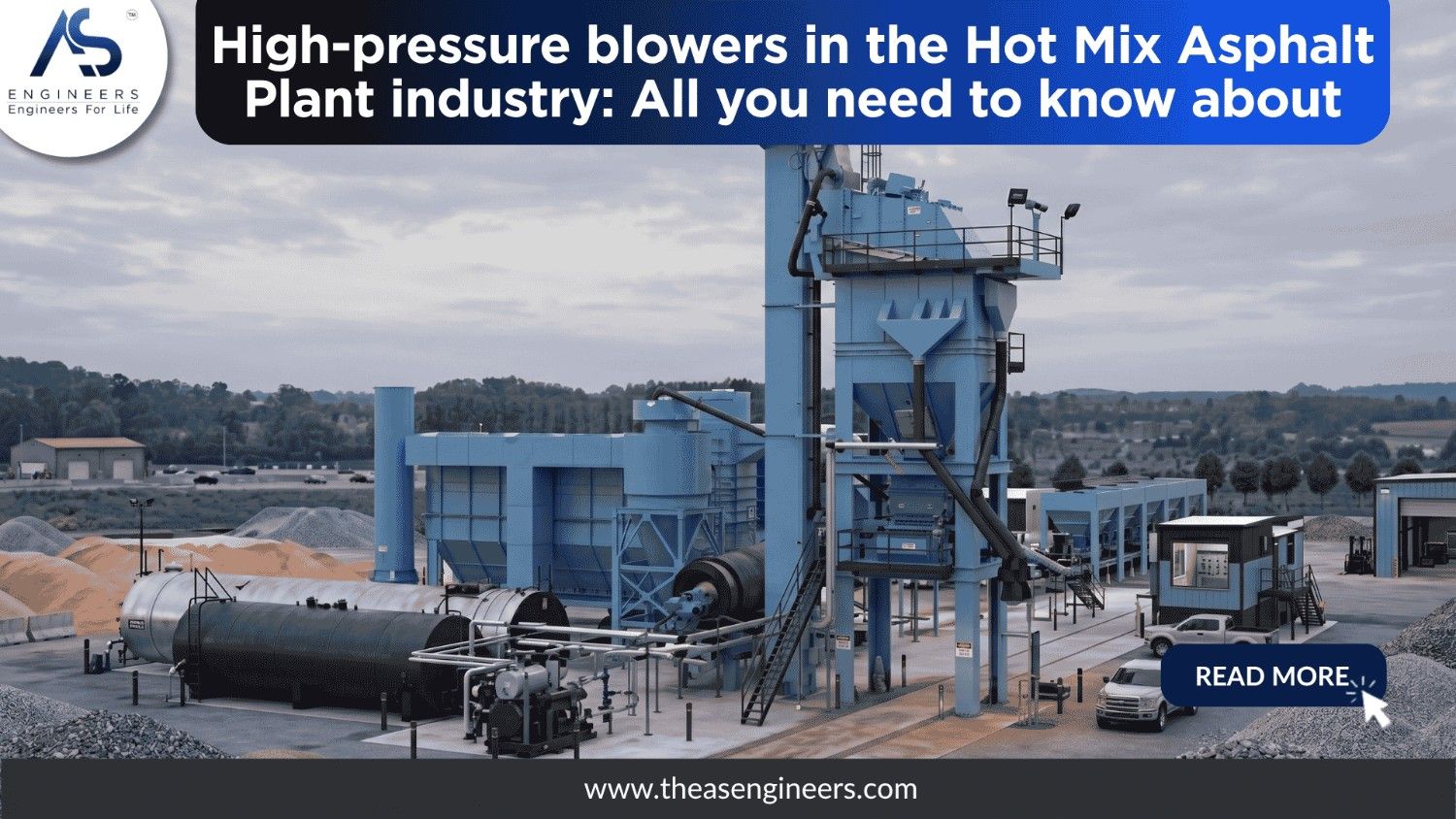
High pressure blowers in hot mix asphalt plant operations are not just “air suppliers.” They influence combustion air, dryer draft, moisture removal, dust collection, baghouse performance, fuel efficiency, and plant stability. The correct blower depends on whether the duty is clean combustion air, hot exhaust gas, dust-laden draft, or filler-handling air.
In a typical HMA plant, the dryer drum removes moisture from aggregates before mixing. The burner provides heat, while fans and blowers control the movement of air, gases, dust, and fines through the system. If the blower is undersized, the plant may struggle with incomplete drying, poor burner stability, high emissions, or production delays. If it is oversized, the plant may waste power, disturb burner tuning, increase baghouse load, or create unstable draft conditions.
This is why blower selection should begin with the actual duty point, not only the plant capacity in TPH.
For related air-handling applications, see the guide on high pressure blowers in the air pollution control industry and high pressure blowers in the bag filter industry.
What Does a Blower Do in an Asphalt Dryer Drum?
A blower supports dryer drum performance by maintaining the required air movement for combustion, heat transfer, exhaust removal, and dust control. The dryer does not work on airflow alone. It works on controlled airflow, correct flame condition, aggregate residence time, moisture load, and draft balance.
The common mistake is assuming that higher airflow will always improve drying. In many asphalt plants, excess airflow can carry heat away too quickly, increase dust carryover, raise baghouse loading, and force the burner to work harder. Low airflow is also risky because it can reduce combustion quality, delay moisture removal, and affect discharge temperature consistency.
The blower or fan duty changes with:
- Aggregate moisture percentage
- Aggregate gradation and fines content
- RAP percentage, if used
- Burner fuel type and air requirement
- Dryer drum length, slope, and flight design
- Ducting losses from dryer to baghouse
- Baghouse pressure drop
- Site altitude and ambient temperature
For plants using a hot air generator or indirect heating arrangement, review high pressure blowers in the hot air generator industry because the blower duty may shift from direct burner support to hot air circulation or transfer.
Which Blower Duties Matter Most in a Hot Mix Asphalt Plant?
A hot mix asphalt plant can require multiple blower or fan duties. Treating all of them as the same “high pressure blower” is a selection error.
| HMA plant duty | Air or gas condition | Suitable blower direction | Selection warning |
|---|---|---|---|
| Burner combustion air | Mostly clean air, controlled fuel-air ratio | Backward curved, backward inclined, or radial depending on pressure | Do not oversize without checking burner tuning |
| Dryer exhaust / ID fan | Hot, dusty gas with moisture | Radial blade or heavy-duty ID fan design | Confirm inlet temperature and dust load |
| Baghouse draft | Dust-laden before filtration, cleaner after filtration | Radial blade before dirty-side duty, backward inclined after clean-side duty | Baghouse pressure drop changes as bags load |
| Filler or fines handling | Powder-laden conveying air | Radial blade or application-specific conveying blower | Check abrasion and buildup risk |
| Tank or auxiliary air duty | Application-specific | Only if the plant design requires it | Do not assume every asphalt tank needs blower agitation |
AS Engineers manufactures industrial centrifugal blowers for air movement duties where airflow, pressure, temperature, dust load, material of construction, and mounting arrangement must be engineered around the process condition.
How Should You Select a Blower for Asphalt Plant Burner Air?
For burner air duty, the blower must support stable combustion. The goal is not maximum air. The goal is the correct air volume and pressure for the burner, fuel type, control system, and dryer load.
A burner air blower should be checked against the burner manufacturer’s requirement, fuel type, air damper position, expected turndown, and site conditions. Diesel, gas, LDO, and solid-fuel systems can have different combustion air behavior. Poor air control can show up as flame instability, high fuel use, visible smoke, poor aggregate temperature control, or repeated burner adjustment.
A common buyer mistake is selecting the blower from motor HP alone. Motor HP does not define the duty. Airflow and static pressure at the operating point define the duty. The motor only tells you how much power is available to drive the blower at that condition.
For high-pressure combustion air applications where the air stream is mostly clean but pressure demand is significant, high pressure radial blade blowers may be evaluated. Where the application involves elevated temperature or furnace-like heat exposure, high temperature plug blowers may be more relevant.
Also compare related operating logic in high pressure blowers in the furnace industry.
Why Is the Baghouse Fan Critical in Asphalt Plants?
The baghouse fan or ID fan controls the draft path from the dryer through the dust collection system. If this duty is wrong, the plant can face dust escape, poor suction, bag blinding, high differential pressure, or unstable burner behavior.
Asphalt plant exhaust is not a clean-air duty. It may contain fine aggregate dust, moisture, heat, and gas from the drying process. The fan must be selected for real inlet conditions, not catalogue air at room temperature. Gas density changes with temperature. Dust load affects impeller choice. Ducting losses and baghouse resistance affect static pressure.
For dirty-side or heavy dust applications, radial blade impellers are often preferred because they tolerate particulate better than high-efficiency backward curved designs. On a clean-side fan after proper filtration, backward inclined or backward curved designs may reduce energy consumption.
AS Engineers supplies bag filter systems and related air pollution control equipment. For site teams comparing dust collector duty, the article on high pressure blowers in the cement industry is also useful because cement and asphalt plants share problems around abrasive dust, fan wear, and baghouse pressure drop.
What Data Should Be Shared Before Asking for a Blower Quote?
A reliable blower quote for a hot mix asphalt plant needs process data. Without this, the supplier is forced to assume, and assumptions are where most fan problems begin.
Share these inputs before selection:
- Plant capacity in TPH and operating schedule
- Blower duty: burner air, ID fan, baghouse draft, filler handling, or auxiliary air
- Required airflow in CFM or CMH
- Static pressure in mmWG, mmWC, Pa, or mbar
- Inlet air or gas temperature
- Dust load and dust nature: fine, abrasive, sticky, moist, or fibrous
- Aggregate moisture range and RAP percentage, if relevant
- Fuel type and burner details for combustion air duty
- Baghouse pressure drop, duct length, bends, dampers, and stack details
- Site altitude, ambient temperature, and available motor supply
- Preferred material of construction and corrosion concerns
- Layout constraints, inlet/outlet orientation, and motor mounting arrangement
AS Engineers evaluates blower selection based on application, density, temperature, dust load, humidity, site location, altitude, MOC, impeller blade design, and motor mounting arrangement. The verified centrifugal blower range covers airflow from 300 CFM to 200,000+ CFM, pressure up to 1700 mmWG, fan speeds from 300 RPM to 4500 RPM, and motor power from 0.5 HP to 500 HP.
For a broader checklist, use 8 key factors to consider when choosing a high pressure blower.
Which Impeller Type Is Best for Hot Mix Asphalt Plant Duty?
The best impeller depends on dust, pressure, temperature, efficiency target, and maintenance tolerance. No single impeller type is best for every asphalt plant duty.
Backward curved blowers are useful for clean-air or low-dust duties where energy efficiency is important. Backward inclined blowers can be a practical choice for moderate airflow and cleaner exhaust after filtration. Radial blade blowers are better suited for dust-laden, abrasive, or heavy-duty applications because the blade geometry is less prone to dust buildup.
The wrong conservative choice can still be expensive. For example, specifying a radial blade blower on a clean-air duty may increase power consumption unnecessarily. Specifying a backward curved blower on a dusty dirty-side baghouse duty may save power initially but increase cleaning, vibration, and balancing problems later.
A practical rule:
- Clean combustion air: evaluate backward curved, backward inclined, or radial based on pressure.
- Dusty exhaust before filtration: evaluate radial blade.
- Clean-side baghouse exhaust: evaluate backward inclined or backward curved.
- Hot gas duty: confirm temperature rating before impeller selection.
- Abrasive fines handling: prioritize wear resistance and maintenance access.
For troubleshooting symptoms after installation, see troubleshooting common issues with high pressure blowers.
How Do Maintenance Teams Keep Asphalt Plant Blowers Reliable?
Asphalt plant blower maintenance should focus on vibration, temperature, bearing health, impeller cleanliness, belt tension, alignment, and pressure readings. The plant environment is dusty, hot, and often exposed to outdoor conditions, so neglect shows up quickly.
Key checks include:
- Record static pressure and motor current during normal production.
- Monitor baghouse differential pressure and compare it with fan load.
- Inspect impeller buildup during shutdowns.
- Check bearing temperature and abnormal noise.
- Confirm belt tension and pulley alignment on belt-driven units.
- Inspect flexible connectors, expansion joints, and duct leakage.
- Rebalance the impeller after major cleaning, repair, or blade wear.
- Verify damper position and VFD settings after process changes.
One field warning: when a blower starts drawing higher current after a baghouse issue, do not only blame the motor. Check system resistance, duct blockage, bag condition, damper position, and dust buildup. A motor trip may be the final symptom of an airflow-system problem.
For preventive planning, read 7 tips for maintaining your high pressure blower and the importance of regular high pressure blower maintenance.
When Should an Asphalt Plant Replace, Retrofit, or Repair a Blower?
Replace the blower when the duty has changed beyond the original design, wear is severe, repeated balancing no longer holds, or efficiency losses are costing more than replacement. Retrofit or repair may be suitable when the casing, base frame, and general arrangement are usable but the impeller, shaft, bearings, drive, or lining require correction.
Repair is worth evaluating when:
- The plant has changed aggregate source or RAP percentage.
- Dust load has increased after production expansion.
- Baghouse resistance has changed after filter replacement.
- The blower is vibrating after impeller wear or buildup.
- The motor is overloaded at higher production rates.
- Duct modifications have changed static pressure.
- The existing blower is mechanically sound but mismatched to current duty.
AS Engineers provides blower services including performance analysis, engineering surveys, retrofitment, repair, material identification, on-site alignment, on-site balancing, customized engineering, AMC, expedited shipping, and site-based design. For existing installations, a performance review often gives better answers than replacing the blower blindly.
FAQs
1. What type of blower is used in a hot mix asphalt plant?
Hot mix asphalt plants may use combustion air blowers, ID fans, baghouse draft fans, and filler-handling blowers. The correct type depends on whether the air is clean, hot, dusty, abrasive, or moisture-laden. Radial blade designs are often considered for dusty duties, while backward curved or backward inclined blowers are better for cleaner air duties.
2. Is a high pressure blower the same as an ID fan in an asphalt plant?
Not always. An ID fan pulls exhaust gas and dust through the dryer, ducting, baghouse, and stack. A high pressure blower may supply burner air, conveying air, or process air depending on plant design. Some people use the terms loosely, but selection should be based on airflow direction, pressure, dust load, and temperature.
3. Why does blower selection affect asphalt plant fuel consumption?
Blower selection affects draft balance, burner air supply, heat transfer, and exhaust losses. Excess air can carry heat away and increase baghouse load. Insufficient air can reduce combustion quality and drying performance. Correct blower sizing helps the burner and dryer operate closer to the intended process condition.
4. Which impeller is better for asphalt plant baghouse duty?
For dirty-side dusty duty, a radial blade impeller is usually safer because it handles particulate and buildup better. For clean-side exhaust after proper filtration, backward inclined or backward curved designs may offer better efficiency. The final decision should consider dust concentration, temperature, pressure drop, and maintenance access.
5. What information is needed to select a blower for an asphalt plant?
Share airflow, static pressure, inlet temperature, plant capacity, duty type, dust load, aggregate moisture range, fuel type, baghouse pressure drop, duct layout, altitude, MOC requirement, and motor supply. A blower selected without these inputs may run, but it may not run efficiently or reliably.
A hot mix asphalt plant blower should be selected around real process duty, not only TPH capacity or motor HP. If your plant is facing unstable draft, high baghouse pressure drop, burner tuning issues, vibration, or repeated blower maintenance, the right next step is a duty-point review.
Share your airflow, pressure, temperature, dust load, baghouse details, and plant layout with the AS Engineers centrifugal blower service team. The team can evaluate whether your application needs a new blower, impeller correction, retrofitment, on-site balancing, or a custom-engineered solution.

Karan Dargode is Head of Operations at AS Engineers, where he supports manufacturing, assembly, commissioning, and operational execution for industrial equipment including paddle dryers, sludge dryers, centrifugal blowers, industrial fans, and pollution control systems. His role connects shop-floor manufacturing discipline with practical site commissioning, EHS compliance, and process reliability for industrial clients.