
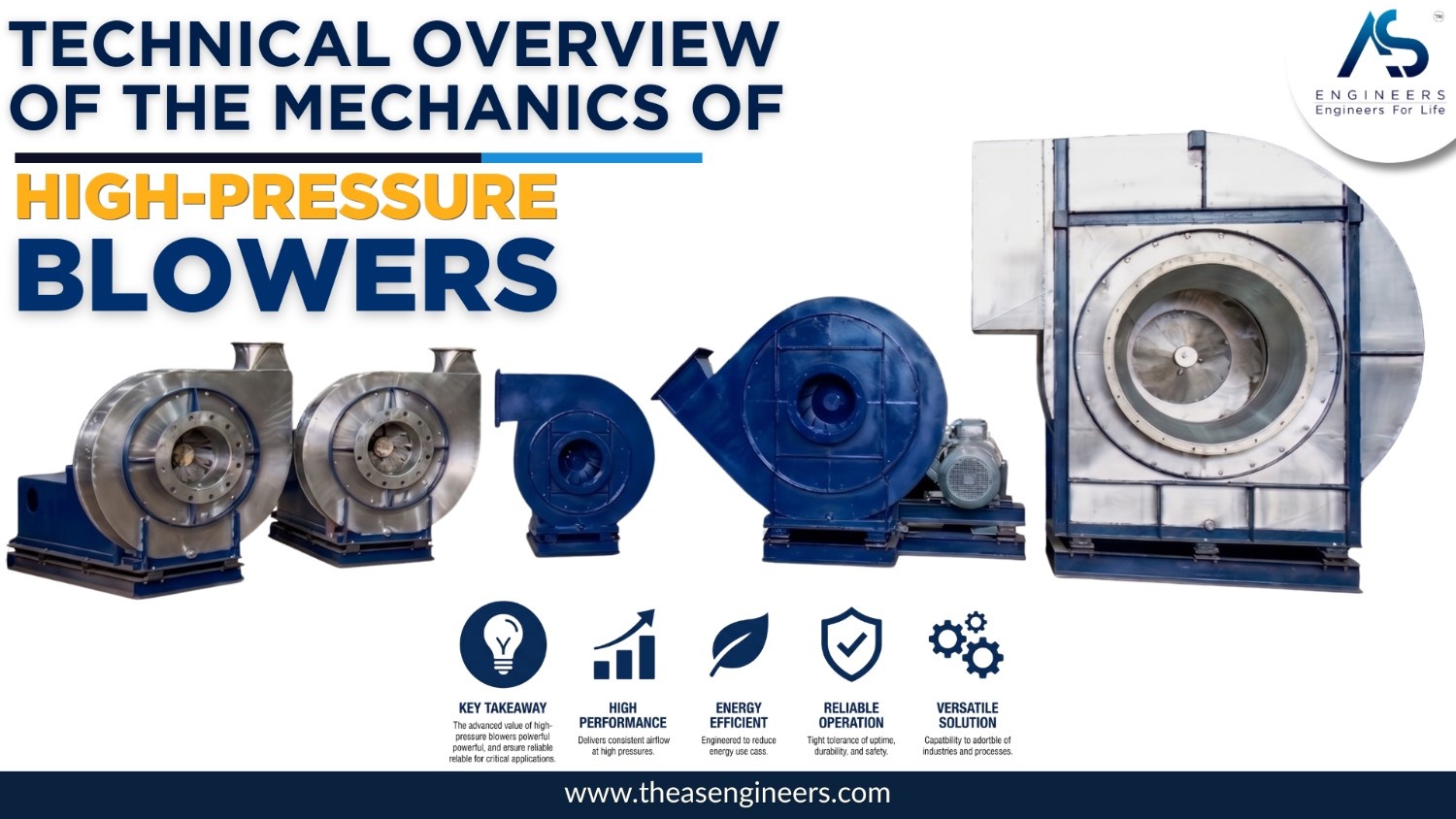
The mechanics of high pressure blowers are based on one practical principle: the blower converts motor power into controlled air movement, then turns part of that air velocity into usable static pressure. In a centrifugal high pressure blower, air enters near the impeller eye, gains velocity from rotating blades, moves through the casing or volute, and exits with enough pressure to overcome duct, filter, scrubber, furnace, dryer, or process resistance.
For industrial buyers, this is not just a working-principle topic. It affects power consumption, vibration, noise, bearing life, dust handling, and whether the blower can actually perform at the duty point after installation.
AS Engineers designs centrifugal blowers for airflow from 300 CFM to 200,000+ CFM, pressure up to 1700 mmWG, fan speeds from 300 RPM to 4500 RPM, and motor power from 0.5 HP to 500 HP, depending on the application and operating condition. If you are comparing design basics before selection, this companion article on understanding the science of high-pressure blower design will help you connect theory with blower sizing.
How Does a High Pressure Blower Convert Velocity Into Pressure?
Answer: A high pressure blower creates pressure by accelerating air through the impeller and then slowing that high-velocity air inside the casing so part of the velocity becomes static pressure.
The process starts at the inlet. Air or gas is pulled toward the impeller eye because the rotating impeller creates a lower-pressure region at the center. As the blades rotate, they transfer energy from the motor to the air stream. The air is pushed outward from the center toward the blade tips.
Once the air leaves the impeller, it does not simply “blow out.” It enters the casing, usually a scroll or volute-shaped path, where the high-speed air is guided and partially decelerated. This pressure recovery is one of the core mechanics behind centrifugal blower performance.
A common buyer mistake is asking only for “more airflow.” More airflow is not useful if the blower cannot overcome system resistance. In many industrial duties, the real challenge is not moving free air. It is moving air through bends, dampers, bag filters, cyclones, heat exchangers, scrubbers, long ducting, or material-laden process paths.
For a deeper application-level view, see the role of high-pressure blowers in industrial processes.
What Are the Main Components Involved in High Pressure Blower Mechanics?
Answer: The main mechanical components are the inlet, impeller, casing or volute, shaft, bearings, drive arrangement, motor, base frame, and outlet connection.
Each component affects performance differently.
| Component | Mechanical role | What can go wrong if ignored |
|---|---|---|
| Inlet | Guides air into the impeller eye | Turbulence, uneven loading, reduced efficiency |
| Impeller | Transfers energy to air | Wrong blade type can cause wear, noise, or low pressure |
| Casing / volute | Converts velocity into pressure and directs discharge | Poor pressure recovery and higher losses |
| Shaft | Carries rotating load | Misalignment, bending, vibration |
| Bearings | Support rotating assembly | Heat, noise, seizure, downtime |
| Motor | Provides power | Overload if pressure or density is miscalculated |
| Drive system | Transfers power to impeller | Belt slip, coupling issues, speed mismatch |
| Outlet | Connects blower to system | Poor duct transition can increase pressure loss |
The impeller is the heart of the blower, but the casing and installation layout decide how much of that energy becomes useful pressure. That is why practical blower engineering should never treat the machine and ducting as separate topics.
If the requirement involves dust, high temperature, or demanding pressure conditions, an AS Engineers high pressure radial blade blower may be more suitable than a clean-air blower style.
Why Does Static Pressure Matter More Than Free Airflow?
Answer: Static pressure matters because the blower must overcome the resistance created by the connected system, not just move air in open space.
Free airflow figures can look attractive on paper, but they do not represent actual plant operation. A blower installed on a real system works against duct friction, elbows, dampers, filters, scrubbers, cyclones, silencers, outlet losses, and process equipment pressure drop.
This is where many selection errors begin. A plant team may report the desired airflow but miss the true static pressure. The blower is then selected too close to the wrong duty point. After installation, the symptoms appear as low suction, low discharge pressure, high motor load, excess noise, vibration, or unstable process performance.
For industrial selection, static pressure should be estimated from the whole system. Do not count only the main duct length. Include bends, transitions, dampers, filters, process equipment, discharge stack, temperature effect, and future fouling margin.
This is why 8 key factors to consider when choosing a high-pressure blower should be reviewed before sending a technical enquiry.
How Do Impeller Types Change Blower Performance?
Answer: Impeller design changes how the blower handles pressure, efficiency, dust load, temperature, and mechanical stress.
The working principle may remain similar, but the impeller design decides the blower’s application fit. A backward curved blower is commonly preferred where efficiency and clean-air performance matter. A backward inclined blower can support high-volume industrial air movement with quieter operation. A radial blade blower is often more practical where higher pressure, dust, or rugged duty is involved.
AS Engineers’ centrifugal blower range includes backward curved blowers, backward inclined blowers, high pressure radial blade blowers, exhauster radial blowers, high temperature plug blowers, and exhauster air handling blowers. These are not interchangeable names. Each design exists because the process condition changes the mechanical requirement.
A dust-laden exhaust fan in a cement plant should not be selected like a clean ventilation blower. A furnace-ready blower should not be selected like a room ventilation fan. A scrubber ID fan should consider moisture, corrosion, pressure drop, and system layout. The wrong impeller may still rotate, but it may not survive the duty economically.
For airflow improvement from a system perspective, see maximizing air flow with high-pressure blowers.
What Operating Conditions Affect High Pressure Blower Mechanics?
Answer: Temperature, gas density, dust load, humidity, corrosion, altitude, material of construction, RPM, and duty cycle all affect blower mechanics.
Air is not always the same. Hot air has different density than ambient air. Dusty air loads the impeller differently. Humid or corrosive gas can change material and coating requirements. Abrasive particles can wear blade surfaces and reduce balance quality over time.
Important operating conditions include:
- Required airflow and static pressure
- Inlet temperature and gas density
- Dust load and particle characteristics
- Moisture, humidity, or sticky vapors
- Corrosive gas content
- Site altitude and ambient temperature
- Continuous or intermittent operation
- Required material of construction
- Motor mounting and drive arrangement
- Space for maintenance access
The hidden buyer question is: “What happens when the plant condition changes?” If feed moisture rises, filter resistance increases, ducting is extended, or process temperature changes, the blower may move away from its original duty point. Good selection allows for realistic operating variation without oversizing blindly.
AS Engineers considers application, density, temperature, dust load, humidity, site location, altitude, material of construction, impeller blade design, and motor mounting arrangement during blower selection.
How Do Losses, Vibration, and Noise Develop Inside a Blower System?
Answer: Losses develop when airflow becomes turbulent, restricted, misdirected, or forced away from the blower’s efficient operating zone.
Not every pressure loss comes from the blower. Many losses come from the system around it. Sharp duct bends near the inlet, sudden expansion at the outlet, partially closed dampers, dirty filters, misaligned belts, worn bearings, and fouled impellers can all reduce performance.
Vibration is often a warning sign, not a minor inconvenience. It may come from impeller imbalance, bearing wear, shaft misalignment, foundation looseness, duct strain, belt tension issues, or material buildup on blades. If ignored, vibration can damage bearings, loosen fasteners, affect motor life, and increase downtime.
Noise also has a mechanical story. Excess noise can come from high tip speed, turbulence, unstable airflow, poor inlet conditions, resonance, or operating away from the selected duty point. Adding a silencer may reduce sound, but it will not fix the root cause if the blower is mechanically or aerodynamically mismatched.
This is why performance checks, alignment, and balancing should be treated as reliability tools. For practical issue diagnosis, review troubleshooting common issues with high-pressure blowers.
Which High Pressure Blower Type Fits Which Mechanical Duty?
Answer: The correct blower type depends on pressure, airflow, dust condition, temperature, gas nature, and system resistance.
| Duty condition | Better-fit blower direction | Reason |
|---|---|---|
| Clean air with efficiency focus | Backward curved blower | Good efficiency for suitable clean-air duties |
| High volume industrial movement | Backward inclined blower | Practical for high-volume air handling |
| Higher pressure and dusty service | High pressure radial blade blower | Rugged design for demanding duty |
| Furnace or oven air movement | High temperature plug blower | Built for elevated-temperature applications |
| Light dust or exhaust service | Exhauster radial blower | Suitable for exhaust and air handling duties |
| Abrasive construction/process air | Exhauster air handling blower | Better fit where durability matters |
The best selection is not made by blower name alone. It is made by matching the mechanical design to the real process condition. A blower handling clean ambient air in an AHU is not facing the same duty as a blower connected to a bag filter, scrubber, dryer, furnace, boiler, or pneumatic conveying line.
If the application is already industrial and non-standard, start from the AS Engineers centrifugal blower range instead of forcing the requirement into a generic blower category.
What Should Engineers Check Before Finalizing a High Pressure Blower?
Answer: Engineers should check the duty point, system resistance, operating gas condition, impeller suitability, MOC, motor power, RPM, drive arrangement, access, and service plan.
Before finalizing a blower, keep this enquiry checklist ready:
- Required airflow in CFM or m³/hr
- Required static pressure in mmWG, Pa, or in. WC
- Inlet temperature and expected maximum temperature
- Gas composition, humidity, dust, or corrosive content
- Application, such as dust collection, combustion air, drying, cooling, ventilation, scrubber duty, or furnace duty
- Duct layout with bends, length, and connected equipment
- Continuous or batch operation
- Motor preference and available electrical supply
- Required material of construction
- Space for inspection, belt access, bearing maintenance, and balancing
One practical rule: do not finalize blower HP before confirming pressure and density. Motor power is the result of the duty calculation, not the starting point.
For performance validation, this guide on testing your high-pressure blower for quality and performance is a useful next step.
How Should Maintenance Support the Mechanics of High Pressure Blowers?
Answer: Maintenance should protect the mechanical balance, airflow path, bearing health, drive condition, and system cleanliness of the blower.
A high pressure blower is a rotating machine. Its reliability depends on keeping air movement and mechanical rotation stable. Maintenance should not be limited to cleaning the outside surface.
Key checks include:
- Inspect impeller for dust buildup, erosion, corrosion, or damage
- Check bearing temperature and lubrication condition
- Monitor vibration trends
- Inspect belt tension, pulley alignment, or coupling condition
- Confirm foundation bolts and guards are secure
- Clean inlet filters and check duct restrictions
- Inspect dampers and flexible connections
- Review motor current against normal operating load
- Check for unusual sound during startup and shutdown
- Schedule balancing when vibration trends rise
The mistake is waiting for failure before inspection. In blower systems, early symptoms are usually visible: changing noise, rising current, falling suction, pressure fluctuation, heat near bearings, or process inconsistency.
AS Engineers supports blower performance analysis, engineering surveys, retrofitment, repair, material identification, on-site alignment, on-site balancing, customized engineering, AMC, expedited shipping, and site-based design. If your plant is already facing reliability issues, the centrifugal blower services page is the right service reference.
For routine care, also use 7 tips for maintaining your high-pressure blower.
Where Do High Pressure Blowers Deliver the Most Value?
Answer: High pressure blowers deliver the most value where air must move against resistance, carry process load, support combustion, remove fumes, feed pollution control equipment, or stabilize industrial drying and ventilation.
Common applications include:
- Dust collection systems
- Bag filter and cyclone support
- Scrubber ID fan duty
- Furnace and oven air movement
- Boiler FD and ID fan duties
- Pneumatic conveying support
- Drying and cooling systems
- Hot air circulation
- Process exhaust
- Ventilation in high-resistance duct systems
- Food, cement, steel, chemical, textile, paper, power, and wastewater applications
The value comes from matching the blower to the process, not simply installing a larger machine. Oversized blowers can waste energy, increase noise, and force damper throttling. Undersized blowers may fail to maintain pressure or flow. The right blower sits close to the required duty point with room for realistic operating variation.
For application mapping, refer to 13 applications for high-pressure blowers in industrial settings.
FAQs
1. What is the basic working principle of a high pressure blower?
A high pressure blower works by using a rotating impeller to accelerate air or gas and direct it through a casing where part of that velocity is converted into static pressure. This allows the blower to move air through ducts, filters, scrubbers, dryers, furnaces, and other resistance-heavy industrial systems.
2. Which component creates pressure in a high pressure blower?
The impeller adds velocity to the air, while the casing or volute helps convert part of that velocity into static pressure. In practical terms, both the impeller and casing are important. A good impeller with poor inlet or casing conditions can still lose performance.
3. Why is static pressure important in blower selection?
Static pressure tells you how much resistance the blower must overcome in the connected system. Duct length, bends, filters, dampers, scrubbers, cyclones, heat exchangers, and outlet losses all add resistance. Airflow without pressure data is not enough for reliable blower selection.
4. Can the same blower be used for clean air and dusty air?
Not always. Clean air, dusty air, abrasive particles, corrosive gases, humid air, and high-temperature air require different impeller designs, material choices, seals, coatings, and maintenance planning. The blower should be selected for the actual gas and process condition.
5. What information should I send before asking for a high pressure blower quote?
Send airflow, static pressure, application, gas temperature, dust load, humidity, corrosive content, operating hours, duct layout, installation space, motor preference, material requirement, and any existing blower performance issue. These inputs help the manufacturer select the blower by duty, not guesswork.
A high pressure blower performs well only when its mechanics match the real system resistance, gas condition, temperature, dust load, and duty cycle. If you are selecting a new blower, replacing an underperforming unit, or troubleshooting pressure and airflow issues, share your operating data before finalizing the design.
For engineered blower selection, service support, or a custom duty review, connect with AS Engineers through the AS Engineers contact page.

Karan Dargode is Head of Operations at AS Engineers, where he supports manufacturing, assembly, commissioning, and operational execution for industrial equipment including paddle dryers, sludge dryers, centrifugal blowers, industrial fans, and pollution control systems. His role connects shop-floor manufacturing discipline with practical site commissioning, EHS compliance, and process reliability for industrial clients.